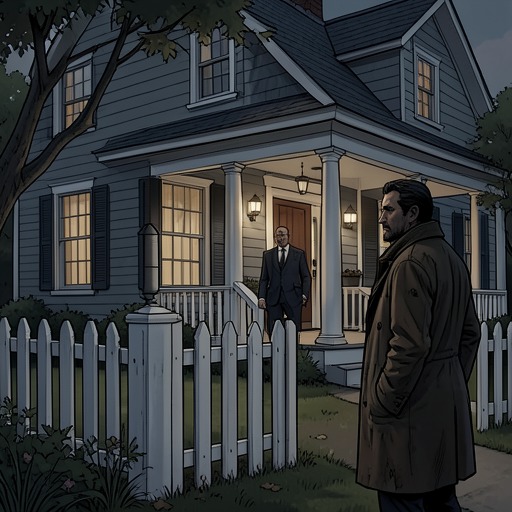
Max
Native SonMax, a lawyer from the Labor Defenders, becomes Bigger Thomas’s defender after the arrest. His role is larger than protecting a client in court: he argues that Bigger’s crime cannot be separated from the conditions that shaped his possibilities, and challenges a public response that would treat execution as a solution. Yet Max’s broad political argument does not automatically reach Bigger. Their relationship is marked by both advocacy and a persistent difference in what each can understand or communicate.
Identity and Introduction
In the novel’s cast, Max represents a coldly analytical, fallible form of Communism, set against the genial but paternalistic Jan and the charitable liberalism represented by the Dalton household. This framework makes Max a political figure, but not simply a mouthpiece: his courtroom work takes the form of concrete questions about rights, housing, responsibility, and punishment. He enters a case in which Bigger has already become a focus of intense public hostility, and in which the prosecutor, Buckley, presents the prospect of severe punishment as assured.
Jan first urges Bigger to let Max help him. He tells Bigger that Max understands the situation and wants to represent him, and insists that he is not approaching as an enemy. Bigger is unsure whether the offer is a trap. Jan’s friendship nevertheless alters the meaning of the encounter: Bigger recognizes that Jan is willing to stand with him despite the fact that Bigger has harmed someone Jan loved. Max arrives soon afterward. He identifies himself as a representative of the Labor Defenders and offers to represent Bigger in court. When Bigger says he has no money, Max makes clear that payment is not a condition of the offer.
Defending Bigger and Contesting Buckley
Max’s immediate legal objective is to protect Bigger’s rights and prevent a confession from being obtained without his defense. When Buckley arrives, Max declares that Bigger is his client and will not sign confessions. Buckley responds that the available evidence could secure a death sentence many times over; Max answers that he will see that Bigger’s rights are protected. The exchange establishes their opposition as more than a personal dispute: Buckley treats the case as already settled, while Max insists on the need for legal representation.
Max also disputes the prosecution’s political framing. Because Bigger used the Communist Party’s name in the kidnapping note, Buckley invokes that connection. Max acknowledges the fact but argues that Bigger took the idea from newspapers and that public attacks on Communists helped make the false attribution seem plausible to him. Max says he is defending Bigger because he believes men like Buckley helped produce the conditions behind his actions. His aim, as he explains it, is not only to conduct a defense but to make the public understand why Bigger acted as he did.
The work demands effort beyond the courtroom encounters. Jan reports that he and Max have spent the day trying to raise bail money after attending a meeting that lasted until three in the morning. The detail presents the defense as sustained labor, not a gesture of sympathy. Max’s advocacy also places him in direct conflict with those who present the Daltons’ assistance to Black people as sufficient proof of goodwill. He sympathizes with Mr. Dalton’s loss but rejects the idea that killing Bigger would help anyone.
Challenging Charity and Housing Inequality
At the inquest, Max presses Mr. Dalton about the relationship between his business and his philanthropy. He asks why the Thomas family and other Black families pay higher rents than white families for comparable housing. Mr. Dalton denies personally setting the rent scale and appeals to supply and demand. Max follows with a specific comparison: the Thomas family pays eight dollars a week for one unventilated, rat-infested room in which four people eat and sleep, while Mr. Dalton is also known for donating millions to Black education.
Max’s questions connect an individual household’s deprivation to the policies and routines of the housing market. He asks whether the company’s practices keep Black families concentrated in one area, and confronts Mr. Dalton with the contrast between extracting rent from tenants and returning some money through charitable giving. Mr. Dalton invokes a business code of ethics; Max presents that code and the charitable response as inadequate to the conditions that the housing system sustains. The coroner interrupts him and warns that he may be removed from the proceedings, illustrating the institutional limits placed on his attempt to turn the inquiry toward structural causes.
The confrontation also continues in the scene where Mr. Dalton describes sending ping-pong tables to a South Side boys’ club. Max challenges the substitution of a small gift for a meaningful response to the inequalities surrounding Bigger’s life. He argues that people need a meaningful life, not simply recreational equipment, and asks Mr. Dalton to recognize the depth of other people’s experience. Mr. Dalton denies responsibility for the larger state of the world and asks whether Max expects him to give away his fortune. Max rejects that as a false choice: his criticism concerns the underlying arrangement, not merely the size of a donation.
Trial Argument and Requested Sentence
In his summation, Max expands the defense from Bigger’s individual history to a wider account of social restriction. He explicitly says that he is not asking the court to treat Bigger as an innocent victim of injustice or to respond only with sympathy. Instead, he asks the court to recognize a distorted mode of life produced by collective social arrangements, and warns that fear and crime cannot be understood as isolated personal aberrations while those arrangements remain unchanged.
Max describes the limits imposed on Black life in concrete terms: where people may live, how much schooling they can receive, where they may eat, and what work they may do. He argues that education can awaken capacities while segregation and exclusion prevent those capacities from being used. He also points to the court itself, where Black and white spectators sit apart even without an explicit order directing them to do so. In his account, that separation expresses a broader division of political, social, economic, and property rights.
Max asks the court to spare Bigger’s life and send him to prison for life. He presents imprisonment not simply as mercy, but as the first formal recognition Bigger might receive from a society that has otherwise denied him a stable place within it. In Max’s reasoning, prison would give Bigger an identity, a defined relation to the world, and the prospect of living among other inmates on a basis of equality. The plea is both an attempt to prevent execution and an indictment of the social order: Max argues that the court’s decision will reveal whether it can acknowledge the conditions it has helped create.
Relationship with Bigger and Narrative Role
Max’s political eloquence does not mean that Bigger fully understands his case. After the summation, Bigger has not followed the speech’s argument, though he senses some of its meaning in Max’s voice. He feels that his life may not be worth the effort Max has made to save it. This gap is central to their relationship: Max can formulate a public account of the forces surrounding Bigger, but his words do not immediately become Bigger’s own understanding. During their final meeting in the supplied scenes, Max comes through the bars into Bigger’s cell. Bigger is glad he has come, yet remains bewildered by him.
The novel’s crowded cell scene likewise gives Max a specific dramatic function. Wright acknowledged that gathering so many central figures into one cell was implausible on the surface, but retained it because he wanted their presence to provoke an important emotional response in Bigger. Max therefore belongs both to the practical defense and to the arrangement through which competing social positions confront Bigger. His advocacy offers an alternative to Buckley’s demand for force and to Mr. Dalton’s reliance on charity, but the evidence also preserves its limits: Max’s understanding of structural injustice cannot erase the harm Bigger has done, nor does Bigger immediately grasp the full meaning of Max’s defense.