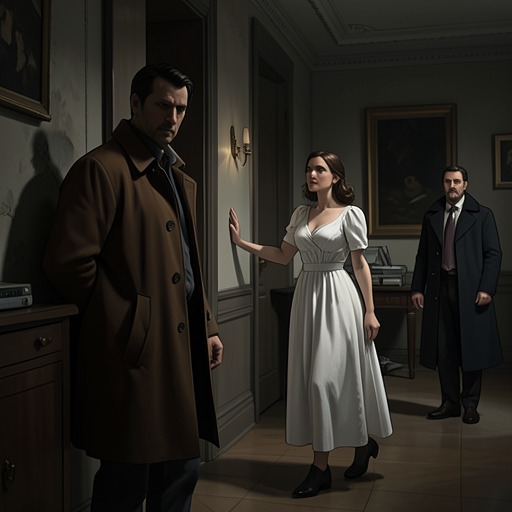
Murder of Bessie Mears
Native SonBessie Mears’s death is revealed through the evidence collected after Bigger Thomas’s capture and through Bigger’s later account of his motive. The disclosure transforms a crime he had treated as secondary into a consequence of the false ransom scheme: Bessie had tried to withdraw, and Bigger killed her to keep her from speaking. His response to learning the circumstances of her death exposes both the practical sequence of the crime and the stark hierarchy in which he had placed its victims.
Discovery and Delayed Confirmation
Buckley confronts Bigger with the discovery of Bessie and tells him that the brick Bigger used had not killed her immediately. The distinction matters: Bigger first reacts as if Bessie may still be alive, jerking to his feet when he hears that she was found. When Buckley continues and explains that she tried to get out of the air shaft but could not, and froze to death, Bigger sits down again. The change in his posture marks the moment when the possibility of survival gives way to confirmation of her death.
Buckley’s account turns the investigation’s physical evidence into a reconstruction of what happened. The brick is recovered, along with the blanket, quilt, and pillows Bigger took from Bessie’s room. These objects connect the crime to the earlier circumstances of the pair’s flight and concealment; they are not merely a general accusation but evidence tied to Bigger’s actions. The detail that Bessie tried to leave the air shaft supplies the final circumstance of her death: after the initial blow, she was unable to escape and died there.
The evidence also includes a letter from Bessie’s purse that she had written to Bigger but never mailed. In it, she said she did not want to go through with trying to collect the ransom money. Her private decision, never communicated to him in the letter itself, nonetheless becomes central to the explanation of why Bigger regarded her as a threat. The letter makes visible the point at which their participation in the scheme had ceased to be shared: Bessie wanted out, while Bigger was intent on avoiding exposure.
Bigger’s Account of the Killing
When asked why he killed Bessie, Bigger says that he acted after realizing he could not get the money, and that he killed her to keep her from talking. Later, speaking with Max, he gives the same essential motive: he killed her to protect himself. The account ties her death directly to the failed extortion plan and to Bigger’s fear that she might disclose it. It does not present the killing as the result of an argument over affection or of a stated personal hatred.
Bigger describes the step from Mary Dalton’s death to Bessie’s killing as a change in what he could bring himself to do. He tells Max that after killing Mary, killing someone else was no longer difficult to contemplate; he says he did not have to think much before killing Bessie, because he believed he had to do it in order to get away. The explanation identifies a sequence of self-preserving decisions, not an isolated act detached from the earlier crime. His account connects the two deaths through the pressure of escape and concealment, while making clear that Bessie was killed because Bigger saw her knowledge as dangerous to him.
Evidence, Relationship, and Response
Bessie’s unsent letter gives her a position in the story that Bigger’s actions had suppressed. She had a decision of her own about the ransom attempt, and the letter records her refusal to continue. Because she never mailed it, the document did not give her a chance to negotiate that decision with Bigger. It instead reaches the investigation as evidence after her death, establishing that her intentions differed from his and helping explain why he feared what she might say.
Bigger’s later description of their relationship is equally stark. He tells Max that he neither hated nor loved Bessie; he had treated her as his girl because, in his view, a man was expected to have one. He presents their association as a fact of his life rather than an intimate bond, and admits that he killed her to save himself. That account does not excuse the murder; it shows how completely he subordinated Bessie’s life to his own need to escape. His claim that he felt fear rather than love or hatred makes the relationship’s imbalance explicit: he speaks of her chiefly in terms of what she meant to his own security.
Significance of the Revelation
The disclosure also exposes Bigger’s own hierarchy of attention. After his capture, he had thought of Bessie only once, and he considered her death unimportant beside Mary’s because he expected to be killed for Mary’s death, not Bessie’s. Buckley’s question therefore forces him to confront a victim he had pushed out of his immediate calculations. His surprise at the report that Bessie was found alive briefly interrupts that detachment; the confirmation that she died restores the finality he had not stopped to consider.
As the account emerges, Bessie’s death is at once a concealed consequence of the ransom plot and a measure of Bigger’s increasingly narrowed concern with survival. Buckley’s recovered objects and the letter establish the circumstances that Bigger’s silence had obscured; Bigger’s later admissions supply his stated motive and clarify the relationship he claims to have had with Bessie. Together, the evidence and confession show that she was not killed because he loved or hated her, but because he believed her disclosure could prevent his escape.