Racial oppression and segregation
Native SonRacial oppression and segregation in Native Son are not limited to personal prejudice: they function as a system that confines Black Chicagoans through housing, education, employment, and public institutions, then treats the consequences of that confinement as evidence of individual criminality. The novel makes the system visible in the mismatch between charitable intentions and material arrangements. The Daltons may describe themselves as benefactors, but their property practices help determine where Black families can live and the conditions under which they must do so. In Max’s courtroom argument, that contradiction becomes central to understanding Bigger Thomas’s life and the social forces surrounding the case.
Housing, Profit, and Philanthropy
The hearings expose housing segregation through questions Max puts to Mr. Dalton about the South Side Real Estate Company. Mr. Dalton acknowledges that he helps formulate company policy, while explaining rents through the language of supply and demand. Max presses the gap between that ostensibly neutral explanation and its unequal results: the Thomas family pays eight dollars a week for one room, where four people eat and sleep, while Black families are charged more than white families for comparable housing. The exchange makes the rent itself evidence of how economic rules distribute disadvantage along racial lines.
The restrictions extend beyond price. Mr. Dalton confirms that he refuses to rent houses to Black people in other sections of the city. He also concedes that the company’s policy keeps Black residents concentrated in one area. Max’s questions connect this practice to the profitability of keeping Black tenants together and to a business code that can preserve racial exclusion without requiring an openly stated agreement among realtors. The resulting geography is not simply a preference or an accident: it is produced by decisions about property and access.
The novel sets Mr. Dalton’s donations to Black education against the rent and housing practices that help sustain his wealth. Max challenges the idea that giving money to education cancels out charging the Thomas family heavily for inadequate housing. The contrast is not between kindness and cruelty as isolated personal qualities, but between charity and the arrangements that charity leaves intact. Mr. Dalton’s intentions do not undo the company’s effect: Black families remain confined to the South Side, while philanthropy offers no equivalent change in where they may live or what they can afford.
Restrictions Across Everyday Life
Max’s argument widens from real estate to the conditions governing Black life. He describes a system that dictates where people can live, how much schooling they can obtain, where they can eat, and what kinds of work they can do. Bigger’s education has prepared him with ambitions and impulses comparable to those of white children, but the boundary between school and adult life reveals that those ambitions cannot be pursued on equal terms. The restriction works not only by withholding opportunity; it also cultivates desire and then bars its fulfillment.
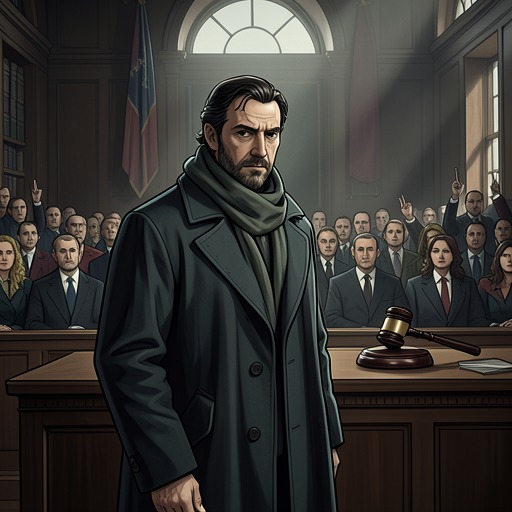
The courtroom itself reproduces the division under discussion. Max points out that Black spectators sit together behind a railing, although no one has explicitly instructed them to do so. Their separation is maintained through an understood expectation about where they belong. A similar division appears inside Cook County Jail, where Black and white prisoners occupy different cell blocks. The recurrence across court and jail shows that segregation is carried through ordinary institutional arrangements as well as explicit policies. Bigger encounters the boundary as part of the environment of public life, not as a rule limited to one place.
Max’s account places these restrictions within a long historical duration. He argues that oppression lasting across generations becomes embedded in how people live, earn a living, speak, and understand right and wrong. His distinction is between an isolated injustice, which might be corrected as a discrete wrong, and a social order that has shaped an entire way of life. That order narrows available choices and helps produce conditions that outsiders then misread as natural or inevitable.
Policing, Public Fear, and Unequal Protection
After Mary Dalton’s remains are found in the furnace, newspaper coverage presents the case through a racialized presumption of sexual violence and a public threat attributed to Blackness. The report describes thousands of police surrounding the Black Belt, searches of Black homes and people leaving the South Side, and white vigilante groups offering assistance to the authorities. It also reports smashed windows in Black neighborhoods, beatings of Black men, and dismissals of Black employees. The search therefore expands beyond finding one suspect: it exposes Black communities broadly to suspicion, disruption, and retaliation.
The report’s framing also shapes the danger Bigger believes awaits him. Its suggestion of a sex crime makes him understand that white readers may judge him before his capture and that the accusation itself could bring death. At the same time, the article treats Jan Erlone as a possible accomplice even though the reported fingerprints are absent. Bigger recognizes the false implication and considers declaring that Jan had no part in the crime. The episode links the public construction of racial threat to the pressure placed on individuals caught inside it.
The inquest further reveals unequal public concern. Bessie’s death enters proceedings as evidence against Bigger, while the investigation into Mary’s death has already commanded the attention of white officials and the public. Bigger understands that the two deaths will not be treated as equivalent: he expects to be punished for Mary’s death, while Bessie’s killing is made useful to that case. The disparity shows how racial oppression orders not only exposure to violence but also whose death receives attention and whose suffering is treated as consequential in its own right.
Max’s Argument and the Novel’s Social Diagnosis
In court, Max asks the listeners to see Bigger’s life as formed within a society that has restricted Black people’s claims to housing, education, work, and property. He does not present this account as proof that Bigger is blameless. Instead, he argues that reducing the case to punishment for one individual allows the wider conditions to remain unexamined. In his formulation, oppression produces fear and hatred, and the response of greater punishment can intensify rather than end the cycle.
Max also connects segregation to the economic relations between the Thomas and Dalton families. One is the renter, customer, and employee; the other is the landlord, merchant, and employer. The Thomas family becomes poor while the Dalton family becomes rich. Within that imbalance, personal assistance cannot substitute for structural change. Mr. Dalton’s employment of Bigger and donations to Black education coexist with the housing restrictions that keep Bigger’s family in the Black Belt and constrain their opportunities.
The novel’s account of racial oppression and segregation thus moves among private transactions, institutional divisions, public narratives, and historical argument. Rent policy confines; schools and work rules limit; courts and jails reproduce separation; and the press turns an individual crime into grounds for a collective racial panic. The system’s force lies partly in this continuity: each sphere can appear to operate by its own logic, while together they determine who is protected, who is confined, and whose life is treated as a public danger.