Racial terror and lynch-mob violence
Native SonRacial terror and lynch-mob violence in Native Son turn the threat against Bigger Thomas into a public spectacle and expose how crowd violence is sustained by racial segregation and unequal institutions. The danger is immediate—Bigger is moved through hostile crowds under police guard—but the novel also traces the conditions that make such violence seem acceptable: constrained Black housing, racialized judgments of criminality, and a legal process that can treat Black lives unequally. Max’s courtroom argument connects the mob’s fury to this broader structure without erasing Bigger’s responsibility for the deaths he caused.
The Threat Becomes Public
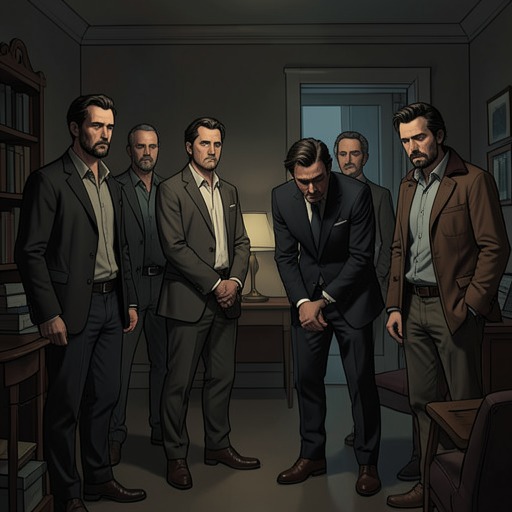
After Bigger is taken into custody, Buckley leads him to a window and shows him the crowds gathered in the streets. He tells Bigger that people want to lynch him and urges him to speak quickly, presenting the crowd as an immediate danger that the authorities are trying to contain. The police guard and the window frame the threat as both physical and political: Bigger is imprisoned, yet the people outside exert pressure on what happens next.
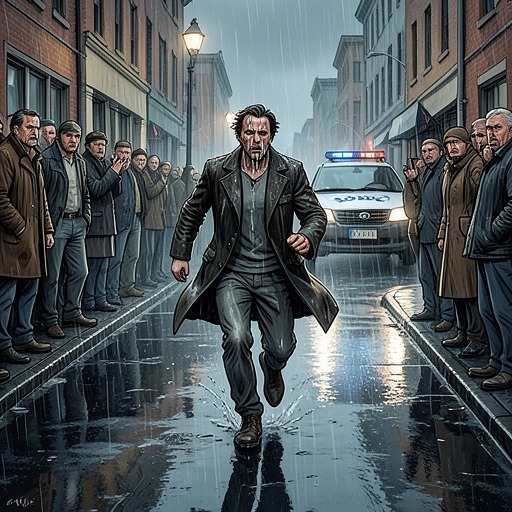
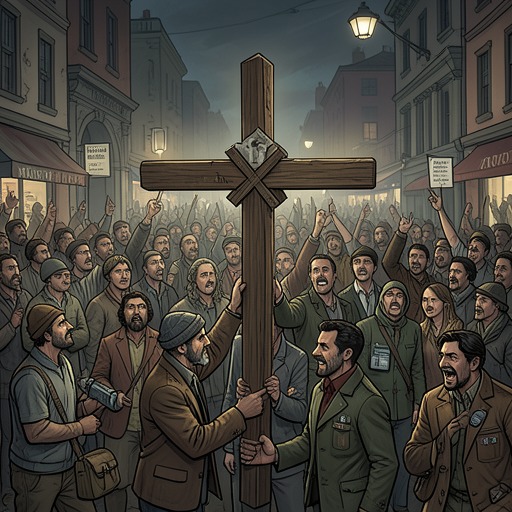
The danger becomes visible again when officers escort Bigger through a mass of people. The crowd shouts for him to be attacked and killed, and one person tries to break through the police line. As the officers force a route to the waiting car, Bigger sees a burning cross raised above the crowd. The image links the gathering to an explicit language of racial intimidation; it also contrasts the cross’s threatening public display with the Christian message of endurance he had heard from Reverend Hammond. The officers prevent the crowd from reaching him, but their protection cannot make the surrounding hostility disappear.
From Crowd to State Response
The threat follows Bigger into the public account of his trial. A newspaper headline announces that troops are guarding the proceedings, while the accompanying report describes fear of violence, rising public demands for death, and anxiety about unrest in a Black neighborhood. The Illinois National Guard has been ordered out to maintain public peace. The deployment indicates the scale of the crisis, while the newspaper’s labels for Bigger frame him through accusation and racial identity before the trial can resolve his fate.
This sequence gives mob violence a reach beyond the people assembled in the street. The crowd threatens immediate harm; press language circulates fear; and armed forces stand ready around the trial. The novel presents these forces together, showing how public hostility can shape the atmosphere in which legal judgment takes place. The available scenes do not make the crowd and the state identical, but they place the trial under the pressure of a racialized demand for punishment.
Segregation Behind the Spectacle
Max’s argument at trial directs attention from the crowd to the conditions that precede it. He challenges Mr. Dalton about the higher rents charged to Black families for comparable housing and asks whether the company’s policy keeps Black residents concentrated in one part of the city. Mr. Dalton acknowledges that the policy works that way, even as he distances himself from having originated it. The exchange makes segregation more than a matter of individual hostility: housing practices help determine where Black families can live and the conditions in which they must do so.
Max further argues that Black people are told where to live, how much schooling they can obtain, where they can eat, and what work they can do. He points out that even the courtroom is divided by race: Black spectators sit together behind a railing, not because anyone has formally ordered them there, but because they understand that they are not welcome on the same bench as white spectators. The courtroom thus reproduces the separation Max describes, making racial hierarchy visible inside the institution that is judging Bigger.
Unequal Recognition of Victims
The inquest into Mary Dalton’s death gives the racial imbalance another, painful form. When Bessie Mears’s body is introduced, Bigger understands that it is being used as evidence against him and that its appearance may intensify the case for his death. Her killing had not been mentioned during the inquest until then. Bigger recognizes that Mary’s death, because she was white, has dominated the proceedings, while Bessie’s death is brought forward in service of the prosecution’s case.
The narrative does not make Bigger innocent of Bessie’s death: he killed her. Instead, it exposes the unequal public value assigned to the two women’s lives. Bigger believes that white society is far less concerned when a Black person kills another Black person than when a white person is harmed. As he watches Bessie’s body presented, he feels a sympathy he had not fully acknowledged while she was alive and resents that her death is being made an instrument in the effort to destroy him. Her experience of being commanded and denied the ability to act for herself becomes, in his understanding, part of the same social order that continues to claim authority over him after his arrest. That recognition does not undo the violence he committed; it reveals how the proceedings can use a Black woman’s death while giving it little independent public attention.
Max’s Structural Argument
Max asks the court not to reduce the case to a contest between an innocent victim and a monstrous individual. He describes a life shaped by collective restrictions and argues that fear and hatred are produced within that social condition, rather than appearing outside history. He explicitly says that he is not asking the court simply to regard Bigger as a victim of injustice or to excuse him. His plea is instead for the court to understand the conditions that have made such a life possible and to consider changing them.
That argument connects racial terror to more than the crowd’s explicit threats. The hostile gathering, the cross, the newspaper’s inflammatory framing, segregation in housing, and the courtroom’s own racial division form distinct but related pressures. Max’s explanation does not guarantee that the court will accept his reasoning, nor does the evidence make Bigger’s crimes disappear. Its significance lies in forcing the trial to confront a question the mob’s demand for immediate punishment suppresses: how a society that restricts and separates people helps create the conditions it later claims only to fear.