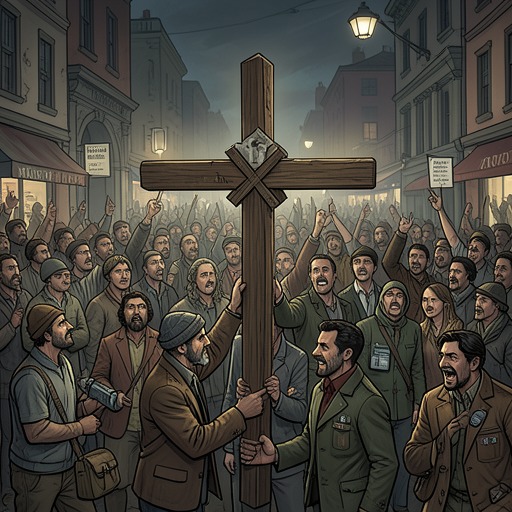
Reverend Hammond
Native SonReverend Hammond is the pastor of Bigger Thomas’s mother’s church and a visitor who comes to Bigger at his cot. His brief appearance brings a religious response to Bigger’s predicament: he prays for mercy and urges Bigger to seek comfort in the soul and eternal life. But the visit is not simply a moment of consolation. Bigger recognizes the preacher and immediately guards himself against what the encounter might make him feel, while Hammond offers a doctrine of love, forgiveness, and nonresistance. Their meeting therefore sets spiritual consolation beside Bigger’s resistance to its emotional demands.
Identity and Introduction
The narrative introduces Reverend Hammond through Bigger’s half-awake perception. Overcome by drowsiness, Bigger closes his eyes, opens them abruptly, and sees a man enter. The man is tall and well dressed; he approaches the cot and reaches out to touch Bigger’s hand. This contact precedes recognition. When Bigger sees the man’s dark suit, he remembers that he is Reverend Hammond, the pastor of his mother’s church.
That relationship supplies the immediate context for Hammond’s presence, but it does not make him a welcome visitor. Bigger associates the pastor not only with a particular person but with his mother and what she represents to him. The distinction between Hammond himself and those associations scarcely holds in Bigger’s mind: although he wants to tell the preacher to leave, he cannot make himself speak. The scene thus presents religious authority as personally familiar and emotionally difficult at once.
Bigger’s Guarded Response
Bigger anticipates that Reverend Hammond will awaken remorse in him. He responds by shutting his heart and trying to suppress feeling, rather than by answering the offered touch or beginning a conversation. His wariness is not described as a reasoned judgment of Hammond’s character; it arises from what the preacher signifies to him. The pastor evokes his mother, while the newspapers evoke the public account surrounding him, and Bigger cannot neatly separate his reactions to either.
That confusion becomes especially charged around race and belonging. Bigger feels both a love for his own people and hatred toward others, yet experiences those opposed feelings as equally guilt-producing. The passage does not resolve that conflict or identify Hammond as its cause. Instead, it shows how the encounter gathers private family association, racial feeling, and public judgment into a single pressure that Bigger tries to keep at a distance. His silence is therefore significant: Hammond’s presence reaches him, but the evidence does not show that Bigger welcomes or accepts the approach.
Prayer and Christian Counsel
Reverend Hammond responds through prayer. He asks God for mercy and forgiveness for Bigger, describes him as a sinner in need of help, and also prays for compassion toward those trying to help him. The prayer places Bigger within a framework of sin and mercy, but it does not dwell on the details of his actions. Its emphasis is on the possibility of divine forgiveness and on the need for compassion around him.
Afterward, Hammond counsels Bigger to turn his attention away from the newspapers and from the significance attached to his Blackness, and toward his soul and eternal life. He presents God as seeing beyond skin and loving the soul, then offers to tell a story that will make Bigger’s heart glad. This advice directly addresses the two pressures already active in the scene: the public story carried by the newspapers and Bigger’s own conflicted sense of racial belonging. Hammond proposes spiritual attention as a way to set those pressures aside, not as a practical answer to them.
The story Hammond begins to explain is a Christian account of suffering and salvation. He describes generations of prayer, the coming of Jesus in human form, and Jesus’s death as a victory that demonstrates a way through a hostile world. In Hammond’s account, earthly life is marked by suffering, and the route to salvation is love and forgiveness rather than resistance. He urges Bigger to follow Jesus’s example, believe in eternal life, and surrender himself to God. The counsel is clear in its religious terms, but the encounter does not establish how Bigger receives it.
Relationship and Narrative Significance
Reverend Hammond’s relationship with Bigger is mediated by the mother whose church he serves. He arrives as a pastor seeking to offer spiritual help, yet Bigger experiences him through a knot of family memory, anticipated remorse, racial identification, and hostility. That disparity gives the visit its central tension: Hammond speaks of mercy and love, while Bigger tries to close himself off from feeling and cannot speak freely to him.
At the end of the supplied encounter, Bigger acknowledges that someone in his situation needs help and identifies himself as Reverend Hammond. The exchange confirms the preacher’s identity and the practical purpose of his visit, but it does not record a conversion, reconciliation, or change in Bigger’s beliefs. Hammond’s narrative role is consequently bounded but important: he articulates a Christian interpretation of suffering at a moment when Bigger is being approached through both personal attachment and public judgment. The scene leaves the difference between offering spiritual consolation and reaching its intended recipient unresolved.