Sexual Panic over Black Men and White Women
Native SonSexual Panic over Black Men and White Women is a social force in Native Son, not simply a set of private prejudices. Suspicion surrounding relations between Black men and white women colors the questioning of Bigger Thomas, turns the discovery of Mary Dalton’s remains into a citywide racial emergency, and helps explain why the deaths of Mary and Bessie are treated so differently. The novel traces how assumptions about sex become a language of threat: they shape what authorities believe, what newspapers publish, and which victims the public is moved to protect.
Suspicion as an investigative framework
During the search for Mary, an investigator asks Bigger whether Jan Erlone had promised that joining the Communist Party would let him meet white women. Bigger becomes alarmed and feigns embarrassment. The narration makes clear that he understands the force of the taboo: white men generally regarded sexual relations between Black people and white people as repulsive. The question therefore does more than test what Jan may have said. It introduces the possibility that political association with Jan concealed a sexual inducement, connecting interracial desire to suspicion of Communist influence.
That framing gains force when Mary’s bones are found in the furnace at the Dalton home. A newspaper reports that authorities suspect a sexual crime, although the report does not establish that account as fact. It also announces that Jan has an alibi, yet continues to suggest he may have been involved because the alleged crime seems too elaborate to have been devised by a Black man. Bigger recognizes both the danger of the sexual allegation and the injustice of the suspicion directed at Jan. He wants to tell the police that Jan had no part in the crime, even as the reports make clear how quickly racial assumptions can overtake what is known.
News coverage and collective alarm
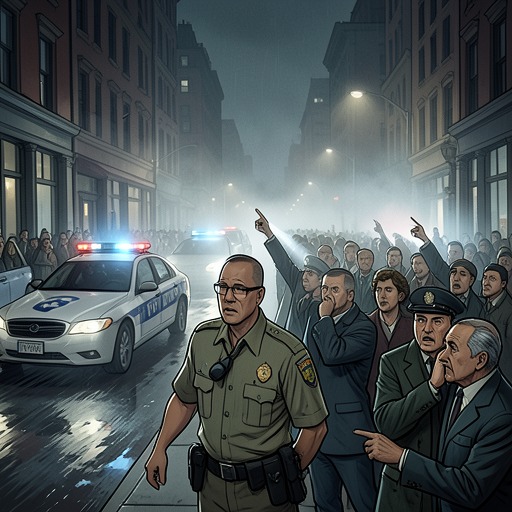
Newspaper coverage converts suspicion into a public emergency. Reports identify Bigger as the sought-after suspect and describe a vast search through the Black Belt: five thousand police are joined by more than three thousand volunteers, while transit routes are stopped and searched and Black homes are raided under a blanket warrant. The same coverage records smashed windows, assaults on Black men, dismissals of Black workers, and white parents’ fears for their children. These are not consequences of a proven sexual motive; they follow from a racialized accusation circulated as though it were established.
The coverage also gives Bigger a map showing the search area expanding across the South Side. In a later report, the shaded territory leaves only a small unsearched space in the middle of the Black Belt, while the newspaper says that eight thousand armed men have searched cellars, buildings, and more than one thousand Black homes. As the hunt closes in, the public story gives Bigger a fixed identity as a sexual predator before he has been tried. The sexual allegation thus functions as a means of organizing fear and mobilizing force, rather than as a conclusion reached through demonstrated evidence.
The color line and unequal protection
The investigation draws on a wider code of racial control. A report from Jackson, Mississippi, argues that Black people must be kept in their place and that contact between Black men and white women must be restricted. It recommends segregation in public facilities and housing as a way to prevent such contact. The report presents racial separation as protection, but its logic treats Black men collectively as a danger and white women as people whose safety requires control over Black life.
The novel places that logic beside the housing arrangements associated with Mr. Dalton. Under questioning, he acknowledges that his company’s policy keeps Black residents in one area, while the hearing raises the fact that Black families, including Bigger’s family, pay more rent than white families for similar housing. The juxtaposition links the sexual taboo to material segregation: the same social order that restricts where Black people may live also casts their presence near white women as a threat. Mr. Dalton’s charitable giving does not erase the consequences of that arrangement.
Gendered violence and unequal attention
The case’s public focus on Mary also exposes how unevenly women’s suffering is recognized. During the inquest, Bessie’s body is presented as evidence in the case against Bigger, surprising the white people in the room. Bigger understands that the two deaths do not carry equal public weight: Bessie’s death is made to intensify the case against him, while the public response centers on Mary’s death. His recognition does not excuse his responsibility for either death; it shows how racial hierarchy shapes whose victimization commands attention and how another woman’s suffering can be used within the prosecution’s story.
The novel also places Bigger’s sexualized fear of the white world beside his treatment of Bessie. When Bessie protests during their encounter, he ignores her. This parallel does not make the forms of violence equivalent: it brings into view both the racial taboo that shapes his fear and the gendered violence for which he is responsible. The later feminist criticism noted in the novel’s critical reception has emphasized that Wright’s fictional world is often hostile to women, especially Black women. Bessie’s treatment in the inquest makes that imbalance particularly visible: her death matters publicly chiefly as evidence in a case already organized around the white woman’s death.
Trial, social explanation, and legacy
Before Bigger’s trial, reports say that two regiments of the Illinois National Guard have been ordered to protect public order amid fear of mob violence and rising demands for the death penalty. The scale of the response extends the panic beyond the initial investigation: the alleged sexual threat becomes a rationale for military deployment and a public demand for lethal punishment. The novel’s newspapers repeatedly shape that atmosphere by presenting accusation through racialized descriptions and assumptions rather than separating confirmed facts from conjecture.
In his courtroom address, Max asks the court to consider the broader social conditions that produced a distorted mode of life, rather than treating Bigger only as an isolated object of fear. He does not claim that Bigger is innocent or ask the court simply to pity him. Instead, he argues that the conditions at issue are collectively produced and must be understood and changed. That argument contests the panic’s simplifying story: it does not deny Bigger’s actions, but it rejects the idea that racial danger can be explained by portraying Black people as naturally threatening. The subject also belongs to the novel’s contested literary legacy. Though later feminist criticism drew attention to its hostility toward women, the book’s renewed relevance amid the Black Power movement and urban violence in the 1960s reflected its forceful exposure of racial fear, violence, and the social structures that sustain them.