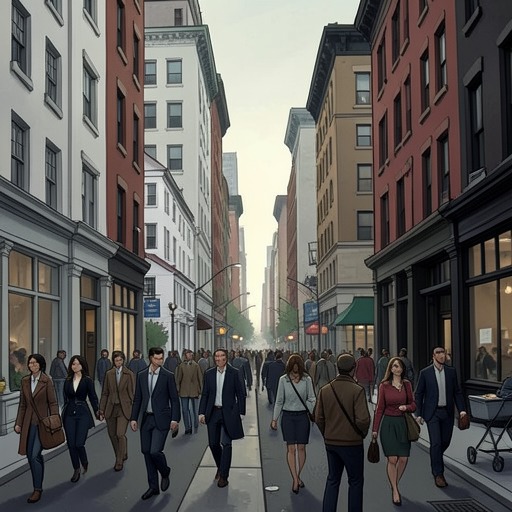
South Side of Chicago
Native SonThe South Side of Chicago is not simply the neighborhood through which the novel’s characters move; it is a contested urban space that limits where Black residents can live, work, and go, while concentrating the consequences of those limits. From the planned robbery of Blum’s Delicatessen to the citywide search for Bigger Thomas, the South Side’s streets become a map of unequal opportunity and unequal exposure to force. Its physical boundaries are also social ones: they define who is watched, who can cross freely, and whose suffering draws public attention.
Setting and Everyday Geography
The novel places the South Side within a network of specific streets, businesses, and routes. On the morning Bigger considers taking work with Mr. Dalton, he weighs whether to meet Gus, G.H., and Jack at Doc’s Poolroom. Their proposed robbery of Blum’s Delicatessen depends on local knowledge: they believe no policeman will be on duty on the block between three and four, and plan to use the store’s front, back, and alley to escape. The job would be different from their earlier robberies, which had targeted Black-owned or Black-visited places. Blum’s is a white man’s store, and the gang understands that crossing that social boundary could bring a different and more determined response from the white world. The South Side’s geography thus enters the plan not as neutral scenery but as a system of risks and permissions.
The area also appears through the route taken by the Daltons’ car. When Mary Dalton and Jan ask to eat at a place serving Black customers rather than at a fashionable restaurant, Bigger suggests Ernie’s Kitchen Shack at Forty-seventh Street and Indiana. Jan drives west from the Outer Drive to Indiana Avenue and then south, through the Black Belt. Mary expresses a wish to visit Black homes and learn how people live nearby, but her curiosity makes Bigger acutely conscious of being observed and made into a representative of a whole population. The passing apartment buildings hold Black life in view, while the passengers’ presence inside the car marks the distance between looking at a neighborhood and living within its constraints.
Housing and the Color Line
The South Side’s most consequential boundary is the line restricting Black residence. While fleeing through the snow, Bigger tries to find shelter and remembers how scarce vacant flats are in the Black Belt. His experience of housing shortage is tied to rules and practices that leave Black families few alternatives: he recalls that rental agencies said there were not enough homes for Black residents, that buildings occupied by them were condemned, and that his family had once been forced from a flat in a building that collapsed shortly after they moved in. He also recalls the unequal cost of housing: Black families could pay twice as much as white families for the same kind of flat.
Those memories turn the search for a room into evidence of confinement. Bigger knows that a Black renter cannot simply look for a home anywhere in the city; white real-estate agents will not rent to him outside the areas assigned to Black residents. The result is a neighborhood where empty flats are difficult to find even as residents are charged heavily for inadequate housing. The novel connects this restriction to the broader experience of being held in one area: a person pursued by the police cannot use the whole city as space in which to disappear. During Bigger’s flight, the difference between an open city and a bounded neighborhood becomes a matter of immediate safety.
The hearing into Mary Dalton’s death makes the structure of property ownership visible. Mr. Dalton explains that his company owns stock in a company that owns the building where the Thomas family has lived for three years; the second company is the South Side Real Estate Company. When asked whether his company’s policies keep Black residents on the South Side in one area, he acknowledges that they have that effect, while distancing himself from having originated them. The exchange reveals how segregation can be maintained through layers of ownership and policy, rather than only through a single landlord’s declared intention. Max contrasts this arrangement with Mr. Dalton’s charitable giving, pressing the difference between donating money and changing the conditions that make housing insecure and expensive.
Policing, Public Crisis, and Unequal Protection
After the remains of Mary Dalton are found in the furnace at the Dalton home, the South Side becomes the focus of an immense manhunt. Newspaper accounts describe a cordon of five thousand police, supplemented by more than three thousand volunteers, and the stopping and searching of vehicles and public transport leaving the area. Police and vigilantes search Black homes under a blanket warrant; Black men are beaten in other parts of the city, and several hundred men resembling Bigger are detained. The search is presented as a response to a specific crime, but its reach falls across an entire community. The South Side’s population is treated as a suspect mass, and the rhetoric of danger helps authorize collective surveillance and punishment.
The novel also exposes the unevenness of the protection offered by law. During the inquest, Bigger recognizes that Bessie’s death receives attention as evidence against him, while Mary’s death is the event around which white fear and public urgency gather. He understands that he is likely to be punished for the white woman’s death, while the killing of a Black woman has not drawn comparable concern. This contrast does not make Bessie’s death less serious; it shows how the public meaning assigned to a crime changes with the race of its victim. The South Side is therefore not only the site of restricted housing and intensive searching, but also the place from which Black victims can be excluded from public grief even as their bodies are drawn into the legal case.
A Neighborhood Interpreted as a Social Condition
The conditions associated with the South Side recur beyond the immediate scenes of flight and investigation. In a jail cell, a disturbed man addresses the authorities with accusations about overcrowding, stale food sold at higher prices, inadequate hospitals, crowded schools, and discriminatory hiring and firing. His claims are delivered in a state of agitation and are not presented as a measured report; their narrative force lies in how they condense grievances about life on the South Side into a demand to be heard. The other prisoners’ calls for him to stop underline how little room the institution gives his speech.
Max’s courtroom argument gives the neighborhood a wider political meaning. He asks the court to consider the conditions imposed on Black people: where they may live, what schooling they can obtain, where they may eat, and what work they may do. He points to the physical separation visible even inside the courtroom, where Black spectators sit together behind a railing without being formally instructed to do so. He describes Black Americans collectively as a nation within the nation, deprived of political, social, economic, and property rights. His argument links the South Side’s housing boundaries to a system operating across the city and country, while insisting that the neighborhood’s conditions are produced by human choices rather than by nature.
In this way, the South Side of Chicago functions as both a concrete setting and a test of the city’s claims about freedom and fairness. Its routes connect restaurants, poolrooms, apartments, and stores; its color line restricts ordinary movement and housing; and its residents become targets of broad police action when a white woman disappears. The novel repeatedly turns local geography into a record of power: who can cross a boundary, who is made to remain within it, and whose life is recognized when violence reaches the courtroom.