The cross motif
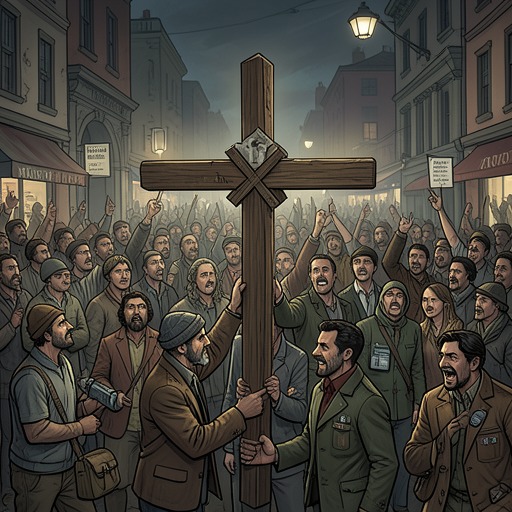
Native SonThe cross motif gives a visible form to the conflict between religious hope and racial terror. When Bigger Thomas sees a cross burning above a crowd during his transfer to jail, he recognizes it not as the Christian sign he has been given but as a threat associated with the Ku Klux Klan. The cross around his neck, offered by Reverend Hammond as a sign of salvation, becomes inseparable from the flames in his mind. His rejection of it marks a turning point: a fragile openness to hope gives way to a determination to rely on himself alone.
Two Crosses, Two Meanings
Before the burning cross appears, Bigger recalls Reverend Hammond speaking solemnly in his cell about Jesus, the cross, and a way of living and dying. That teaching has given the symbol a meaning of shared suffering and spiritual possibility: a cross is presented as something that belongs not to one person alone but to everyone. Bigger’s memory of the preacher’s account makes the rooftop image especially difficult to interpret. Both objects are crosses, but the similarity of form does not make their meanings compatible.
The distinction becomes explicit in Bigger’s response to the scene. The preacher’s cross had inspired awe and a desire to pray; the burning one produces fear and anger. He sees the faces around him as unlike the preacher’s face when speaking of love, and he understands the burning emblem as the Ku Klux Klan’s cross rather than Christ’s. The motif therefore does not treat the cross as a stable sign whose meaning survives every use. Its significance changes according to who bears or displays it, and to the power brought to bear through that display.
The Burning Cross and Racial Threat
The rooftop cross enters the scene amid hostile shouts and an attempt by someone in the crowd to reach Bigger, stopped by police. Bigger understands the burning as directed at him. The image converts the threat surrounding his passage through the crowd into a sign he can read: this is not a call to Christian love, but an expression of hatred. The passage thus sets religious language against the public spectacle of racial intimidation without suggesting that the two forms of the cross are equivalent.
The transfer to jail carries that conflict with him. Seated between policemen, Bigger continues to focus on the burning cross and feels the preacher’s smaller cross against his chest. The two images become linked in his awareness, even though their meanings oppose one another. He fears that the token he had accepted as a promise of salvation has become a sign that he will die. When he reaches his cell, he tears open his shirt, removes the cross, and throws it away, insisting that he does not want it. The gesture is a refusal of the object and of the hope he now associates with it.
Rejection and Its Aftermath
Reverend Hammond later gathers the Bible, hat, and cross from the floor, briefly tends to his bruised face, and leaves the cross inside the cell. After the preacher and guard have gone, Bigger picks it up and holds it for a long moment before throwing it through the bars. The second rejection matters because it follows the immediate crisis rather than simply repeating it: even after the preacher has left the object within reach, Bigger chooses to cast it away again.
The narration connects that choice to a change in what Bigger is willing to hope for. He decides that he does not want to feel hope again, because he had begun to imagine that something might change, only to see the cross he wore replaced in his understanding by the burning one. The motif makes spiritual reassurance vulnerable to the surrounding racial violence: the promise attached to the cross cannot remain separate from the threat that Bigger has just witnessed. His rejection is not evidence that the opposing meanings have been reconciled; it records his loss of trust in the promise.
Isolation and the Motif’s Significance
After his emotional storm subsides, Bigger notices that Black and white prisoners are housed in separate cell blocks even inside Cook County Jail. The observation is presented as a fact he registers without bitterness, but its placement extends the cross scene’s conflict beyond the street. The burning symbol has made racial hostility immediately legible; the jail’s segregated arrangement shows that division also persists as part of the institution’s ordinary organization.
Bigger resolves that, from then on, his thoughts and actions will have to come from himself. He includes Jan and Max among those he can no longer fully trust, while allowing that they may be well-intentioned. He does not want another cross that might turn to fire while still against him. In this image, the motif gathers the episode’s central reversal: a symbol accepted as hope becomes, through the burning cross, a reminder of danger and betrayal. Its final force lies not in a general rejection of religion but in the specific break between Reverend Hammond’s promise and the racial terror Bigger sees enacted around him.