The mob attack and threat to lynch Bigger
Native SonThe mob attack and threat to lynch Bigger is the public eruption of a manhunt shaped by racist reporting and suspicion. After Mary Dalton’s remains are discovered in the Dalton family furnace, the press recasts the case around an alleged sexual crime, and authorities and crowds treat Black residents as a collective danger. Bigger is captured amid this climate, assaulted while being moved through a crowd, and later taken to trial under the protection of state troops. The threat is not confined to one confrontation: it follows him from the search through the courtroom, where the prosecution’s language and the public demand for punishment compete with a wider account of the social order that helped shape the case.
From discovery to public alarm
The immediate turning point is the discovery of bones in the furnace at the Dalton family residence, later identified as Mary Dalton’s remains. A newspaper headline announces that the kidnapping case has been cracked, but another headline alleging a sexual crime changes the public meaning of the news. To Bigger, that allegation signifies more than a charge awaiting proof: it makes him feel excluded from human regard before the police have captured him. The reporting thus announces a social verdict in advance of a legal one, preparing readers to see him as a threat rather than as a person whose actions and responsibility must be established.
The news is followed by a sweeping search of the Black Belt. Police and vigilantes, carrying weapons and photographs, stop vehicles and public transport leaving the South Side and search Black homes under a citywide warrant. Searches extend to abandoned buildings; white parents ask that schools close until the suspect is captured; and reports circulate that Black men have been beaten in other parts of the city. Vigilante groups organize in Hyde Park and Englewood and offer assistance to the police. The campaign therefore reaches beyond the effort to locate one fugitive: Black neighborhoods and their residents become the objects of collective scrutiny and punishment.
Newspaper accounts also cast suspicion on Jan Erlone, suggesting that he may have helped plan the crime because authorities supposedly consider the scheme too elaborate to have been devised by a Black man alone. Bigger wants to deny Jan’s involvement and accept responsibility himself, but the public story has already made racial presumption part of its logic. The accusation against Jan and the sexual-crime narrative about Bigger expose opposite uses of the same distorted frame: the press assigns guilt through racial expectation, not through a careful accounting of what each person did.
Capture amid a hostile crowd
As the search tightens, a newspaper map shows police advancing from both ends of the Black Belt and leaving a small area between them. Bigger reads the shrinking space as a sign that he has been cornered. This image links the pursuit to the larger geography of racial confinement: the police operation closes in on him within the same segregated city that has sharply limited where Black residents can live.
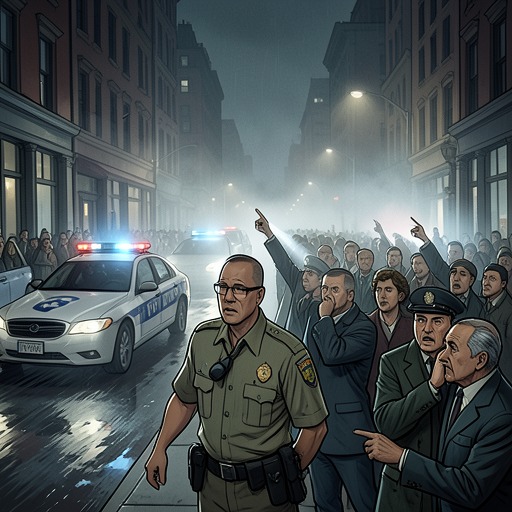
After his capture, officers handcuff Bigger and lead him through a building toward an elevator and a waiting crowd. In the passage through the crowd, he is struck and falls; after being pulled upright, he sees police struggling with a slender white man. The surrounding noise and disorder make the transfer itself dangerous, even though the evidence does not identify who struck him. Police then take him through a dense crowd. Its members are silent while he passes close by, but their voices rise when he is farther away. Outside, amid shouted threats, police lines and armed officers surround the car carrying him toward the Dalton home. The escort protects him from immediate attack while also displaying the scale of the public hostility gathered around his case.
The threat follows him to trial
The danger returns during the trial. A report in the Chicago Tribune says that two regiments of the Illinois National Guard have been ordered to preserve public order. Its account describes rising demands for the death penalty and fear of unrest. When Bigger is moved from his cell, police line the corridor, shackle him between officers, and escort him through underground passages and crowded halls. From a window he glimpses a crowd held behind ranks of troops. The military presence makes the threat concrete: the court proceedings take place under guard because officials anticipate mob violence.
The mob does not decide the verdict, but its pressure forms part of the trial’s setting. Public calls for death reinforce the newspaper portrait of Bigger as a sexual and racial menace, while the armed escort underscores how precarious his physical security remains even in state custody. The episode thus distinguishes two kinds of judgment that converge around him: the formal court’s determination of legal responsibility and the crowd’s demand for immediate racial punishment.
Structural violence and the counterargument
The testimony and argument surrounding the case widen the frame beyond the mob itself. Questions to Mr. Dalton at the inquest challenge whether his company’s rents charge Black families more for comparable housing and help confine them to one South Side area. In the courtroom, Max argues that Black people have been directed where to live, how much schooling to receive, where to eat, and what work to do. He points out that Black and white spectators remain separated even inside the court. These details do not erase Bigger’s responsibility for his actions; they expose the segregated conditions obscured by a story that treats the case only as an individual crime and the Black community only as a threat.
The episode’s central contrast is between the state’s capacity to mobilize force against Black neighborhoods and its need to deploy troops to keep a crowd from attacking a single prisoner. The manhunt turns racial fear into searches, beatings, accusations, and threats; the trial makes visible the institutional divisions beneath that fear. By carrying the danger from the streets into the courthouse, the narrative shows that Bigger’s immediate survival and the question of justice cannot be separated from the racial order that has already shaped public judgment.