The preacher's cross given to Bigger
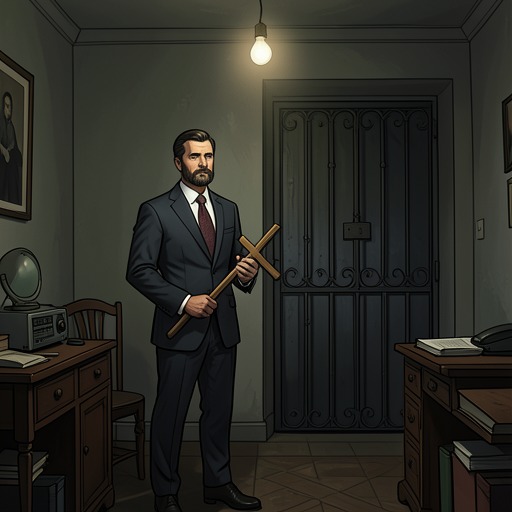
Native SonThe preacher's cross given to Bigger is a small religious object whose meaning changes sharply during Bigger Thomas's arrest. Reverend Hammond had placed it around Bigger Thomas's neck as an emblem of Christian salvation; after Bigger sees a burning cross outside the Dalton home, he experiences the two crosses as opposed signs of what awaits him. The cross that had represented hope now rests against his chest while he is taken into custody, seeming to connect religious consolation with the threat of racist violence. His repeated attempts to cast it away turn the object into a measure of his fear, anger, and refusal of the comfort it once offered.
Identity and First Meaning
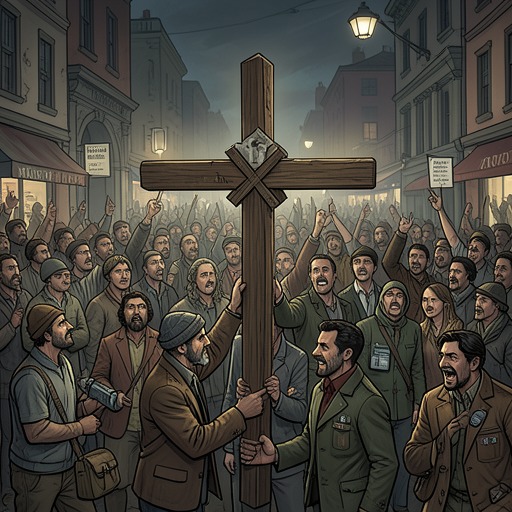
The cross first appears as part of Reverend Hammond's effort to offer Bigger Thomas religious consolation. Bigger distinguishes this cross from the one burning above him: the preacher's cross belongs to a story of Christ's suffering and salvation, while the blazing cross is associated with the Ku Klux Klan and hatred. For Bigger, the difference is not merely between two religious symbols. One had prompted awe and the possibility of kneeling; the other produces fear and panic. Their visual resemblance makes the contrast more disturbing, because the same sign seems capable of carrying either a promise of salvation or a threat of death.
The cross is physically close to Bigger Thomas throughout the arrest scene. He becomes aware of it against the skin of his chest as officers take him away, and its contact feels to him like a danger rather than reassurance. The object has not changed, but its setting and association have: after the burning cross appears, the emblem Reverend Hammond gave him can no longer remain a transparent token of faith. It becomes conspicuous, unwanted, and bound to the immediate events around him.
Rejection in Custody
Once inside the cell, Bigger Thomas tears open his shirt, removes the cross, and throws it away. The men present react with surprise and urge him not to discard what they understand as his cross. Bigger answers that he can die without it. The exchange makes the disagreement over the object's meaning explicit: they treat it as a necessary aid to his soul, while he refuses the premise that it can help him face what is happening.
The cross does not stay discarded. After the men leave it just inside the cell door, Bigger picks it up and throws it away again. This repeated action gives the object a force beyond its size: it keeps returning to the immediate space of the cell, and Bigger must reject it anew. His response is not a considered theological argument so much as a physical refusal of the hope associated with Reverend Hammond's visit. The cross is close enough to retrieve, but he does not accept the comfort others attach to it.
Reverend Hammond and the Object's Return
Reverend Hammond comes to the cell with a guard after Bigger has rejected the cross. Bigger tells him he does not want him. Later, Reverend Hammond gathers his hat, Bible, and the cross from the floor. He leaves the cross inside the cell, but its presence there does not reconcile Bigger to it. Once Reverend Hammond and the guard have walked away, Bigger picks it up, holds it for a moment, and throws it through the bars. It strikes the wall beyond the cell, ending this encounter with the object in another act of separation.
The sequence does not present the preacher as simply absent or indifferent: he comes to see Bigger, retrieves the items from the floor, and leaves the cross behind. Nor does the object become a source of renewed faith through that visit. Bigger understands the burning cross as proof that the hope he had begun to entertain can be answered by violence. His rejection therefore falls on the object as a reminder of a hope he no longer trusts, not only on the person who brought it.
Significance and Consequences
The cross's meaning is shaped by its contrast with the burning cross associated with the Ku Klux Klan. In Bigger Thomas's experience, a sign of salvation has been placed beside a sign of racial hatred, and the threat of the latter overwhelms the reassurance of the former. The juxtaposition exposes how religious symbols can be made to feel incompatible when the surrounding world gives Bigger immediate reason to fear. The cross around his neck becomes, in his perception, not protection but a vulnerable point of contact with that world.
After throwing it away for the final time, Bigger Thomas decides that he does not want to feel hope again. As he lies in the Cook County Jail, he notices that Black and white prisoners are separated into different cell blocks. He then resolves not to trust anyone or anything, including Jan and Max, and to depend only on what comes from himself. The preacher's cross does not cause that segregation or create the danger represented by the burning cross; its importance lies in the way it concentrates Bigger's response to them. By the end of the episode, repeatedly rejected and left beyond the bars, it stands for the faith and trust he has come to regard as unsafe.