
The Sense of Evil
NemesisThis flow traces Jane Marple’s intuitive perception of menace and its eventual conversion into concrete evidence.
increasing Bearing strength in each event
 decreasing
Bearing strength in each eventdecreasingAn Atmospheric Intuition

Sorrow in the Rooms
Jane Marple senses that The Old Manor House contains more than financial decline. Its neglected rooms and garden seem saturated with a grief that has not dispersed.
Intuition Before Proof
She cannot identify a crime from atmosphere alone. Yet the feeling prevents her from accepting the sisters’ ordinary explanations without examination.
The House as Evidence
Place becomes a form of testimony. The house communicates through decay, silence, and the emotional behavior of its inhabitants.
Anthea’s Backward Glance
Fear Behind the Shoulder
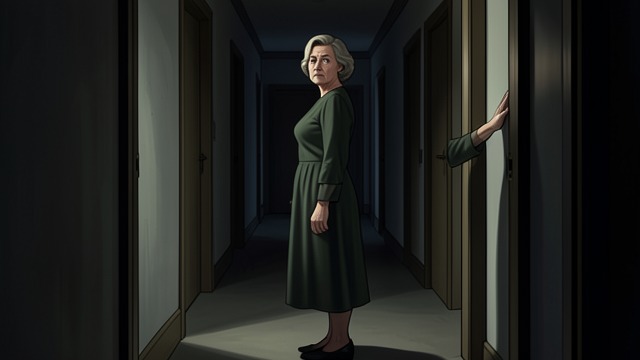
Anthea Bradbury-Scott repeatedly looks behind her as though someone invisible stands there. Jane Marple interprets the gesture as fear rather than mere eccentricity.
A Divided Atmosphere
Anthea’s behavior suggests that the household contains knowledge she cannot safely express. Her fear becomes an indirect witness to Clotilde’s secret.
Intuition Refined
Marple does not accuse Anthea immediately. She stores the gesture until later details connect it with the greenhouse and the parcel.
The Menacing Plant

Beauty That Overgrows
Polygonum baldschuanicum covers the mound where the greenhouse collapsed. Its rapid growth hides the structure beneath a mass of attractive white flowers.
Concealment in Nature
The plant appears ornamental, but its function is to swallow and dry out whatever it covers. It becomes a botanical image of suppressed history.
A Material Suspicion
Marple recognizes that the mound is not simply neglected. Its placement, Anthea’s fear, and the plant’s concealment suggest deliberate preservation of a secret.
From Feeling to Hypothesis

The Atmosphere Explained
The Archdeacon confirms that Verity and Michael planned to marry and that neither came to the wedding. This information gives Marple’s earlier sense of menace a causal structure.
Emotional Logic
Clotilde’s attachment, Verity’s wish to escape, and Anthea’s fear now fit together. Atmosphere becomes an interpretation of human relationships rather than a supernatural sensation.
Evidence Follows Intuition
Marple’s instinct has not solved the crime alone, but it has directed her toward the place where proof can be found.
The Grave Beneath Beauty

Evil Under Flowers
Jane Marple identifies the Polygonum-covered mound as Verity Hunt’s grave. The garden’s beauty has concealed a crime for a decade.
Perception Confirmed
What began as an uneasy atmospheric impression becomes physical evidence. Marple’s sensory response and her reasoning converge.
The Limits of Intuition
The novel does not present intuition as magic. It is accumulated attention to setting, gesture, memory, and incongruity, disciplined until it can name the danger.
When Marple first enters The Old Manor House
During the first walk through the garden
During the garden inspection at The Old Manor House
After Archdeacon Brabazon’s testimony
During the final confrontation
