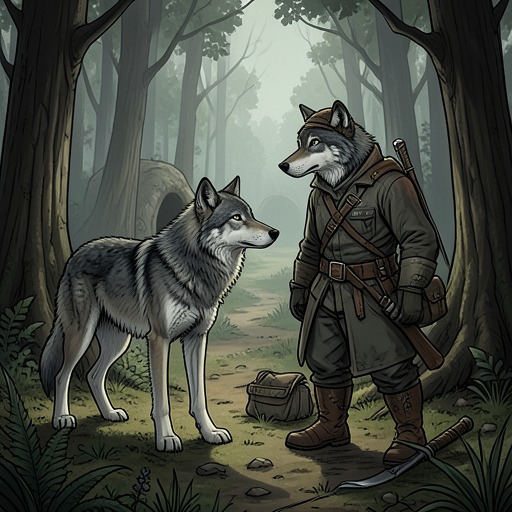
Albert and Kooa’s Brief Mating Bond
Never Cry WolfUncle Albert and Kooa’s short-lived bond brought Mowat’s study of the Keewatin Barren wolves’ family life into contact with Mike’s Husky dogs. What began as an effort to observe a part of wolf behavior that Mowat had not yet seen became a temporary partnership: Uncle Albert and Kooa spent about a week together away from the camp, then returned to their separate groups. The episode revealed both the limits of human control over the animals and the gap between a planned experiment and the relationship that unfolded around it.
The Question Behind the Experiment
By the time Mike’s dog team returned to the cabin, Mowat had spent much of his fieldwork observing the wolves around their den. He had watched family routines and cooperation, but their sexual life remained unknown to him. The animals’ mating period was brief and occurred in March, when the wolves travelled with the caribou herds. Following them then would have been necessary to study that behavior directly, and Mowat saw little prospect of doing so.
A chance circumstance supplied another possibility. One of Mike’s female dogs, Kooa, was coming into heat, and her condition had stirred up the team. Mowat understood from what Mike and Ootek had told him that wolves and dogs would mate when they had the opportunity, although the dogs were usually tied up when not working. Mike was interested too: he had long wondered what kind of sled dogs a wolf-and-Husky cross might produce. Their separate interests converged in a proposed experiment, though the account follows the animals’ encounter rather than reporting any later offspring.
Mowat planned the introduction in stages. First, he took Kooa along a wolf trail so that the wolves would encounter her scent and become aware of her presence. She pulled eagerly down the trail, investigating its markers so forcefully that Mowat had difficulty restraining her with a heavy chain leash. When he brought her back to the cabin and tethered her, she howled through the night. The following morning, he and Mike led her to the observation site and chained her to a wire, leaving her room to move while keeping her position under observation.
The Meeting at the Summer Den
Kooa initially settled and slept through much of the afternoon. The adult wolves were not visible, though the pups could sometimes be seen moving about the grassy area and pouncing after mice. At about half past eight in the evening, the wolves began their pre-hunting chorus from behind a ridge. Kooa rose and joined in. Her call changed the scene from a waiting experiment into an encounter: the wolves’ song stopped, and moments later three adults came over the ridge and saw her, a quarter of a mile away.
George and Uncle Albert both started toward Kooa. George’s approach ended quickly when Angeline overtook him; Mowat thought she might have tripped him, though he did not claim certainty. George’s interest then seemed to disappear. He and Angeline withdrew to the summer den and watched from the ravine, leaving Uncle Albert to approach. That separation of roles mattered to the encounter: the established pair observed, while the third adult, whose place in the family had once puzzled Mowat, became Kooa’s suitor.
Uncle Albert first rushed past the tethered dog, then turned back and slowed as he came near. His manner changed markedly. He lowered his head and adopted an awkward, submissive-seeming display; when Kooa backed away, he moved closer in a posture that Mowat found difficult to interpret. Ootek restrained Mowat from intervening and indicated that, from a wolf’s point of view, events were proceeding normally. Uncle Albert then shifted into a more assured display, approaching at a measured pace. Kooa responded by turning toward him and initiating contact. Mowat’s account presents this sequence as a courtship, but its most immediate evidence is behavioral: approach, withdrawal, altered display, and a change in Kooa’s response.
A Bond Outside the Camp
Once the pair had come together, Uncle Albert showed no sign of leaving. Mowat and Ootek waited for two hours before approaching, hoping to take Kooa back. Uncle Albert ignored them, and the two men found themselves unable to break up the encounter simply by coming closer. Mowat eventually fired into the ground nearby. At the cabin, a volley into the air also failed to end the attachment; it only made Uncle Albert withdraw a short distance.
Keeping Kooa on the dog-line overnight would have risked a fight between Uncle Albert and the other dogs, so Mike and Mowat took her inside. Uncle Albert remained outside, calling for hours. The dogs answered with their own cries, and Kooa joined the exchange from within the cabin. The camp, meant to contain and observe the experiment, had become the setting for a prolonged separation that neither the men’s presence nor their attempts to quiet the animals resolved.
Ootek proposed a different response: release Kooa, he advised, because she would remain near the camp with the wolf and return when her heat was over. Mike accepted his judgment. Over the following week, Mowat and the others sometimes glimpsed the pair walking shoulder to shoulder along a distant ridge. They kept away from both the den and the cabin, moving through a space apart from the human camp and the wolves’ usual den area. The men did not direct this period of the bond; they could only observe it from a distance.
Return and Significance
One morning, Kooa was back in her old place on the dog-line, looking exhausted but satisfied. Her return matched Ootek’s prediction that the attachment would end and she would come home. Uncle Albert, in turn, rejoined the wolves’ evening chorus at the esker the next night. Mowat heard a new, mellow self-satisfaction in his voice and interpreted it as braggadocio, an emotion he disliked even in a wolf. The return to the chorus marked a quiet resumption of the animals’ separate routines after a week in which Uncle Albert had withdrawn from them.
The episode’s significance lies partly in the contrast between the researchers’ aims and the animals’ conduct. Mowat set out to fill a gap in his observations and, with Mike’s cooperation, arranged a controlled introduction. Yet the encounter did not remain under human control: George and Angeline withdrew, Uncle Albert persisted in the courtship, and Ootek’s advice—not force—made it possible for the pair to separate without further disruption. The eventual return of Kooa and Uncle Albert’s renewed participation in the chorus gave the bond a clear ending, but not a lasting union. The account documents a temporary relationship and its observable course, while leaving its possible reproductive outcome unreported.