Angeline and Albert’s Cooperative Care of the Pups
Never Cry WolfAngeline and Albert’s Cooperative Care of the Pups is a recurring arrangement in which Angeline leaves her young in Albert’s care, and he watches over them, plays with them, and remains close while they sleep. Its significance lies partly in the contrast between the narrator’s initial uncertainty about the third adult wolf and the unmistakable care visible in Albert’s actions: his precise kinship remains unknown, but his contribution to the pups’ daily life is plain.
A Third Adult in the Family
At first, the presence of a third adult wolf unsettled the narrator’s understanding of the den. He had seen three adults, and in the early days of observation occasionally glimpsed the wolf who seemed to stand apart from the established pair. Angeline and George had been together for at least five years, according to information later obtained from Mike; the third wolf’s place in their family was much less clear. The narrator could imagine a mated pair raising pups, but could not explain what he initially perceived as an extra adult in the group.
The third wolf was smaller than George, less lithe and vigorous, and had a gray cast to an otherwise white coat. The narrator named him Uncle Albert after seeing him with the pups. That name captured a role he could observe, not a family relationship he could verify. Even after Albert’s attentiveness became evident, the narrator acknowledged that his exact connection to the others remained uncertain. The narrative therefore distinguishes between what the wolves’ behavior showed and what human observers could only guess about their kinship.
Albert Takes Charge of the Pups
One clear demonstration came on a sunny morning when Angeline’s four pups followed her up a sandy ridge. They had been tugging at her tail and ears, and, harassed by their attention, she bounded away from them. Before the pups could reach her, she gave a high, yearning call. The narrator could not then interpret its meaning, but he saw a swift response: Albert, who had been sleeping in a hollow at the southern end of the esker, rose and trotted toward the den area.
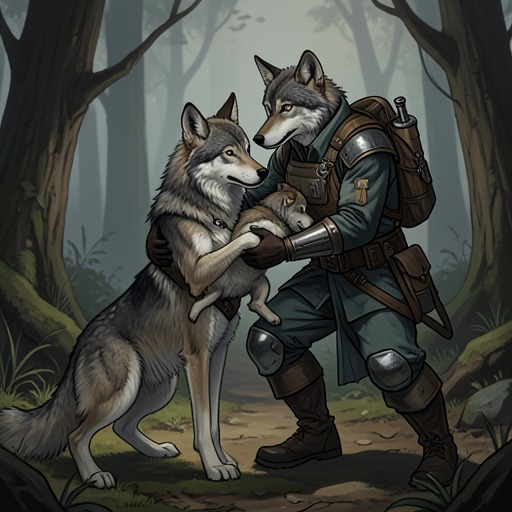
Albert intercepted the pups as they climbed the last slope toward their mother. He knocked the leading pup onto its back with his shoulder, sent it skidding down the slope, lightly nipped another, and shepherded the group back to the nursery knoll. The action transformed a scene of unruly pursuit into supervised play. Albert stayed with the pups for about an hour, repeatedly drawing them into games of chase around the nursery rather than letting them continue after Angeline.
When the pups tired, Albert did not simply withdraw. He sprawled on his back and invited them to clamber over him. They attacked his ruff, pawed sand into his face, leaped onto his belly, and bit at vulnerable parts; his thick neck fur protected him from their small teeth. He tolerated the assault until the pups had exhausted themselves and fallen asleep. Then he rose carefully, avoiding their sprawled bodies, and settled at the edge of the nursery knoll. From there he dozed, looking toward the pups every few minutes to make sure they were still nearby.
The sequence gives the care relation its clearest shape: Albert interrupts a pursuit, redirects the pups’ energy, absorbs their rough play, and remains on watch after they sleep. The narrator’s observation does not establish that Albert is their father or otherwise identify his exact place in the family. It does establish that, in this episode, the pups’ safety and company continued to occupy his attention even after the immediate play was over.
Angeline’s Departures and Albert’s Care
The episode was part of a larger pattern rather than an isolated rescue. The narrator had seen Angeline enlist Albert to look after the pups while she went down to the bay for a drink or what he then assumed was a walk. On rare occasions, George also took on that duty. A later observation sharpened the picture: Angeline nuzzled Albert until he yawned, stretched, and got to his feet, then trotted away across the muskeg, leaving him with the pups.
On that occasion, her journey was not merely a brief disappearance from the den. She waded into the icy bay until the water reached her shoulders and drank. After noticing nearby ducks, she returned to shore and performed a series of energetic movements among the rocks and grasses. The narrator watched her from a distance; Albert, seated among the pups, was also watching her, but showed no alarm. The episode makes the division of attention visible: Angeline could leave the young in Albert’s company while she attended to activity away from the nursery, and Albert remained with them as she did so.
Other observations placed these departures within the wolves’ demanding feeding routine. As summer advanced, small rodents became abundant, and the narrator eventually recognized that the Wolf House Bay wolves relied heavily on mice. He watched Angeline catch and swallow mice, while later evidence and Ootek’s explanations broadened his understanding of the wolves’ varied diet. This context helps explain why parental care was not simply a matter of one adult remaining continuously at the den: the adults’ activities beyond the nursery were part of a life organized around feeding as well as tending the young. The evidence does not assign each outing a precise purpose, but it repeatedly shows Albert present with the pups when Angeline was away.
A Shared Arrangement, Not a Solved Genealogy
The arrangement became especially apparent on the evening of June 23. Angeline and the wolves gathered for their pre-hunt vocal routine, and she sang with conspicuous intensity. George and Angeline then trotted off together, while Albert went down to the den and settled in for an all-night watch over the pups. The contrast is direct: the established pair left together, and the third adult stayed behind with the young.
This episode complements the earlier play scene. In one, Albert responded to Angeline’s call and managed an energetic brood; in the other, he took up the overnight duty after the parents departed together. His care was not limited to keeping pups from following their mother. It included remaining with them when their parents were away and accepting the work of an extended spell at the den.
The narrator’s affectionate name for Albert reflects the strength of this observed role, but it does not resolve the original mystery of his identity within the family. The account leaves that question open while making the practical relationship compellingly concrete. Angeline repeatedly entrusted the pups to him; Albert answered through supervision, play, and watchfulness. Their cooperation is presented not as a human-style declaration or a proven genealogical fact, but as a pattern legible in repeated actions and in the care that continued after the pups had fallen asleep.