Department of Mines and Resources
Never Cry WolfThe Department of Mines and Resources is the federal institution assigned to investigate the alleged threat wolves pose to other wildlife. In the book, its importance lies not simply in sending an investigator into the field, but in showing how a government inquiry can begin with a politically manufactured problem: public complaints are amplified into demands for action, contrary evidence is punished, and the costs of wildlife policy fall on animals and ecosystems rather than on the interests pressing for intervention.
Mandate and Political Pressure
The Department’s chief briefs the narrator against a backdrop of institutional ceremony: a massive desk, old groundhog skulls, and the portrait of a deceased mammalogist. The chief reports that the Department has received thirty-seven memoranda in a single year from Members of the House of Commons, reflecting constituents’ demands that the government address the wolf. The complaints are attributed largely to Fish and Game clubs and business interests, including ammunition manufacturers. Their stated concern is that hunters are returning from their trips with fewer deer and that wolves are responsible.
The book immediately places that claim beside an alternative explanation already raised within the Department. The chief’s predecessor had argued that hunters had become so numerous that they outnumbered the deer by about five to one. The Minister repeated this explanation in the House of Commons, where members denounced it; three days later, the predecessor had retired to civilian life. The Minister then announced a full-scale inquiry into the alleged damage wolves were causing. The sequence makes the investigation’s political setting part of its subject: the Department is asked to establish facts after the official who offered an unwelcome explanation has been driven out.
The Inquiry and Its Evidence
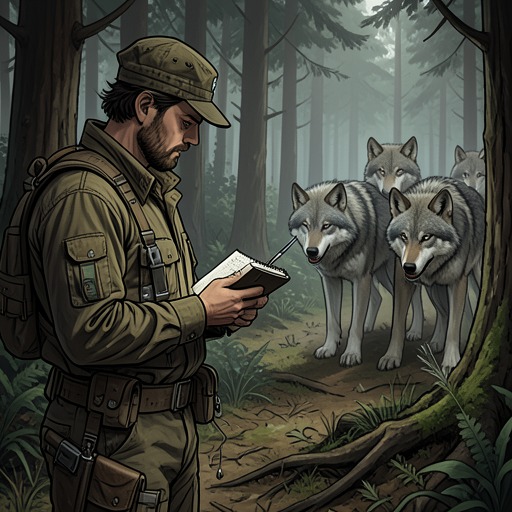
The chief assigns the narrator, addressed as Lieutenant Mowat, to go into the field and take up the wolf as his problem. The order is presented with exaggerated solemnity, as though the investigation were a mission of national security. That comic framing undercuts the grandeur of the assignment while exposing the gap between administrative urgency and the evidence behind the supposed crisis.
The field evidence also challenges the account that wolves alone explain declining caribou numbers. Mike, a trapper, explains that he kills caribou to feed his fourteen dogs and himself, and to use carcasses as bait for foxes. He estimates that his annual kill may reach two or three hundred animals. The narrator’s records show that eighteen hundred trappers operated across parts of Saskatchewan, Manitoba, and southern Keewatin within the herd’s winter range. Yet an Ottawa poll conducted through fur-trading companies had recorded trappers and traders denying that they killed more than one or two caribou a year, while blaming wolves for immense losses. The narrator’s deliberately conservative calculation still produces an estimated annual take of 112,000 caribou. The contrast exposes a serious weakness in the evidence available to public authorities: the people whose practices bear on the decline had supplied accounts that concealed the scale of their own hunting.
Government Policy and Economic Incentives
The Department’s investigation takes place within a broader pattern of government action that the book links to economic and political interests. In late 1972, despite contrary advice from its own biologists, Quebec’s Minister of Fish and Game announced a contest open to Canadian and American hunters, with a target of five thousand dead wolves. The episode illustrates how official policy could convert anti-wolf pressure into organized killing rather than treat scientific disagreement as a reason for caution.
Provincial and federal governments also offered wolf bounties, generally worth ten to thirty dollars per animal. When fur prices fell, the bounty could function as a subsidy to trappers and traders. The book describes a trapper on the Manitoba–Keewatin boundary who collected payment for 118 wolves, 107 of them young born the previous spring. Rather than kill them individually by trapping or shooting, he spread strychnine over a wide area. The poisoning also eliminated foxes, wolverines, and other small carnivores; in the account, the wolves’ bounty value remained, while the foxes had no market value that year. This example shows how incentives could produce consequences extending well beyond the species targeted by a policy.
Government involvement also appears in commercial caribou hunting. A provincial tourist bureau developed organized hunting trips intended to attract wealthy trophy hunters from the United States, sometimes using government-owned aircraft. For a fee of one thousand dollars, participants were promised a set of caribou antlers. The account describes aircraft circling herds on lake ice to gather them together while hunters fired from the plane; officials are presented as having accepted the arrangement. Here, public administration supports a lucrative hunt even as hunters’ claims about wildlife losses help sustain pressure against wolves.
Institutional Significance
The Department is both the mechanism for investigating the alleged wolf problem and part of the administrative world the book asks readers to scrutinize. The narrator’s commission gives him access to official files and field experience, but the evidence he encounters does not fit the public case against wolves. Instead, the book juxtaposes hunter complaints, concealed hunting practices, commercial incentives, and government responses to show how an inquiry’s findings can be constrained by the political conditions in which it is conducted.
That critique extends beyond the Department’s original assignment. The book describes wolves being pursued with traps and poison, and by aircraft that chase them over open ground; such methods belong to a wider campaign supported by governments through bounties and permissive policy. The Department is not identified as the direct agent of every practice described. Its narrative function is more specific: it embodies the official demand to investigate wolves while the surrounding evidence redirects attention toward human hunting, institutional pressure, and the economic uses of wildlife. The resulting tension makes the inquiry a test of whether government will follow evidence that challenges the interests behind its mandate.