Farley Mowat
Never Cry WolfFarley Mowat is both the narrator of the account and the government biologist sent north to investigate Wolves. His defining trajectory is a collision between institutional expectations and a field-based interest in living animals: the assignment begins as an official campaign against a supposed menace, but his encounters with Ootek, Mike, and the evidence surrounding Caribou complicate the premise on which the work was founded. The book presents that change not as an instant conversion but as a gradual test of what counts as knowledge.
Identity and Background
The narrative places the beginning of Mowat’s northern story far from the Barrens, in his grandmother’s bathroom in Oakville. He identifies the distance between that childhood setting and the bottom of a den in central Keewatin as a long road, while declining to recount every step along it. The opening therefore makes his eventual field assignment the destination of a personal history, not an isolated professional episode.
At university, Mowat’s interest lay in studying living animals in their own habitats. He was out of step with colleagues moving toward specialized, statistical, and analytical research, and he regarded the increasing distance from living creatures as a contradiction in the study of biology. While fellow students secured research positions in narrow specialties, he remained committed to a broader interest and found himself with no obvious place in the biological job market. The mismatch shaped his entry into government service: he did not arrive with an established specialty in Wolves, but with a preference for studying life where it occurred.
The Government Assignment
A winter summons from the Dominion Wildlife Service brought Mowat to Ottawa at a salary of one hundred and twenty dollars a month. He was ordered to report at once and complied with only a subdued sense of rebellion. His description of the scientific hierarchy stresses the obedience expected of its junior members, an expectation that becomes concrete when he reaches the Wildlife Service offices and encounters his former schoolmate, now the Chief Mammalogist, transformed by professional dignity.
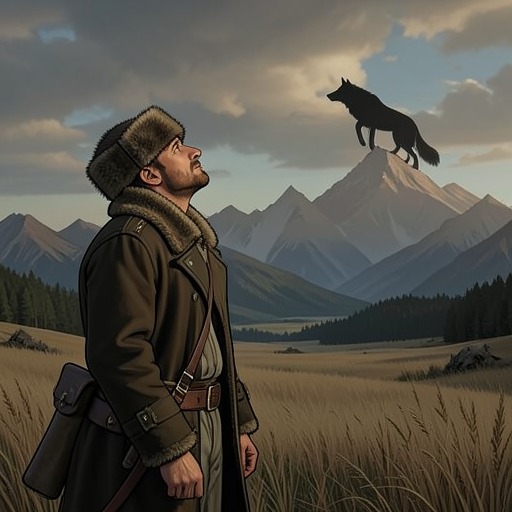
The assignment was presented as a response to the supposed devastation of the deer population by Wolves. The Minister announced a full-scale investigation, and Mowat’s chief made him responsible for the problem while rhythmically clacking the jaws of a groundhog skull. Addressed by the administrative title Lieutenant Mowat, he was told to go into the field immediately. He saluted involuntarily, fled the room, and left Ottawa that same night aboard a Canadian Air Force transport plane. Churchill, on Hudson Bay, was his immediate destination; beyond it lay his intended field of study in the subarctic Barren Lands. The abrupt departure gives the assignment the shape of a summons, while the official language has already narrowed the investigation toward a conclusion: Wolves are treated as the cause before Mowat has examined them.
Fieldwork and Evidence
Mowat’s scientific outlook is not presented as simple rejection of formal research. Rather, the account repeatedly shows him asking what can be checked. He is wary of accepting every report about Wolves without auxiliary proof, even when the source is Ootek, whose observations he comes to respect. When proof is obtainable, he finds Ootek’s information consistently right. This distinction matters to Mowat’s method: local knowledge is neither dismissed for being unfamiliar nor treated as self-validating; it is tested against what the field allows him to observe.
His encounter with the Caribou decline brings the official account into sharper conflict with practical testimony. Ottawa’s files recorded a poll of trappers and traders across the winter range of the Keewatin Caribou herd. The respondents had denied killing more than one or two Caribou a year and had blamed Wolves for slaughtering them in vast numbers. Mike, however, explained that trappers had to kill many Caribou to support their work, because dogs fed on fish became weak and sick and could not haul loads well. Mowat knew that about eighteen hundred trappers operated across parts of Saskatchewan, Manitoba, and southern Keewatin. Even after halving both the number of trappers and Mike’s reported annual kill before multiplying, he arrived at an estimate of 112,000 Caribou killed by trappers each year in the area. He recognized that such a figure could not safely appear in his reports if he wanted to avoid being sent away to study tortoise ticks in the Galapagos Islands. The calculation exposes both a possible source of pressure on Caribou and the constraints on what an official report could accommodate; it does not, by itself, settle the population question.
Ootek and Other Sources of Knowledge
The working relationship with Ootek develops through mutual interest rather than formal instruction. Mowat could not make Mike understand the importance or nature of his scientific work, but he had no comparable difficulty with Ootek, who seemed to share his conviction that the work mattered. Mowat later learned that Ootek was a minor shaman. From what Mike had told him and what he observed, Ootek had assumed that Mowat was also a shaman, though of an unfamiliar kind. The possibility that he hoped to expand his knowledge through their association remains Mowat’s speculation, not an established motive.
Ootek attached himself to the work and appeared the following day at the observation tent with his sleeping robe, prepared to stay. A few words of English, perceptiveness, and continued contact allowed the two men to establish rudimentary communication. Ootek’s personal totem was Amarok, the Wolf Being, and he considered Wolves actual relations rather than creatures defined by the hostile assumptions Mowat associates with accepted public opinion. Ootek also recounted that, at about five years old, his father had left him at a den for twenty-four hours. He played with the pups; the adult Wolves sniffed him but did not harm him. Mowat treats this account as testimony to Ootek’s experience, while distinguishing what he can verify from what he must receive through report.
That exchange extends beyond zoological observations. Ootek described the connection between Caribou and Wolves as so close that they were almost one entity, and explained it through a traditional story of the world’s creation. Mike identified the story as part of the semi-religious folklore of inland people. Mowat thus receives the account through several layers: Ootek’s telling, Mike’s contextual explanation, and his own paraphrase for readers. The story gives the animal relationship a cultural and spiritual frame that differs from the government’s language of a problem to be controlled.
Reports, Relations, and Narrative Significance
Mowat’s account of animal knowledge also includes details that he can partly confirm through observation or practice. Ootek told him about fishing by Arctic sculpins; later in the summer, Mowat watched Uncle Albert fish in that way. He did not see Wolves catch Northern pike, but after hearing Ootek describe their method, he imitated it himself, using a short spear rather than teeth to finish the catch. These episodes place Mowat between report and firsthand experience: he does not claim to witness everything, but shows how an account can direct an observation or an experiment.
A more unsettling test of communication occurs when Ootek reports that news of the Caribou moving south has passed from a wolf in the northern territory through a still more distant wolf and then reached George, who relayed it onward. The first wolf, according to the report, had not seen the Caribou itself; it was repeating information received from another. Mowat was incredulous, but Mike immediately packed for a hunting trip, willing to travel for two or three days on the report. The episode sets Mowat’s skepticism beside Mike’s practical response without claiming that the message has been independently verified in the evidence presented here.
During a later journey, Ootek raised his paddle to hail a family camp beside a river. He introduced Mowat to the family, and the visitors spent the afternoon drinking tea, talking, laughing, singing, and eating boiled Caribou. The camp had been placed near a downstream narrows where Caribou crossed; the men hoped to take enough animals with kayaks and short stabbing spears to last through winter. Ootek wanted to join the hunt and asked Mowat to stay for several days. Mowat agreed, and the next morning the three men departed. The scene shows the material setting of the knowledge Mowat is learning: hunting plans, seasonal needs, and movement across the land are part of ordinary life, not abstractions detached from people.
As a character, Mowat is defined by the widening gap between the terms of his commission and the evidence gathered through sustained contact. The government sends him to tackle Wolves as a cause of Caribou loss; his own calculations expose the relevance of trapping, while Ootek’s testimony and observed practices reveal forms of knowledge the official framing leaves out. The book’s 1973 preface extends that inquiry into public advocacy, expressing hope that organized efforts can prevent the elimination of Wolves and describing their destruction as a crime against nature. Mowat’s significance therefore lies in the link between the field investigator and the narrator who later asks readers to reconsider what the investigation was supposed to prove.