Farley Mowat–Wolf House Bay wolves
Never Cry WolfFarley Mowat’s relationship with the Wolf House Bay wolf family begins with an encounter between lived experience and a powerful inherited story about wolves. After the animals repeatedly leave him unharmed, including when he enters their home and seems to threaten their pups, he resolves to study them as they are rather than as human tradition says they must be. Their eventual recognition of his small camp as a bounded piece of territory turns observation into an unusual form of coexistence: neither friendship nor taming, but a cautious accommodation whose terms the wolves help establish.
From Fearful Expectation to Open-Minded Study
Farley Mowat’s change of outlook follows several encounters in less than a week in which he finds himself at the mercy of the animals. The contrast between what he expects and what they do is difficult to dismiss: instead of attacking him, the wolves show restraint even when he has entered their home and appears to pose a direct threat to young pups. Their conduct unsettles the familiar account of wolves as inherently savage, but it does not immediately make that account easy for him to abandon.
His resistance is partly professional and partly personal. To reject accepted beliefs about wolf nature feels like scientific disloyalty; it would also strip his mission of some of its aura of danger and adventure. More privately, accepting the evidence means admitting that animals he had treated as predictable threats have made his expectations look foolish. The relationship therefore changes first in his interpretation: the wolves have not altered their behavior to reassure him, but their repeated restraint forces him to reconsider what he thought he knew.
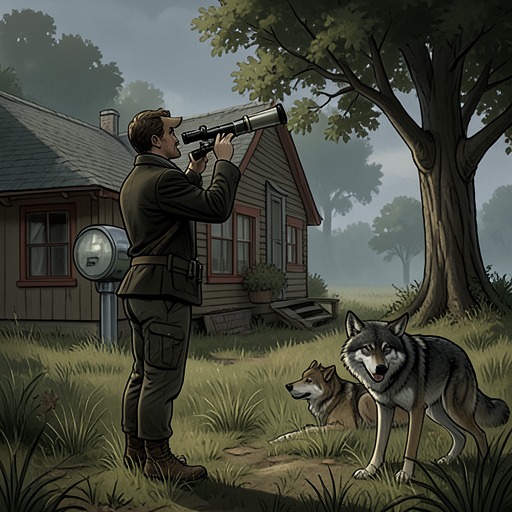
By the following morning, Farley Mowat has decided to enter the wolves’ world with an open mind and learn from what they actually do. In the weeks that follow, he puts that decision into practice by leaving Mike’s cabin and setting up a small tent on the opposite shore of the bay, near the den esker. He keeps his equipment minimal, takes no weapons, and positions a large telescope at the tent entrance so he can watch the den without leaving his sleeping bag. At first, he remains inside except for necessary trips outdoors when the wolves are out of sight, hoping the animals will accept the tent as an ordinary feature of the terrain. The precautions also reflect his awareness that he is a stranger in their habitat, not an invited participant in their lives.
Living Beside the Wolves
The wolves’ response is less dramatic than Farley Mowat’s careful preparations anticipate. His concealment proves unnecessary: they seem already to have assessed him and then largely ignore him. By accident, he has pitched his tent within ten yards of one of their main paths between the den and hunting grounds to the west. Within hours, a tired wolf returning from a night’s work approaches to within fifteen yards. A clank from the teakettle draws its attention; the animal looks briefly toward the tent and continues on its way.
That first close passage establishes the character of the relationship. Farley Mowat wants to avoid disturbing the wolves, yet their lack of interest is disconcerting to him. For the next two weeks, one or more use the track past his tent on almost every night, ordinarily showing no apparent interest in the observer. The animals do not behave as though his presence is a constant emergency, and he gradually learns that living near them depends less on attracting their attention than on understanding the patterns by which they organize their own lives.
His observations also revise his picture of the wolves as nomadic roamers. The Wolf House Bay wolf family occupies a permanent territory of more than a hundred square miles, bounded by a river on one side and marked in other directions by the wolves themselves. About once a week, the family makes a round of its lands to refresh those markers. Two other wolf families hold neighboring territories, but Farley Mowat sees no evidence of disputes between them; he suspects the regular boundary tour is largely ritual. The wolves’ range is not an empty wilderness without social limits. It is an organized estate, and his own camp lies within it.
The Camp Becomes a Recognized Enclave
Once Farley Mowat understands the importance of territory, he tries to use that knowledge to make the wolves acknowledge him. After they leave for their nightly hunt, he lays claim to roughly three acres around his tent, including a hundred-yard stretch of their path. He marks stones, moss clumps, and vegetation at intervals of no more than fifteen feet, a labor that occupies much of the night and requires frequent returns to his tent for tea. The attempt is not simply to hide within the wolves’ range; it is a deliberate effort to communicate, in a form he has observed them using, that this small area is his.
At 8:14 the next morning, the leading male returns along the trail and stops where Farley Mowat’s boundary meets it. The wolf sniffs a marked bush, withdraws a few yards, and sits before finally looking directly at the tent and its occupant. Farley Mowat has achieved his immediate aim, but the attention he has sought now makes him wonder whether, through ignorance, he has violated an important wolf rule. He has no weapon, and the prolonged look from the wolf leaves him increasingly uneasy.
The wolf then inspects the claimed area. At each marker it sniffs and places its own mark just outside Farley Mowat’s line, completing the circuit in about fifteen minutes. The animal’s measured response gives the encounter its practical outcome: it does not simply ignore the human boundary or drive him away, but marks the other side of it. Farley Mowat recognizes that his own marking has been inefficient; the wolf completes the task economically and without interruption. Their exchange establishes a limit that is legible to both parties, though in different ways.
After the wolves have formally accepted the enclave, it remains inviolate. They do not again cross into Farley Mowat’s domain. Occasionally a passing wolf refreshes a marker on its side of the boundary, and he follows suit as best he can. His lingering doubts about personal safety recede, allowing him to devote his attention to observation. He records a regular but flexible pattern: males leave for the hunt sometime between four and seven in the evening, range within the family territory as far as he can tell, and normally travel thirty or forty miles before dawn. In daylight they sleep in short intervals, waking briefly between naps. Such details mark the change from anxious proximity to sustained study: the wolves’ routines, not his fears, increasingly organize his understanding of them.
Observation Against the Wolf Myth
The relationship remains one of distance and attention, not sentimental intimacy. Farley Mowat does not describe the Wolf House Bay wolf family as domesticated, nor does the boundary agreement erase the fact that he is an outsider in their range. Its significance lies instead in the animals’ apparent capacity to assess his presence and respond without the indiscriminate aggression that human accounts predict. Their treatment of his camp makes coexistence possible, while their independent routines keep the limits of that coexistence clear.
Farley Mowat’s observations stand in sharp contrast to the public fear illustrated by the 1946 wolf panic in Churchill. During a period of scarcity and rabies, a sick wolf was reported by a Canadian Army corporal as a grave threat. The report prompted American and Canadian military contingents to mobilize armed search parties; during the ensuing excitement, eleven Husky dogs, an American private, and a Chippewayan Indian became casualties of the vigilantes. A wolf reported from an Army aircraft on the second day proved to be a cocker spaniel belonging to the Hudson’s Bay Company manager. On the third day, a truck accidentally killed the sick wolf, which had become too ill to move.
The aftermath shows how an episode can acquire a scale and character far beyond what its events support. Residents continued to recount an invasion involving desperate encounters, attacks on women and children, and a community under siege. Farley Mowat’s close observations at Wolf House Bay offer a counterweight to that expanding story: instead of treating every wolf as a single, timeless threat, he attends to particular animals, their territories, their ordinary movements, and the circumstances in which danger actually arises. His relationship with the family thus becomes part of his method. The boundary he marks does more than protect a campsite; it embodies a shift from imposing a legend on wolves to learning how to live, carefully and observantly, alongside them.