George
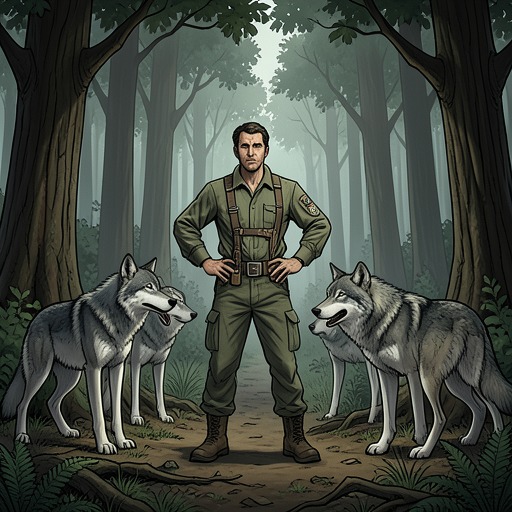
Never Cry WolfGeorge is the silver-white father of the wolf family the narrator observes, a large, attentive animal whose conduct repeatedly complicates human assumptions about wolves. Initially recorded in the field notebook as Wolf A, he acquires his name as the narrator comes to recognize his individual character. Across encounters at the den, on the tundra, and near the narrator’s camp, George appears not as a faceless predator but as a member of a family: dignified, affectionate, watchful, and capable of both measured hunting and playful interaction.
Identity and Characterization
The narrator names the father George because he recalls a prominent figure for whom he had served during the war. The name marks a shift in method as well as feeling: the notebook’s impersonal Wolf A gives way to an individual whose habits and relationships the observer can distinguish. The narrator describes George as massive, about a third larger than his mate, with a silver-white coat and a commanding presence. His size, however, is not the whole of his authority. The account stresses his conscientious attention to others, thoughtfulness, and affection within the family, presenting him as an unusually compelling example of fatherhood.
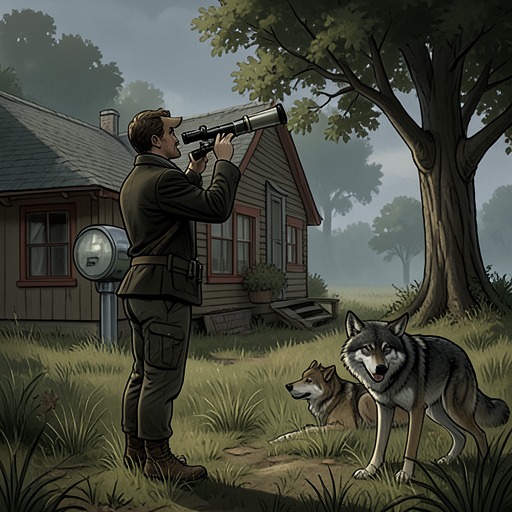
That portrait develops through observation rather than a single dramatic encounter. The narrator watches George’s routines, interactions, and responses in changing circumstances, while also acknowledging the limits of what can be known from a distance. On an early visit to the den, the narrator chose a concealed observation point roughly four hundred yards away, with the wind blowing from the wolves toward him. Despite careful fieldcraft, he initially saw no wolves through his powerful telescope. The empty view reminded him that his research plans depended on the animals’ movements and that the open, immense landscape gave him little control over whether he could observe them at all. George’s later recognizability therefore grows out of patience and repeated attention, not immediate access.
Establishing a Boundary with the Observer
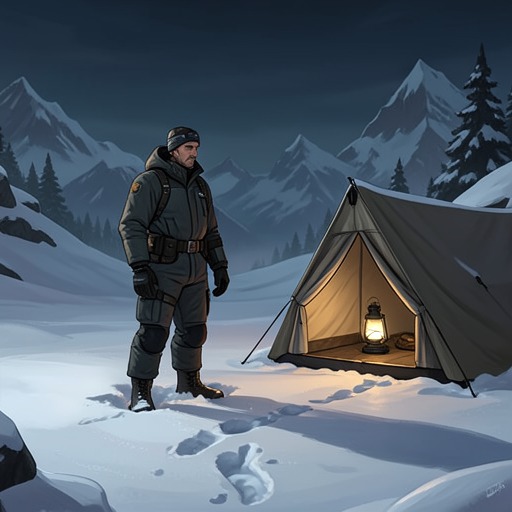
The narrator eventually tries to make the wolves acknowledge his presence by adopting their apparent concern with territorial boundaries. After the animals leave on their nightly hunt, he marks out a claim of about three acres around his tent, including a stretch of their path. He places marks on stones, moss, and vegetation at intervals of no more than fifteen feet, a task that occupies most of the night. At 8:14 the next morning, George returns along the trail. He has previously passed without paying the tent much attention, but this time he stops exactly where the marked boundary intersects his route.
From about fifty yards away, the narrator watches George sniff one of the marked bushes, withdraw a few yards, and sit. After a pause, George looks directly toward the tent and the observer. The narrator takes this sustained, considering attention as evidence that his aim has succeeded: at least one wolf has registered his existence. Yet the moment also reverses the direction of observation. The narrator has arranged himself to watch George, but George’s gaze makes the human presence part of the scene. The narrator wonders whether he has breached an important rule he does not understand and regrets being without a weapon. The passage keeps that fear within the observer’s perspective; it does not establish that George intends to attack.
Family Life and Relationships
George’s relationship with Angeline is presented as a stable, affectionate pair bond. The narrator sees the two greet each other with evident pleasure after even short separations and reports no observed quarrels. Their restraint outside the brief breeding period, which the narrator places early in spring, contrasts with the common reputation of wolves as promiscuous. Mike later tells him that George and Angeline had been together for at least five years. The narrator also learns that local Inuit knew the wolves as familiar individuals and regarded them highly; the den site had been known for decades, with generations of wolves raising families there.
George’s position as father is visible in everyday care as well as in the narrator’s broader characterization. He shares the family’s territory with Angeline, the pups, and Uncle Albert, whose presence initially puzzles the observer. The family’s organization is not immediately legible to him: he first sees three adult wolves and wonders how the apparent group of parents and pups can account for an additional adult. Further observation gradually replaces that uncertainty with a picture of shared family life. George’s place within it is not simply that of the largest animal; he is one of the adults whose conduct helps sustain the group.
The narrator also sees George and Albert together in a scene that briefly appears threatening. Albert, after fishing for sculpins, falls asleep before returning to his resting place on the ridge. George has watched him from a distance, then approaches with deliberate changes in pace and posture. When he is close, George crouches and edges nearer; finally he springs toward the sleeping wolf with a sudden display that startles him awake. The narrator initially fears that family harmony has broken down, but the episode is presented as a startling interaction rather than evidence of a lethal conflict. Its importance lies in how easily the observer’s incomplete knowledge can turn an unfamiliar action into an alarming story.
Hunting, Communication, and the Family’s Work
George’s movements also help the narrator understand how wolves select prey. In hunts he observes, wolves commonly travel at an unhurried pace among caribou, sometimes making short tests of nearby animals and then stopping if the deer run strongly. The narrator concludes that the wolves do not waste effort pursuing animals they are unlikely to catch: prime-condition bucks are seldom tested, while mixed groups that include fawns offer different possibilities. He also learns from Ootek that the wolves stop hunting after a kill until the food is gone. Together, these observations challenge the idea that wolves kill indiscriminately or hunt from an insatiable bloodlust.
On one occasion, George is the only wolf who seems eager to act while the rest of the family rests beside passing caribou. He wanders along a ridge, approaches Angeline repeatedly, and eventually gets her to rise and follow. The other adults, including Uncle Albert and an unfamiliar gray wolf, respond as well, and the pups join the gathering. The adults howl together before Angeline and two other wolves set out, while George remains with the pups. When a youngster tries to follow, George turns it back toward its littermates. The scene presents the hunt as coordinated family activity, with George’s actions connecting the adults’ departure to the pups’ staying behind.
George’s hearing offers another indication of communication beyond the narrator’s immediate senses. Before Ootek arrives, the observer has recorded numerous kinds of wolf vocalizations but lacks evidence that distant calls carry more than simple signals. During a still day at the den, Ootek listens toward hills about five miles to the north and says that wolves are talking. The narrator hears only mosquitoes. George, however, wakes, points his ears and muzzle north, then gives a long, rising howl. Ootek interprets the exchange as news that caribou are coming. The narrator cannot hear the originating call, so the scene distinguishes what he directly observes from the meaning Ootek assigns to it; George’s response nonetheless makes the distant communication consequential to the family.
The Observer’s Changing Perspective
The narrator’s account of George records a movement from classification toward recognition. George begins as an entry in a field notebook and becomes a particular animal whose family bonds, attentiveness, and patterns of action shape the research itself. The narrator’s careful logs, observation distances, and repeated watches remain important, but they do not make the wolves fully transparent. He must interpret pauses, howls, and approaches without always knowing what prompted them. The difference between a visible action and an inferred meaning remains part of the story of George.
At the close of the narrator’s time in the north, a wolf howls to the east. He recognizes the voice as George’s and understands it as a call searching for missing members of the family. The sound also recalls the natural world the narrator had glimpsed during his summer with the wolves, a world from which he now feels excluded. George’s last appearance in this account is therefore neither a confirmed death nor a reunion, but a continuing search heard at a distance. The individual whom the observer once watched from concealment becomes, in the ending, the voice that measures the narrator’s separation from the family and from the world he had nearly entered.