George and Angeline’s Pair Bond
Never Cry WolfGeorge and Angeline’s Pair Bond stands out in Farley Mowat’s account as both a lasting partnership and a challenge to familiar human assumptions about wolves. He describes the two as affectionate and devoted, raising a family together; later information from Mike indicated they had been together for at least five years. Their observed conduct, set beside Mowat’s account of wolf mating patterns, replaces the image of indiscriminate promiscuity with one of enduring pair attachment.
Identity and Observation
Mowat’s understanding of the relationship developed through repeated observation of the wolf family near its den. He approached an observation point roughly four hundred yards away, using a telescope while remaining concealed. This distance and the limits of what he could see matter: his account distinguishes visible conduct, such as the wolves’ reunions, from conclusions about the duration and structure of their partnership.
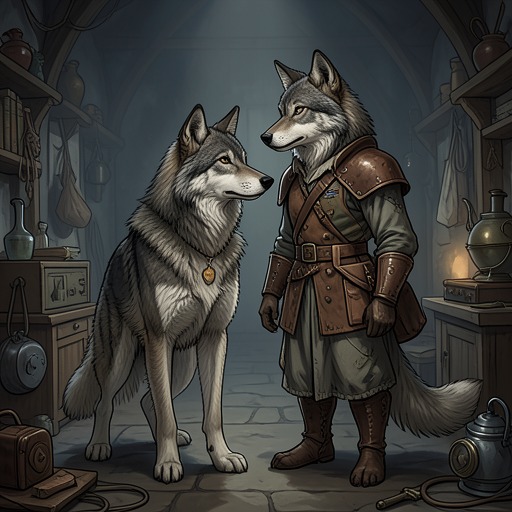
He came to know the adult wolves as individuals rather than leaving them as anonymous entries in his field notes. George, the family’s silver-white male, appeared markedly larger than Angeline and carried himself with what Mowat read as regal assurance. Angeline was slimmer, nearly white, and recognizable by the thick ruff around her face. Mowat’s names and character sketches express a growing personal attachment, but the pair bond is not based only on those descriptions; he also records how the two behaved toward each other.
Conduct as a Pair
Mowat regarded George and Angeline as an unusually devoted mated pair. He did not observe them quarrelling, and he noted that they greeted each other warmly even after short separations. Their affection was visible in those reunions as well as in their continuing life together. The qualification is important: this was a naturalist’s account of what he could observe, not a claim to know every aspect of their relationship.
Their family life also placed the partnership within a wider pattern of shared care. Angeline could leave the den while another adult remained with the pups; Mowat had seen Uncle Albert, and on occasion George, take on that role. The record therefore shows a family in which care was not confined to the mother, while still identifying George and Angeline as the established mating pair. The presence of a third adult initially puzzled Mowat, who wondered whether the family might contain an “eternal triangle”; the observations supplied here do not establish that interpretation, and he does not treat Uncle Albert as Angeline’s mate.
Duration and Reproductive Pattern
Mowat’s field observations alone could not tell him how long George and Angeline had been together. Mike later supplied a longer perspective, saying that the pair had been together for at least five years. Mowat compared that span with human longevity, estimating it as the equivalent of about thirty human years. The comparison gives scale to the relationship without suggesting that its meaning can be measured by human time alone.
Mowat situates their partnership within a sharply limited annual breeding period. He understood physical mating to occur only during two or three weeks early in spring, usually in March, and recorded that females did not breed before their second year. In his account, a female mated with a single male and the pair remained together for life. These details frame the bond not as continual reproductive activity but as a durable association whose breeding season occupies only a brief part of the year.
Community, Reputation, and Significance
The pair belonged to a family and a place with a history beyond Mowat’s own period of study. Mike and local people recognized wolves in the area as familiar individuals. Mowat reported that local people held these wolves in such regard that they would not have thought of killing or injuring them. The den site, too, was known for some forty or fifty years, through generations of wolves raising families there. George and Angeline’s partnership thus appears within a continuing local history, not as an isolated encounter observed by a visiting researcher.
Mowat sets the wolves’ reported lifelong monogamy against the human reputation for promiscuity that people had attached to them. He regarded that reputation as hypocritical when compared with the pair’s enduring attachment. His account does not make the wolves a simple moral lesson: he notes the limits of his knowledge and admits that he could not determine exactly how long they had been together. But the contrast is decisive. By recording their affection, reunions, and shared family life, he gives George and Angeline a relationship that cannot be reduced to the caricature of the wolf as promiscuous or merely instinct-driven.