Gray wolf
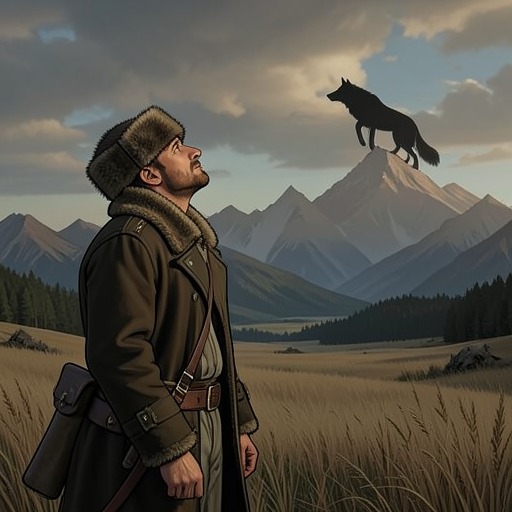
Never Cry WolfThe Gray wolf in Never Cry Wolf emerges as a real animal obscured by an inherited legend: not simply a powerful hunter of large game, but a territorial, social, and resourceful predator whose diet can shift with local conditions. Mowat’s account moves from a fearsome textbook description to observations of the Wolf House Bay wolf family hunting mice and testimony about wolves fishing. That change in perspective also overturns the book’s original design: what began as a satire of bureaucracy became a plea for understanding and preserving an animal threatened by human hostility.
Identity and the inherited image
The book identifies the Arctic wolf as a race of Canis lupus and describes it, through a scientific reference work available to Mowat, as the largest of the wolf races. That source reports specimens weighing 170 pounds, measuring eight feet seven inches from nose to tail, and standing 42 inches at the shoulder; it also says an adult could eat 30 pounds of raw meat at one sitting. Its description of the wolf as a powerful killer, feared and hated by people, supplies the conventional image that Mowat brings into the field. The book presents those measurements and judgments as what the reference work told him, not as the end of his inquiry.
The public image of the Gray wolf has consequences beyond individual fear. In his account of the government’s response to complaints about declining deer, Mowat describes pressure from Members of Parliament, hunting clubs, and ammunition manufacturers, all supporting the claim that wolves were killing the deer. His chief recounts that a predecessor had argued that hunters outnumbered deer by about five to one; after the Minister repeated that explanation in Parliament and was shouted down, the predecessor retired and the government promised a full investigation into wolf-caused losses. The episode shows how readily the wolf could be made the official culprit, even when an alternative explanation had been put forward.
The preface places this hostility against the danger of extinction. In 1973, Mowat wrote that several North American wolf races, including the plains wolf, Gray wolf, and red wolf, were virtually extinct. He estimated that no more than 1,200 wolves remained in the continental United States outside Alaska, with about 500 in northern Minnesota, and noted a state proposal to kill 200 wolves a year there. He also connected the declining security of Canadian wolves to hunters’ increasing access to remote country by light aircraft and snowmobile. The book’s concern is therefore not only how people misunderstand the wolf, but how that misunderstanding licenses its destruction.
Territory and social life
The Gray wolf’s life in Mowat’s field account contradicts the idea that wolves are simply nomadic wanderers. After observing the nearby animals, he concludes that the Wolf House Bay wolf family occupied a permanent territory of more than 100 square miles. A river formed one boundary; elsewhere the limits were not marked by major landscape features, but the wolves regularly made rounds and refreshed their scent markers. Their neighboring territories abutted, yet Mowat found no evidence of disputes between the families. He understood the rounds as a repeated, possibly ritual, observance of boundaries rather than proof of constant conflict.
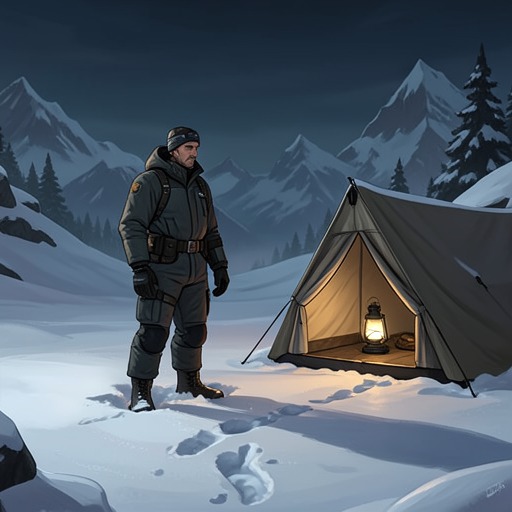
The animals’ regular use of a path near Mowat’s tent further complicates the expectation of a direct confrontation. For two weeks, one or more wolves passed almost nightly and, except on one occasion, showed little interest in him. Their apparent indifference is important to the contrast between the animal’s reputation and its observed conduct: the wolves shared their surroundings with a human observer without making him the focus of their movements.
Mowat also records a wide vocal repertoire among George, Angeline, and Uncle Albert: howls, wails, quavers, whines, grunts, growls, yips, and barks, with variations he could hear but not adequately describe. He noticed that individual wolves seemed to respond intelligently to sounds made by other wolves, although he could not establish what those sounds conveyed. Ootek, whom Mowat describes as a skilled naturalist, appeared able to understand wolf communication. The account thus distinguishes Mowat’s observations from the greater interpretive confidence attributed to Ootek rather than treating every vocalization as fully understood.
A flexible place in the food web
The mystery that prompts Mowat to reconsider wolf behavior is practical: the male wolves leave to hunt each night and return in the morning, but he does not see them carrying prey, while the animals seem well fed. His first attempt to help, baking five loaves of bread and leaving them on a hunting path, fails; he suspects Uncle Albert may have treated them as boundary markers. The unanswered question becomes more striking as rodents multiply around the cabin. Lemmings, red-backed mice, and meadow mice invade the supplies and sleeping gear; one meadow mouse gives birth to eleven young inside the pillow of Mowat’s sleeping bag.
Angeline provides the decisive clue. Mowat watches her hunting across grassy muskeg, where she repeatedly springs down on unseen prey. After several successful pounces, he sees her catch and swallow a mouse. At first he takes the behavior for amusement or snacking, but counts about 23 mice in the space of the hunt and recognizes that the prey amounts to a substantial meal. He eventually concludes that the Wolf House Bay wolf family, and by inference other Barren Land wolves raising families outside the summer caribou range, live largely or almost entirely on mice. His earlier assumptions had made this possibility seem absurd; the observed abundance of rodents and Angeline’s repeated catches make it a more persuasive explanation than the unseen large-game kills he had expected.
Mowat does not solve how the wolves bring small prey back to the den until Ootek explains it. The wolves carry their catch internally: when George or Uncle Albert returns from hunting, he goes straight into the den and regurgitates food for the pups. This detail connects the wolves’ hunting behavior to family care and explains how small prey can support animals that do not carry visible loads home.
Ootek broadens the account beyond mice. He says wolves also eat many ground squirrels, sometimes seeming to prefer them to caribou. In summer, a ground squirrel may weigh as much as two pounds, and Ootek’s explanation emphasizes the lower effort involved in catching enough of these animals for a meal compared with hunting caribou. Wolves also take fish. Ootek reports watching them drive Northern pike through narrowing marsh channels and block their escape toward open water; on one occasion, a wolf caught seven large pike in less than an hour. He also describes wolves taking suckers during spawning runs by waiting beside shallow streams and snatching fish as they passed.
The account makes the basis for these claims clear. Some of the evidence comes from Mowat’s own observation, some from Ootek’s reports, and some from analysis of wolf droppings. In the analyzed samples, about 48 percent contained rodent remains, largely teeth and fur. Other identifiable material included caribou bones and hair, a few bird feathers, and a corroded brass button bearing a merchant-navy-style anchor-and-cable design. Mowat says he could not explain the button’s presence and cautions against treating it as evidence that a wolf had eaten a sailor. The mixture of evidence supports a varied diet without making every unexplained trace into a story.
Narrative and ecological significance
The Gray wolf’s narrative importance rests on the distance between reputation and evidence. The reference book presents a formidable predator; the field account shows wolves whose food includes small rodents and fish, whose boundaries are maintained through regular rounds, and whose hunting supports the pups at the den. These details do not deny that wolves hunt caribou. Instead, they show why an account of wolf ecology cannot be reduced to the claim that wolves kill large game, still less to the political accusation that they are responsible for every decline in deer or caribou.
That revision changes the book’s purpose. Mowat says that he began with the intention of making the wolf a secondary figure in a satire of bureaucracy, but became increasingly absorbed by the animal. The Gray wolf takes over the narrative, turning the book into an appeal for understanding and preservation. Its independent habits and varied food sources matter in their own right, while the human story exposes how received beliefs can overrule observation. The animal first appears as a symbol in a public dispute; it becomes the subject of a field inquiry whose accumulating evidence makes the legend harder to sustain.