Human Estrangement from the Lost Natural World
Never Cry WolfHuman estrangement from the lost natural world names a central reversal in Farley Mowat’s account: the Barrens first make human beings seem like minor visitors in an animal country, but the narrator ultimately recognizes that his own fear and human ego keep him from fully belonging there. The separation is ecological as well as emotional. Wolves and caribou inhabit a shared world of dependence and communication, while human institutions and habits of thought turn animals into threats, resources, or objects of study.
A Country Not Governed by People
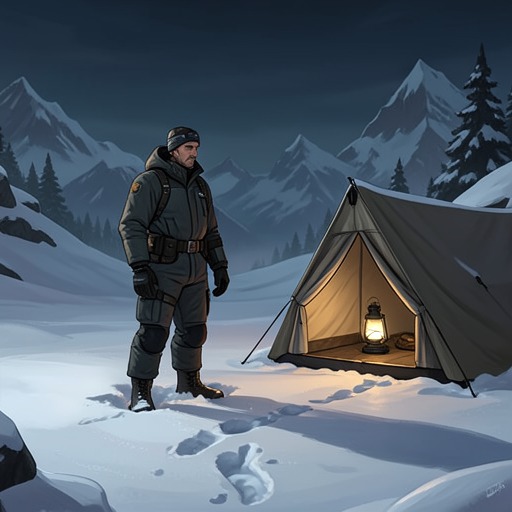
During weeks of travel across the tundra, Farley Mowat and Ootek camp in the territories of different wolf families, staying long enough to become acquainted with each group. Caribou, gulls, and ravens animate the immense landscape. The narrator describes the humans not as its owners but as casual, insignificant intruders: the country belongs to its animals and smaller creatures. That change in scale unsettles the ordinary assumption that wilderness exists chiefly as a setting for human activity.
The account also places this temporary human presence beside a longer history of displacement. The inland people had once lived in this country in harmony with it, but had almost vanished; Ootek’s group, numbering forty, was described as the last of them, nearly swallowed by the wilderness. The passage does not explain the causes of their disappearance. Its emphasis is instead on the contrast between a human community with a relationship to the land and the narrator, who enters as a visitor and cannot presume that relationship for himself.
A meeting with one of Ootek’s families makes subsistence part of this landscape rather than an abstract idea. The family has camped near a river narrows where caribou cross, hoping to take enough animals for winter. The men use one-person kayaks and short spears; Ootek wants to join their hunt and asks the narrator to stay while he helps. The scene places human dependence on caribou beside the animals’ presence in the land, complicating any simple division between a natural world untouched by people and human life outside it.
Ootek’s Knowledge and Animal Kinship
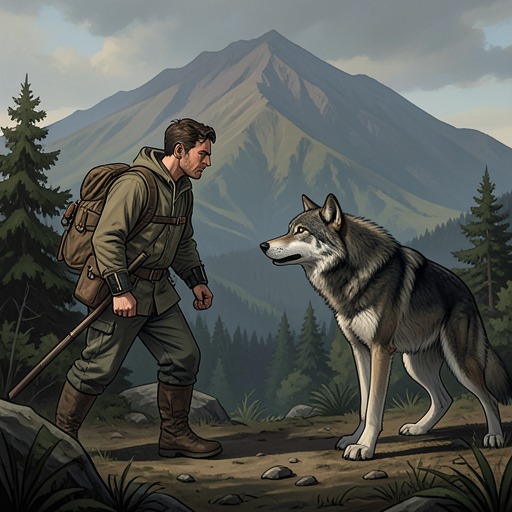
Ootek’s relation to the wolves differs from the narrator’s scientific approach. He treats them as actual relations, not as beasts defined by the hostile misconceptions common in the narrator’s society. As a child of about five, Ootek had been taken by his father, a respected shaman, to a wolf den and left there for twenty-four hours. He played with the pups; the adult wolves sniffed him but did not molest him. The episode grounds his sense of kinship in a remembered encounter, rather than making it merely a symbolic claim.
Their work together also requires trust across differences in knowledge. Ootek assumes that the narrator is a kind of shaman, and although he may not understand the scientific work, he accepts that it matters. The narrator, in turn, does not accept every account without evidence; he says that when proof can be obtained, Ootek is invariably right. This qualification matters: the book presents knowledge as formed through observation, communication, and relationship, rather than treating Ootek’s understanding as a claim that all must accept without testing.
Ootek explains the connection between wolf and caribou as so close that the two are almost one entity. He introduces an inland religious tale in which the caribou is described as the greatest gift and the sustenance of human beings. The account joins three lives—human, wolf, and caribou—through dependence, instead of placing people outside an animal world they merely observe. The narrator’s understanding of wolves is enlarged when he listens to this account, even as he continues to distinguish what he has witnessed from what he has been told.
That distinction becomes visible when Ootek reports that wolves have relayed news of caribou moving south, information passed from one wolf territory to another and then conveyed by George. The narrator remains incredulous, but Mike accepts the report sufficiently to pack for a hunting trip. Their different responses show how knowledge of the land may circulate through relationships that the outsider does not yet understand. The account establishes what Ootek says and how the men react; it does not require the narrator to claim that he has independently verified every part of the report.
Dependence, Denial, and Blame
Human estrangement also appears in the distance between reported hunting practices and official explanations for the declining Keewatin caribou herd. Mike describes trappers killing caribou because the animals provide food for people and working dogs; fish, he says, leave dogs weak and sick and unable to haul loads as well. His explanation makes the hunt a practical condition of life on the Barrens, not a remote statistic.
Farley Mowat sets that account against the Ottawa poll of trappers and traders. There were eighteen hundred trappers across parts of Saskatchewan, Manitoba, and southern Keewatin that formed the herd’s winter range. The respondents, without exception, said they killed only one or two caribou a year and blamed wolves for slaughtering the animals in vast numbers. Using deliberately conservative assumptions—halving both the number of trappers and Mike’s annual kill—the narrator repeatedly calculated an annual total of 112,000 caribou killed by trappers in the area. He judged the figure unusable in his reports, joking that presenting it might get him sent to the Galapagos Islands to study tortoise ticks. The contrast exposes how people can depend on caribou while denying the scale of their own effect and assigning responsibility to wolves.
The book’s final institutional image extends that contrast beyond the narrator’s personal experience. In the winter of 1958–1959, the Canadian Wildlife Service employed Predator Control officers to patrol the Keewatin Barrens in ski-equipped aircraft and set out poison bait stations as part of its continuing wolf-control policy. The account specifies the operation, not its results. Its placement nevertheless sets organized intervention against the earlier picture of a country in which humans were insignificant intruders and animals belonged in their own right.
Fear and the Lost World
The narrator’s last recognition of his separation comes when he sees Angeline and one of her pups at the back of a den, motionless after taking refuge from an aircraft. He retreats from the entrance expecting the wolves to charge, but encounters no movement from them. Once outside, he recognizes that his anger at the wolves is resentment born of fear: their having terrified him has affronted his human ego. The scene turns the idea of estrangement inward. The immediate barrier is not simply distance from the animals; it is the narrator’s reflex to take their fear as an insult to human authority.
As his anger fades, Farley Mowat is ashamed that he has so readily forgotten what the summer among the wolves had taught him about them and about himself. He thinks of Angeline and her pup sheltering from the aircraft, and his own reaction makes the failure of that learning newly plain. The contrast is not between a perfect observer and an imperfect natural world, but between a relationship the narrator had almost entered and the fear-driven self that withdraws from it.
A howl from the east gives the final separation a voice. The narrator recognizes George, calling across the wasteland for the missing members of his family. For him, the sound speaks of a lost world once shared with human beings, a world he had glimpsed but from which he is excluded by his own actions. That ending gathers the book’s ecological and personal strands together: the wolf’s call belongs to an ongoing family life, while the human listener can only recognize the boundary he has failed to cross. Estrangement is thus not presented as proof that the natural world is empty of meaning, but as a loss produced by the human decision to assume an alien role within it.