Husky dogs
Never Cry WolfHusky dogs are both the practical working companions of Mike’s life on the Barren Lands and a point of comparison that sharpens Farley Mowat’s study of wolves. Their first appearance corrects Mowat’s mistaken expectation of a wolf encounter; later, the return of Mike’s dog team brings Kooa into a deliberate experiment with the wild wolves. The account stresses that Huskies are not semi-domesticated wolves, even as it explores the possibility of mating between them.
Identity and Distinction
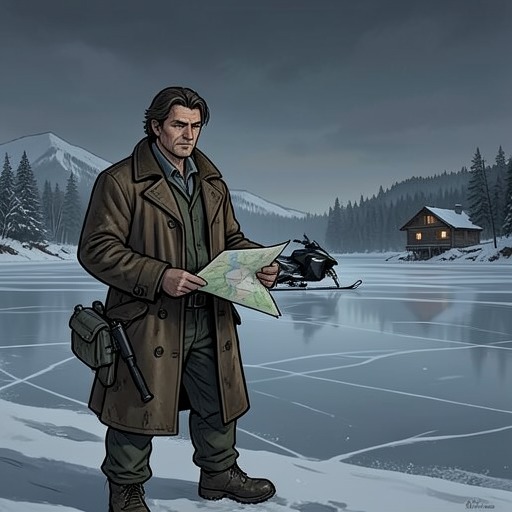
The dogs that Mowat first encounters are a team of fourteen large, formidable Huskies gathered around Mike. From beneath a canoe, Mowat initially sees a mass of wolf feet; when he looks up, the animal he expected to find is instead a young man in caribou furs, surrounded by his dogs. The correction is immediate and emphatic: there is not a bona fide wolf in sight. The scene makes the Husky team more than a detail of the landscape. It is the first living evidence that Mowat’s interpretation of what he sees can be wrong, and that the boundary between the wolves he has come to study and the dogs he meets must be observed rather than assumed.
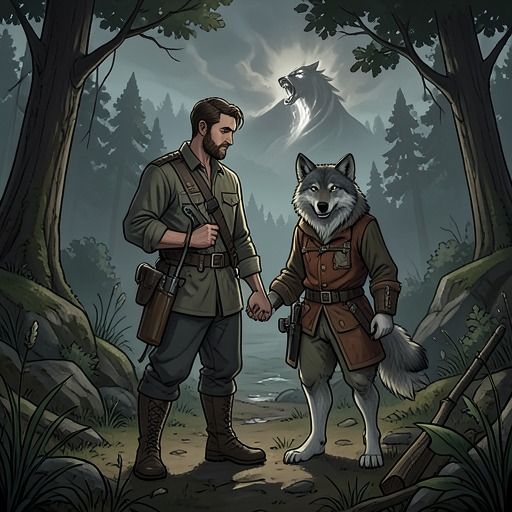
The narrative describes Mike’s dogs as being of aboriginal stock and as magnificent animals, but explicitly rejects the claim that Eskimo dogs are merely semi-domesticated wolves. Huskies are smaller than wolves, yet more heavily built, with broad chests, shorter necks, and bushy tails that curl over their backs. The account allows that the two species may have sprung from a common ancestry, while keeping their present physical differences clear. Their resemblance does not erase their distinction.
Work, Movement, and Seasonal Return
Mike’s team is essential to life across the immense, sparsely inhabited region. After meeting Mowat, Mike takes him to his cabin, and the dogs help move the scientist’s supplies and equipment there. Mowat has brought a large load that would be at risk when the lake ice melts; the dogs’ labor makes the cabin a workable base for his study. Their contribution is practical, but it also places them within the human arrangements that make prolonged observation of the wolves possible.
The team’s presence near the cabin is governed by food and seasonal movement. When Mike leaves shortly after Mowat’s arrival, he takes all the dogs with him. Mowat initially suspects that Mike wants them away from his scalpels, but the actual reason is that the caribou are absent and there is not enough food for the team. Throughout June the dogs remain with the Eskimos, whose camps are in the caribou’s summer territory. When the caribou begin returning south, the person who has been keeping the team brings the dogs back. Their return follows the movement of the animals on which their feeding depends; it also sets the conditions for Mowat’s next use of them.
Kooa and the Wolf–Dog Experiment
One of the returning bitches, Kooa, is coming into heat. Her condition soon creates an uproar among Mike’s team and gives Mowat an opportunity to investigate a gap in his observations: the wild wolves’ sexual life. He has not witnessed their mating, and following them during their brief March breeding season, when they range with the caribou herds, would be difficult. What he has learned from Mike and Ootek is that wolves may mate with dogs, and dogs with wolves, when circumstances permit. The dogs are usually tied up except when working, so such opportunities are uncommon.
Mike agrees to Mowat’s proposal and is himself interested in what kind of sled dogs a wolf–Husky cross might produce. Mowat plans the trial in stages, beginning with Kooa’s introduction to the wolves’ territory. He takes her around the new observation site so that the wolves can encounter her presence and scent. At a wolf trail she becomes so eager that Mowat has difficulty restraining her with a heavy chain leash; she plunges down the trail, sniffing the markers.
For the next stage, Mowat and Ootek set up a length of heavy wire between two rocks, about fifty feet apart and roughly a hundred yards beyond the observation tent toward the summer den. They lead Kooa to the site and shackle her chain to the wire. The arrangement gives her room to move while allowing the observers to control her position from the tent if anything goes wrong. Kooa settles down and sleeps for much of the afternoon. No adult wolves are visible near the den, though the pups occasionally appear on the grassy patch, leaping and pouncing after mice. At about half past eight that evening, the wolves begin their pre-hunting song while remaining out of sight behind a ridge. The episode establishes the carefully arranged circumstances of the experiment without, in these scenes, resolving its outcome.
Narrative and Ecological Significance
The Husky dogs occupy an intermediate position in Mowat’s account: they are familiar domestic working animals, yet their resemblance and possible reproductive connection to wolves make the distinction between the species a question for observation. Their anatomy, behavior, and seasonal breeding patterns are not interchangeable with those of the wild animals. In particular, the account contrasts Husky bitches, which may come into heat at any time of year, with wolves whose mating season is brief and tied to their movements with the caribou.
The dogs’ appearances also connect human livelihood to the rhythms of the Barren Lands. The team moves supplies, leaves when caribou are unavailable, stays with camps in the caribou’s summer range, and returns as the caribou come south. Through Kooa, that working relationship becomes part of Mowat’s field research. The dogs are not simply a backdrop to his study: their needs shape when they are present, their movements make observation possible, and their closeness to wolves raises questions that Mowat must approach through controlled, cautious encounters.