Interdepartmental Nonquestioning Policy
Never Cry WolfThe Interdepartmental Nonquestioning Policy is the narrator’s account of a bureaucratic rule that treated information from another department as beyond challenge. Its practical effect was to separate official certainty from conditions in the field: when instructions based on that certainty failed, responsibility fell on the employee expected to carry them out. In Farley Mowat’s case, the rule turned a mistaken forecast about ice into an operational crisis and exposed how administrative procedure could protect its assumptions while burdening its field staff.
Institutional Rule and Administrative Culture
The narrator learned the rule during his orientation at the Dominion Wildlife Service. The process had already left him unimpressed by the department’s gloomy offices, data compilation, and internal memoranda; it also taught him that the bureaucratic hierarchy in Ottawa demanded unusually strict deference. The nonquestioning principle extended that deference across departmental boundaries: information originating elsewhere was not to be disputed. If a field operation failed because it relied on such information, the fault was assigned to the person in the field.
The principle is presented as an operating norm learned by an employee, not as a quoted statute or a carefully defined formal regulation. Its force lies in the consequences attached to questioning authority and in the asymmetry of accountability: one department could supply an assumption, while the field worker had to absorb the failure when reality did not conform to it. That structure left little room for a subordinate to identify faulty planning without also risking blame for the resulting problem.
The Icebound Assignment
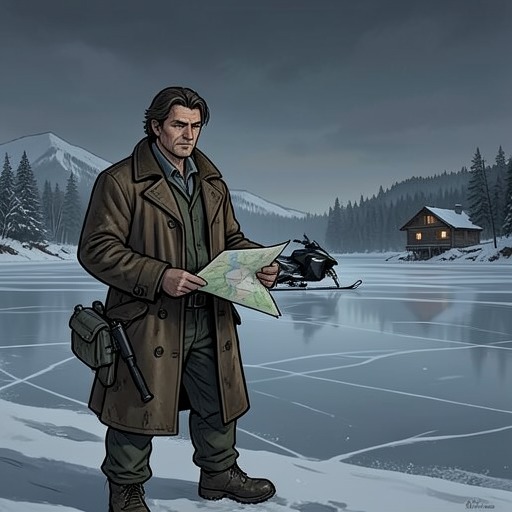
The rule became consequential when Mowat considered how to carry out his assignment in the central Barrens. His instructions called for a permanent base and an extensive survey by canoe, using the waterways to assess the wolf population. But the ice beneath him was still solid. Canoeing would have to wait, and without another means of transport he could not readily move his heavy load of equipment to a permanent site on dry land.
The orders had been prepared after consultation with the Meteorological Service, which had assured the Dominion Wildlife Service that the lakes and rivers would normally be clear of ice by the date of Mowat’s arrival. The word normally could not make the frozen waterways passable. Yet the orientation principle discouraged him from treating another department’s information as something to question, even when the conditions around him contradicted the plan built upon it. The policy thus made the mismatch between forecast and field visible without providing a straightforward way to correct its institutional cause.
Mowat’s immediate response was to seek new orders from Ottawa. He had already received a discouraging reaction to an earlier radiogram, but the circumstances left him little alternative. His portable radio was intended for forest rangers and was not normally expected to work over distances greater than twenty miles. Even so, he set it up and went on the air. The sequence shows the practical burden created by the rule: instead of simply revising a plan that the ice had made unworkable, the field worker had to re-enter the chain of command and request authorization.
Official Knowledge and Field Evidence
The episode belongs to a wider tension in the book between administrative accounts and evidence encountered outside the office. Mowat’s early professional experience had placed him uneasily within a scientific culture increasingly drawn to statistical and analytical work, while his own preference was for studying living animals in their habitats. The interdepartmental rule sharpened that divide: a claim could carry institutional authority because of where it came from, even when direct observation made its limitations apparent.
The political framing of the wolf investigation supplies another instance of official claims preceding field inquiry. The Dominion Wildlife Service’s briefing described parliamentary pressure to respond to complaints that wolves were killing the deer, while a predecessor’s contrary explanation—that hunters greatly outnumbered deer—had been rejected in Parliament. The ensuing demand for a full investigation created a setting in which the assignment began from a public controversy rather than from an open question alone. This does not make the ice forecast and the wolf controversy identical cases, but both show how official decisions and received claims shaped the work expected of the investigator.
The same contrast appears in Mowat’s encounters with local knowledge, though it should not be confused with the specific interdepartmental rule. Ootek’s account of wolves and caribou initially struck Mowat as implausible; he found that Ootek was invariably right when supporting proof could be obtained. Mowat also learned from Mike that trappers killed caribou to feed their dogs and themselves, while official polling had recorded widespread denials by trappers and traders that they killed more than a small number. These episodes distinguish knowledge by its source and its testing: neither a field report nor a local account becomes reliable merely by being asserted, but observation and corroboration can reveal what institutional summaries leave out.
Significance and Limits
The policy’s significance is its allocation of doubt and responsibility. Information received from another department was protected from challenge, while the employee confronting contrary conditions was expected to solve the problem or bear the consequences. In the frozen Barrens, that arrangement turned a forecast into an obstacle to movement and forced Mowat to spend effort seeking revised instructions rather than proceeding with the planned survey.
The book presents the rule through a particular orientation and a particular failed assumption; it does not establish that every department or official always acted in this way. Its force in the narrative comes from the gap between a plan that seemed administratively settled and a landscape that plainly did not accommodate it. By making the field worker responsible when an interdepartmental assumption failed, the policy exemplifies the bureaucracy Mowat set out to satirize: a system confident in its procedures, yet poorly equipped to admit that information from elsewhere may be wrong.