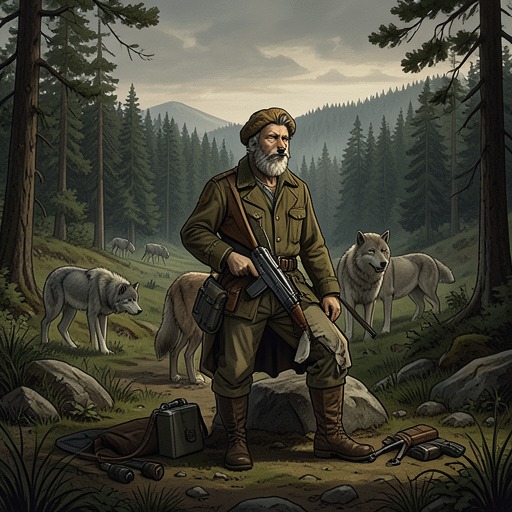
Keewatin
Never Cry WolfKeewatin is the immense northern landscape where Farley Mowat tested claims about Wolves against field observation and the knowledge of people who lived and traveled there. Its scattered family territories, shifting Caribou herds, and harsh seasonal shortages resist simple population totals or single-cause explanations. In Mowat’s account, the region becomes both a field of ecological inquiry and a contested place where subsistence, commercial hunting, government policy, and the reputation of Wolves meet.
Setting and Field Survey
Keewatin’s open tundra made distance and absence as important to observation as any animal sighting. After official orders directed Farley Mowat toward a census and the study of relationships among Wolves and Caribou, he and Ootek closed the observation post and traveled by canoe across the tundra plains. Over the following weeks they covered hundreds of miles, gathering population information as well as observations beyond the department’s stated aims.
The prevailing estimate, assembled from information supplied by trappers and traders, put Keewatin’s Wolf population at 30,000. On that figure, the average would have been one Wolf for every six square miles. Because roughly a third of the tundra lay under water and another third consisted of barren rock hills and ridges, Mowat calculated that the effective density would be closer to one Wolf for every two square miles of usable country. That density seemed implausibly high in light of the landscape they traversed.
Their observations led him to revise the estimate sharply downward. Wolves appeared widely scattered in family groups, each occupying a territory of roughly one hundred to three hundred square miles, though the pattern varied: two families had denned within half a mile of one another at one site, while Ootek recalled three females with litters denning within a few feet of each other on an esker near the Kazan River. Elsewhere, three days of travel along the Thlewiaza River yielded no sign of Wolves. Mowat reduced the regional estimate to 3,000, while acknowledging that even this lower figure might be an exaggeration.
The families they encountered also varied in size, from two adults with three pups to seven adults and ten pups. Ootek described how young Wolves might remain with their parents until a territory became available; the lack of sufficient hunting ground could limit the number of families the region supported. The observed distribution thus offered a different picture from a single, uniform density spread across a map: in Keewatin, habitat, territory, and the availability of prey shaped where Wolves could live.
Local Knowledge and the Caribou Relationship
Ootek became Farley Mowat’s principal source of information about Wolves. Mowat later learned that Ootek was a minor shaman in his community and that he had taken Mowat’s unusual work to be a kind of shamanic practice. Ootek attached himself to the observation project, bringing his sleeping robe to the tent the day after deciding to stay. Their rudimentary communication grew from a few words of English and Ootek’s perceptiveness; Mowat found that whenever he could obtain independent proof of Ootek’s claims, Ootek had been right.
Ootek described Wolves as close relations rather than as the menace assumed in much accepted human opinion. He recounted that, as a young child, he had been taken to a den by his father and spent a day there among the pups, while adult Wolves sniffed him but did not molest him. This account informed Mowat’s understanding of Ootek’s relationship to the animals without, by itself, serving as proof of every statement about their behavior.
The connection between Wolves and Caribou was central to Ootek’s account of life in Keewatin. He described the two as so closely linked that they were almost a single entity, and conveyed that relationship through a traditional story. In its opening, Caribou is presented as the greatest gift to people and as their sustenance. Mowat initially doubted Ootek’s account of Wolves’ predation, particularly when confronted with the many Caribou remains around Mike’s cabin and across the tundra.
Mike explained that he had killed those Caribou himself. He needed meat for fourteen dogs as well as for himself, and used Caribou carcasses to attract Foxes to his traps. He said he might kill two or three hundred Caribou in a year and described this as necessary for trappers who depended on dogs to haul loads. Fish could feed the dogs when Caribou were unavailable, but, in Mike’s account, dogs fed on fish became weak and sick and could not work as well.
That admission altered the meaning of the remains Mowat had taken as evidence against Ootek’s account. Government files recorded 1,800 trappers across parts of Saskatchewan, Manitoba, and southern Keewatin within the winter range of the Keewatin Caribou herd. In an official poll, trappers and traders had denied killing more than one or two Caribou each year while blaming Wolves for killing them in vast numbers. Applying deliberately conservative assumptions to the number of trappers and to Mike’s reported annual kill, Mowat arrived at an estimate of 112,000 Caribou killed by trappers in the area each year. He considered the figure unusable in official reports, but the calculation exposed the gulf between private hunting practice and public explanations of the herd’s decline.
Seasonal Movement and Crisis
Ootek also described a chain of information passing among Wolves about Caribou movements. According to his account, a Wolf in the next territory north had told the local Wolves that Caribou had begun moving south and indicated their current location; that report had itself come from a more distant Wolf. George then passed the news onward. Mowat was skeptical, but Mike accepted the report and set out on a hunting trip, despite the prospect of walking two or three days across the tundra. The episode placed local human reliance on animal knowledge beside the narrator’s scientific skepticism, without converting Ootek’s account into an independently confirmed observation.
Keewatin’s seasonal conditions could make such movements consequential. In 1946, Lemmings were at the low point of their four-year cycle, while depleted Caribou herds changed their longstanding migration pattern and mostly bypassed southern central Keewatin. The resulting shortage affected local people, Foxes, and Wolves. Rabies, already latent among starving Foxes, spread to Wolves as well. The episode locates disease and population stress within a wider convergence of food scarcity and altered migration, rather than presenting the resulting Wolf behavior as evidence of an inherent threat.
Hunting, Policy, and Regional Conflict
People’s dependence on Caribou did not end with subsistence hunting. At Brochet, the northern Manitoba base for Farley Mowat’s winter studies, a game warden told him that local people had once been able to kill 50,000 Caribou each winter, whereas by the time of Mowat’s visit they were fortunate to kill a couple of thousand. Local opinion unanimously blamed Wolves for the scarcity. Mowat’s reply—that Wolves had preyed on Caribou for tens of thousands of years before white settlement without decimating the herds—met either indifference or anger. The dispute reflected the force of immediate loss, but also the difficulty of separating ecological change from the activities of the people who hunted the animals.
Winter brought a concentrated assault on Wolves as they entered timber. Trappers resented their competition for Caribou and their ability to spring light Fox traps without being caught; some white trappers also feared Wolves. Provincial and federal governments offered bounties of ten to thirty dollars per Wolf, which could function as a subsidy when fur prices fell. The account also describes a trapper along the Manitoba–Keewatin boundary who collected bounty on 118 Wolves, 107 of them young, and used strychnine over a broad area rather than killing them by the methods specified in law. The poisoning wiped out Foxes, wolverines, and many smaller flesh-eaters as well.
Government promotion of trophy hunting added another pressure to the northern Caribou country. A provincial tourist scheme organized expensive safaris for visiting hunters, promising a set of Caribou antlers. During the Caribou’s winter stay inside the timberline, aircraft could locate herds resting on lake ice, gather them into a tight group, and allow hunters to fire from the aircraft. This account places state-organized hunting alongside the accusations against Wolves: human use of the herd could be substantial even as responsibility for its decline was assigned to its predator.
Narrative Significance
Keewatin is where Farley Mowat’s assignment to count Wolves and study predator–prey relations widened into an examination of how knowledge about the region was produced. Official estimates depended on reports from trappers and traders; Ootek’s accounts came through a growing personal relationship and were sometimes tested against observation; Mike’s frank description of his own hunting contradicted the public claims Mowat had found in government files. Each source carried a different position in the landscape, and the differences between them mattered.
The region’s significance lies in the contrast between apparent simplicity and accumulated causes. Sparse Wolf families, fluctuating Caribou movements, periodic Lemming scarcity, disease, subsistence needs, trapping, bounty incentives, and organized trophy hunts all appear in the account. Keewatin therefore resists the convenient explanation that Wolves alone caused Caribou decline. It is the setting in which Mowat’s fieldwork makes that accusation answerable to distance, local testimony, observed distribution, and the record of human hunting.