Mice
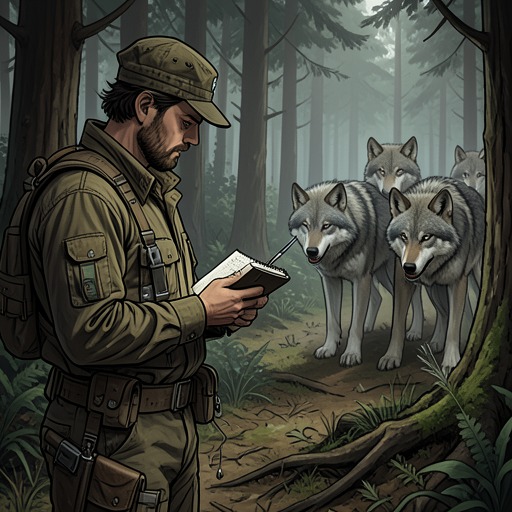
Never Cry WolfMice transform the apparent mystery of how the wolves at Wolf House Bay stay well fed into a demonstration of dietary adaptability. Their abundance around the summer camp is hard to ignore, but their importance to the wolves is harder for Farley Mowat to accept: his inherited image of the wolf as a hunter of large game initially blinds him to the evidence in front of him. Close observation, a later explanation from Ootek, and a dietary experiment gradually establish Mice as a major food source for wolves raising families beyond the summer Caribou range.
Habitat and Abundance
The setting for the discovery is a landscape of spongy sphagnum bog. Its moss provides small rodents with a ready-made place to burrow and nest, and, as June wanes into July, the country seems to fill with them. Lemmings are the most numerous, while red-backed mice and meadow mice are also present. The passage stresses not only their numbers but their capacity to reproduce: their abundance is a seasonal fact of the landscape, not an isolated encounter.
That increase reaches directly into Mike’s cabin. Red-backed and meadow mice invade in such numbers that they threaten Mowat’s food supplies, while also getting into his bed. One morning he finds that a meadow mouse has given birth to eleven young in the pillow of his sleeping bag. The episode turns the shelter into an extension of the surrounding bog: the rodents are not simply passing through the human camp but have made use of its provisions and bedding. Mice readily eat the bread that the wolves had ignored, making their presence all the more difficult for Mowat to overlook.
The Hidden Food Source
The abundance of Mice helps explain a puzzle that had been troubling Mowat. The wolves appear healthy, yet the two males leave to hunt each night and return each morning without any visible prey. He has even baked five loaves of bread for them, left beside a hunting path at Wolf House Bay, but the gift goes unused. The assumption behind his concern is that animals of such size must depend on game large enough to see being carried back. The small rodents around the camp do not fit that expectation.
Angeline supplies the decisive observation. One afternoon, while the male wolves rest before their night’s activity, she wakes Uncle Albert and leaves him with the pups. She then crosses the muskeg toward Mowat. On her return, she moves slowly into the wind, appearing to listen and scent the ground. She repeatedly springs down with her forelegs held out, snaps at something, and swallows. At first, Mowat cannot see what she has caught. After one pounce misses, he sees the tail and hindquarters of a mouse in her jaws; she swallows it. In ten minutes she has made six successful pounces before that visible miss, and she continues until she has eaten about twenty-three Mice.
Mowat initially treats the hunt as amusement or casual snacking. The number of captures changes his interpretation: twenty-three small animals amount to a substantial meal. Only later does he accept the broader implication. The wolves at Wolf House Bay, and by inference other Keewatin Barren Lands wolves raising families outside the summer Caribou range, live largely, perhaps almost entirely, on Mice during this period. The discovery overturns the inherited picture of the wolf as a predator sustained only by large game.
Carrying Food to the Pups
The visible hunt answers what the wolves eat, but not how the adults bring such small prey back to the den. Mowat had noticed that George and Albert went straight into the den when they returned from hunting, without recognizing what happened there. Ootek, a close friend of Mowat’s and an experienced naturalist, explains the missing step: the wolves carry their catch in their stomachs and regurgitate the partly digested food for the pups.
Mowat later sees an adult wolf regurgitate a meal for the pups after they have left the esker den. The observation makes sense of the earlier returns to the den, which had seemed to involve no delivery of food at all. Mice are therefore not merely an individual animal’s opportunistic snack; they are part of the means by which adults feed a family. The prey’s small size shapes the method of transport, while the adults’ return to the den links nightly hunting to the care of the young.
Testing and Interpreting the Evidence
Mowat knows that the claim about a summer diet dominated by Mice would be treated with suspicion unless it were carefully substantiated. He begins a survey to assess the local rodent population by sex, age, density, and species, setting about 150 traps in a nearby bog chosen as a likely example of an area hunted by the wolves and as a site he could tend frequently. The survey reflects a shift from a striking anecdote to an effort to investigate the prey population systematically.
He also tests the diet on himself. During the first week, his vigor remains unimpaired and he notices no apparent ill effects, but he develops a craving for fats. This prompts him to reconsider how he has prepared the Mice. The wolves eat the whole animal, whereas Mowat’s dissections have shown that much of its fat is stored in the abdominal cavity, rather than beneath the skin or in the muscle. He corrects the omission and begins eating the whole mouse, without the skin; the craving eases considerably. The mistake gives the experiment a specific lesson: a test that excludes a key part of the food does not accurately reproduce the animal’s diet.
The evidence also places Mice within a broader menu rather than making them the wolves’ only food. Ootek confirms their importance but describes wolves eating ground squirrels and, at times, fishing for Northern pike. Later scat analysis finds rodent remains in about 48 percent of the samples; the identifiable balance includes Caribou bones and hair, a few bird feathers, and a corroded brass button. That result supports the importance of rodents while showing why the field observations and other evidence matter: the scat identifies rodent remains, not every individual prey species or the full proportions of every meal.
Ecological and Narrative Significance
Mice matter to the account because they expose the limits of a familiar story about wolves. Mowat’s early assumptions lead him to interpret nightly hunting without visible prey as a mystery, and to overlook the small animals plentiful around his own camp. Angeline’s repeated pounces make the overlooked relationship visible; Ootek’s explanation and the later observations of feeding at the den supply the parts that a single scene cannot. The movement from surprise to corroboration is also a movement from reputation toward observation.
The relationship joins the bog’s seasonal abundance to the survival and family life of wolves. Mice provide a substantial food source when the wolves are raising pups away from the summer Caribou range, and adults carry that food back to the den by consuming it and later regurgitating it. Rather than treating a large predator’s diet as self-evident, the account shows how small prey can sustain it—and how careful attention to habitat, behavior, and remains can correct a confident but inaccurate expectation.