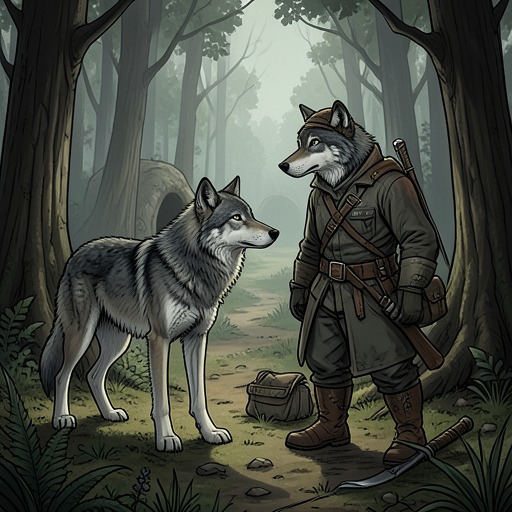
Mowat Arranges for Albert and Kooa to Mate
Never Cry WolfMowat’s arrangement for Uncle Albert and Kooa to mate begins as an attempt to observe a part of wolf life his fieldwork had not yet revealed. When Mike’s Husky dogs return south with the caribou, one bitch comes into heat; Mowat sees an opportunity to study wolf–dog mating without following the wolves during their brief March breeding season. With Mike’s agreement and Ootek’s practical guidance, he introduces Kooa to the wolves, then observes the courtship that follows. The episode becomes both a field experiment and a lesson in the limits of human control: the observers can arrange an encounter, but the animals determine its course and duration.
Background and Purpose
By the time the experiment becomes possible, Mowat has spent much of the summer observing the wolf family, but its sexual life has remained outside his view. The wolves’ habits had made that gap difficult to close. To observe their mating in the wild, he would have needed to follow them during the short season in March, when they moved with the caribou herds. The return of Mike’s team offered a different opportunity: a dog in heat was present near the wolves’ range, and Mowat knew from Mike and Ootek that wolves sometimes mate with dogs when circumstances allow.
The dogs’ return followed a practical seasonal pattern. Mike had taken them away when Mowat first arrived, because the absence of caribou made it impossible to feed the team. During June the dogs stayed with camps in the caribou’s summer territory; as the animals moved south again, the person caring for the dogs brought them back. Mowat describes Mike’s dogs as of aboriginal stock, and distinguishes them from wolves rather than treating them as partly domesticated members of the same species. He notes their more heavily built bodies and the fact that Husky bitches can come into heat at any time of year, unlike the seasonal pattern he was studying in the wolves.
One of the returning bitches, Kooa, was coming into heat and was causing a disturbance among the team. Mike complained about the problem, and Mowat saw a chance to address the missing part of his research. The proposal appealed to Mike for his own reason as well: he wanted to find out what kind of sled dogs a wolf–Husky cross might produce. Their interests therefore converged, though the proposed observation also depended on the animals’ own responses, which neither man could dictate.
Mowat chose to proceed in stages. The first was not to bring Kooa directly to a wolf, but to lead her around the area of his new observation site so that the wolves could encounter her scent. She pulled hard when they crossed a wolf trail, straining at a heavy chain leash and investigating the trail markers. Back at the cabin, she was tethered and howled through the night. The next morning, Ootek reported that a large wolf had visited: tracks showed that one had approached to within a hundred yards of the dog-lines. The visit suggested how quickly the scent had drawn a wolf near, although the presence of the male dogs may have prevented any further approach.
Staging the Encounter
The next phase required a place where Kooa could remain near the wolves’ summer den while Mowat and Ootek watched. They strung a length of heavy wire between two rocks, about fifty feet apart, roughly a hundred yards beyond the observation tent in the direction of the den. The following morning they brought Kooa to the site and fastened her chain to the wire. This arrangement gave her room to move while keeping her position within the observers’ view. Although Mowat expected the wolves to take an interest, the first part of the day offered little evidence of their approach. Kooa settled down and spent most of the afternoon resting; no adult wolves appeared near the den. The pups could occasionally be seen moving through a small grassy patch and pouncing after mice.
The change came around 8:30 in the evening, when the wolves began their pre-hunting chorus from behind a ridge south of the den. Kooa rose and joined in. The wolves’ song stopped, and shortly afterward all three adults appeared over the ridge. Kooa was a quarter of a mile away, but visible to them. George and Uncle Albert set off toward her, while Angeline overtook George before he had gone fifty yards. Mowat thought she might have tripped him, but did not claim certainty. George’s interest then subsided; Mowat considered that he may have been investigating an intruder rather than seeking a mate. He and Angeline returned to the den area and watched, leaving Albert to approach Kooa.
The separation of the adults mattered to the experiment’s outcome. George was Angeline’s long-standing mate, and the third adult, Uncle Albert, had already puzzled Mowat as he tried to understand the organization of the wolf family. Here, the adults’ distinct responses became visible in one scene: George and Angeline withdrew together, while Albert continued toward the tethered dog. The observers had arranged for Kooa to be present, but the sequence that followed was not a simple response shared by the whole group.
Albert and Kooa
Albert reached Kooa at speed, overshooting the place where she was tethered before turning back. As he came within about ten feet, his behavior changed. He stopped and adopted a markedly deferential posture; Kooa, apparently uncertain how to respond, backed away as far as the chain allowed. Mowat began to worry that Albert’s behavior signaled a problem and was preparing to intervene when Ootek restrained him. Ootek understood the display as normal behavior and indicated that the encounter was proceeding as it should.
Albert then shifted into a more assured approach. Kooa responded by turning toward him, and the two animals mated. Mowat does not give a detailed account of the act, but records that his scientific question had been answered. The scene thus supplied a direct observation where previously he had relied on what Mike and Ootek had told him: a wolf and a dog could form a mating bond when an opportunity arose. It also showed that the presence of Kooa did not lead George to mate with her. After Angeline’s intervention, George and Angeline stayed together near the den while Albert was the one who continued to her.
The observation did not end when the mating occurred. Mowat and Ootek waited for two hours, hoping Albert would leave so they could take Kooa back. He showed no sign of departing, and the two men eventually approached. Albert ignored them, creating a stalemate rather than yielding the dog. Mowat fired a shot into the ground nearby; the sound startled Albert into bounding away, giving them time to unfasten Kooa’s chain. Ootek led her toward home while Mowat covered their retreat with the rifle. Albert followed at a distance of fifteen to twenty yards, shifting from behind them to their flanks and sometimes ahead, but not leaving them.
Back at the cabin, a volley fired into the air did little to keep Albert away. Kooa could not safely be put back on the dog-line with the other dogs while Albert remained nearby, so she spent the night inside. Albert’s prolonged calling set off answering cries from the dogs, while Kooa also vocalized from indoors. The episode had moved beyond a controlled observation: keeping the animals apart now disturbed the camp and risked provoking a confrontation between Albert and the dogs.
Temporary Bond and Return
Ootek proposed a solution that relied on what he knew of the animals rather than on further attempts to drive Albert away. He told Mike that Kooa would remain near the camp with the wolf if released, and that, when her heat was over, she would return home while Albert went back to his own kind. Mike accepted the advice, and Ootek’s prediction proved accurate. For the following week, Mowat and the others sometimes saw Kooa and Albert walking together on distant ridges. They did not approach the den esker or the cabin, and remained apart from the observers’ daily life.
The temporary separation ended when Kooa appeared again in her usual place on the dog-line, exhausted but satisfied. The next evening Albert rejoined the wolves’ evening chorus at the esker. Mowat heard a new, self-assured quality in his voice and took it as evidence that the episode had left him changed in mood, if not in his place among the wolves. The return of both animals to their earlier settings supplied the experiment with an ending: Kooa was back with the dogs, and Albert had resumed his association with the wolf group.
Significance
The episode is a study in observation as much as in mating. Mowat deliberately arranged the conditions, recorded distances and timing, and watched how the adults responded; yet the decisive information came through behavior he could not script. George approached and then withdrew with Angeline, Albert persisted with Kooa, and Ootek interpreted Albert’s conduct more accurately than Mowat did. The observer’s uncertainty is part of the evidence: what first looked alarming to him appeared ordinary to Ootek, who knew how to read the wolf’s behavior.
The outcome also marks a limit to the experiment. Mowat gained the observation he wanted and Mike gained an answer to his curiosity about wolf–Husky crosses, but neither controlled how long the pair remained together. The initial tether made the encounter observable; the later decision to release Kooa acknowledged that keeping her confined would bring conflict without changing Albert’s attachment. Ootek’s intervention turned a situation the men could no longer manage into a temporary arrangement with a predicted end.
In the wider account of the wolf family, Uncle Albert’s role becomes more legible through his independent bond with Kooa. Earlier, his presence among George, Angeline, and the pups had raised questions for Mowat about the family’s structure. The episode does not resolve every question about that structure, but it shows Albert acting as a separate adult with his own courtship and subsequent return to the group. His week away does not end the wolf family’s association with him; Kooa, too, returns to the dog-line. The story’s lasting point is not simply that cross-species mating occurred, but that an experiment devised by human observers exposed relationships and choices that exceeded their plan.