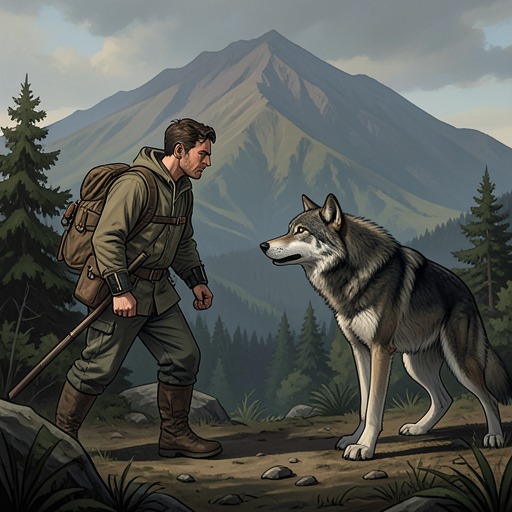
Mowat Marks Out His Own Territory in Wolf Country
Never Cry WolfFarley Mowat’s attempt to mark out a small territory beside a wolf family’s den turned an awkward human intrusion into a recognized boundary arrangement. By observing how the animals maintained their own extensive estate, he tried to make them acknowledge his presence; the leading male responded by inspecting and marking the perimeter. The encounter gave Mowat a safer, more stable place from which to study the animals, while exposing how much he still had to learn about their territorial customs.
Establishing a Place Among the Wolves
Over several weeks, Mowat put into practice his decision to live close to the wolves without disrupting their routine. He abandoned Mike’s cabin and its increasingly unpleasant smell as the weather warmed, and set a tiny tent on the bay shore opposite the den’s esker. His equipment was deliberately spare: a small stove, stew pot, kettle, and sleeping bag. He brought no weapons, though he sometimes regretted that choice, and arranged his telescope at the tent entrance so that he could watch the den without leaving his sleeping bag.
At first he kept himself out of sight, making only brief trips outdoors when no wolves were visible. He hoped the animals would grow accustomed to the tent as an unremarkable feature of the terrain. Mosquitoes soon made shelter necessary for a different reason: except in a strong wind, he spent nearly all his time inside. These precautions, he later concluded, were more elaborate than the wolves required. They had assessed him at their first meeting and generally ignored him, an indifference that unsettled him even as it allowed him to observe them.
By chance, the tent stood within ten yards of a major path between the den and hunting grounds to the west. Only hours after Mowat moved in, a wolf returning from a hard night’s work approached with its head lowered and eyes half closed. It came within fifteen yards before Mowat knocked his elbow against the kettle. The clang made the animal look up, but it neither stopped nor changed pace; after one sidelong glance, it continued on its way. During the following two weeks, wolves used the track almost every night. Apart from one later encounter, none showed the slightest interest in him. The repeated traffic established how close his camp was to their regular movements, but not yet that they recognized his presence as anything requiring a response.
Learning the Territory’s Boundaries
Mowat’s observations led him to reject the widespread picture of wolves as perpetual wanderers. The family he watched occupied a permanent territory of more than a hundred square miles. A river formed one boundary; elsewhere, the edges were not defined by landscape, but were clearly indicated in the animals’ own fashion. The family made rounds of its land roughly once a week, refreshing its markers. This maintenance took place alongside the estates of two other wolf families, whose territories adjoined its own. Mowat saw no evidence of disputes between the neighbors and suspected that boundary patrol was as much ritual as practical necessity.
The comparison with a dog marking its neighborhood helped Mowat recognize the principle, but he did not yet know how to perform the custom properly. Seeing how important territorial ownership appeared to be, he decided to establish a claim of his own so that at least one wolf might have to take notice of him. After the animals had left for their regular night hunt, he marked out roughly three acres, placing the tent near the center and including a hundred-yard stretch of their path.
Making the claim conspicuous took most of the night. Mowat placed marks on stones, moss clumps, and vegetation at intervals of no more than fifteen feet around its perimeter. He repeatedly returned to the tent for tea, and finished the circuit before dawn, when the hunters would be coming home. His effort was careful, but it rested on incomplete knowledge: he had learned that the wolves marked boundaries, not the precise conventions by which they did so.
The Leading Male’s Inspection
Mowat’s wolf log records the leading male’s arrival at 8:14 in the morning. The wolf came over the ridge on its usual route, apparently preoccupied, and did not look toward the tent. At the point where Mowat’s boundary crossed the trail, however, it stopped abruptly, as though it had encountered an invisible barrier. From about fifty yards away, Mowat watched the animal’s fatigue give way to bewilderment. The wolf cautiously sniffed one of the marked bushes, backed away, and sat for a moment without seeming to know what to make of it.
At last it looked directly at the tent and at Mowat. The sustained, considering attention was the response he had wanted: the animal had acknowledged that something had changed on its path. But recognition brought a fresh uncertainty. Mowat wondered whether he had violated an important wolf law and whether his unarmed position might leave him exposed. As the stare continued, he became fidgety and tried to break the impasse by clearing his throat and turning his back briefly, a gesture intended to convey that he found the scrutiny impolite.
The wolf then sniffed the marker again and began a systematic circuit of the new claim. At each stone or clump of grass, it examined Mowat’s mark and placed its own on the outside of the boundary. The distinction was decisive: rather than simply trespassing through the enclosure, the wolf treated the line as something to inspect and answer according to its own practice. Mowat saw that the animal marked with far greater economy than he had. It completed the entire perimeter without needing to replenish its supply, finishing the circuit in no more than fifteen minutes before rejoining the trail and trotting home.
A Ratified Enclave
After the leading male’s inspection, Mowat’s small territory remained inviolate. No wolf again crossed into it. Animals sometimes paused while passing to refresh markers on their side of the line, and Mowat reciprocated as best he could. The result was not a general withdrawal of the wolves from the surrounding land: their path still ran beside his tent, and their boundary work continued. Instead, the marked enclave became a stable exception within their territory.
That outcome eased Mowat’s concern about his personal safety and freed him to devote his attention to observing the animals. More important, it overturned his initial assumption that proximity alone would determine the terms of his presence. For days, the wolves had passed close by while treating him as negligible; a change in the route’s markings made the human camp legible in a way that his concealment had not. Mowat’s claim did not establish dominion over the wolf family’s land. Its significance lay in the wolf’s response: by answering his marks with its own and respecting the resulting boundary thereafter, the animal turned his improvised enclosure into an acknowledged arrangement.