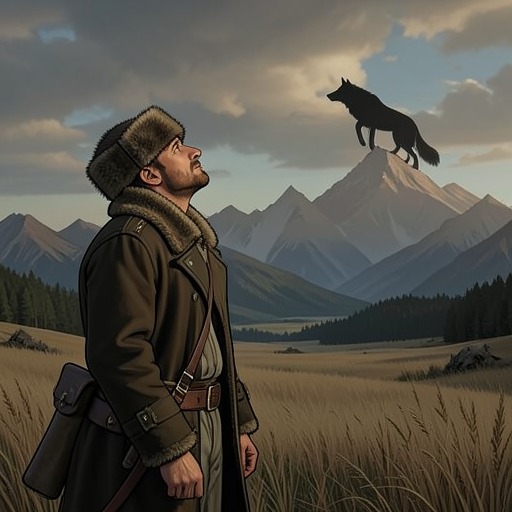
Mowat is abandoned by plane on a barren-land lake
Never Cry WolfFarley Mowat is abandoned by plane on a barren-land lake at the end of his enforced stay in Churchill, turning a promised flight in search of wolves into an uncertain arrival at an unmapped field base. The episode’s decisive reversal is practical as well as comic: Mowat reaches the remote country he needs to study, but neither the pilot nor Mowat can identify the lake’s exact location, and the aircraft leaves with no firm plan for returning.
The offer and the aircraft
During the last week in May, after three days of blizzard conditions in Churchill, a decrepit twin-engine aircraft came down beside a hotel pond. Visibility had been reduced to nothing by snow squalls, and the plane landed so close to the ground that it seemed to arrive almost at rooftop level. The wind threatened to carry it away, so people from the hotel’s beer parlor ran out and held its wings until it was secure.
The aircraft had been built in 1938 as a military training plane and discarded after years of service. Its new owner, a lanky, hollow-eyed former Royal Air Force pilot, had revived it while pursuing his ambition of starting an airline in the Canadian North. He had flown from Yellowknife intending to reach The Pas, but was hundreds of miles off course. Far from being dismayed, he treated the mistake as a manageable detour.
Later that day, Mowat explained his difficulty to the pilot. The pilot offered to fly northwest, the course he trusted most because he did not trust the compass on other headings, and to put Mowat down in wolf country. The offer supplied a way out of Churchill, but the aircraft and its operator were already marked by uncertainty: the destination was approximate, navigation unreliable, and the plane visibly old and temperamental.
Delays, repairs, and concealed cargo
The flight did not begin for another three days. A cloud layer at ground level prevented departure, while a collapsed hydraulic cylinder in the landing gear left the ski-equipped aircraft liable to tip onto its side. The engineer found that seal-oil could restore the cylinder to service, though it continued to leak; the plane could remain upright for only about twenty minutes before leaning over again. The repair made flight possible without making the aircraft dependable.
Its limited carrying capacity forced Mowat to discard some equipment, including a canoe he had regarded as useless. He traded a gallon of alcohol for a seventeen-foot canvas-covered canoe in fair condition. The pilot agreed that it could be lashed beneath the aircraft, creating room for the canoe while keeping it outside the cabin’s restricted load.
Mowat also used the canoe to conceal fifteen cases of Moose Brand, which had been set aside with the nonessential gear. By flashlight he discovered that all the cases would fit inside it; secured tightly beneath the plane, the canoe gave no indication of what it carried. This private alteration to the load became part of the precarious expedition: the aircraft was already struggling to carry supplies, while its passenger had quietly arranged to bring along cargo the pilot had not expected.
The troubled departure and low flight
The weather improved enough for departure, but a brief thaw had caused the aircraft’s skis to sink into slush and freeze to the ice beneath. On the first attempt, the engines strained while the plane remained fixed in place. People from the beer parlor came out, pointed toward the skis, and helped the pilot and engineer understand the problem. Once the plane was rocked free, the weak hydraulic cylinder collapsed again and had to be replenished with seal-oil.
The next takeoff run also failed. The aircraft skittered down the small lake without lifting, then swerved sharply at the last moment, throwing up snow and nearly capsizing before returning to its starting point. The pilot decided to unload the reserve petrol drums he had brought for his return to Churchill, judging that less weight might give the aircraft the lift it needed. Mowat considered this reckless but did not overrule the person in command. After another repair to the cylinder, the plane finally became airborne without the surplus fuel.
Even in flight, the aircraft remained troubled. It would not climb above about three hundred feet, and both engine revolution indicators stayed at roughly three-quarters of their proper readings. The cloud was so opaque that Mowat could not reliably see even the wingtip, let alone the ground or any wolves. For nearly three hours the plane continued through the cloud, making the search promised by the pilot impossible to conduct from the air.
The lake, the departure, and the new base
With only enough petrol left to get back to Churchill, the pilot announced that he was going down, adding that the country below was good wolf country. The plane emerged from the cloud at a little over thirty feet above a frozen lake in a valley about a mile wide, enclosed by high rocky hills. The pilot landed on the aircraft’s one sound ski and delayed settling onto the weak starboard landing gear until most of its speed had been lost. In contrast to the uncertain takeoff and unreliable flight, this landing was controlled and precise.
The engines remained running. The pilot told Mowat to get out quickly because darkness would come before the plane could reach Churchill. The engineer, previously described as lethargic, moved rapidly: within moments Mowat’s large supply load was on the ice, the canoe had been detached, and the landing-gear cylinder had been pumped upright once more. The unloading was efficient, but it did not make the place any less remote or the location any more certain.
After inspecting the canoe and its concealed cargo, the pilot acknowledged that Mowat had not been entirely candid about what he was carrying, then accepted that the supplies might be needed. He said he might return in the fall if the aircraft had not crashed, and suggested that local people could take Mowat back to Churchill. Mowat asked where he had been left so he could record it. The pilot could only estimate that the lake was about three hundred miles northwest of Churchill; he had no maps of the country and did not know the precise location.
The cabin door shut, the aircraft bumped across the pressure ridges, lifted reluctantly, and disappeared into the overcast. Mowat was left with his equipment and canoe on an unidentified frozen lake, without a dependable schedule for rescue or return. The account closes by treating this as a safe arrival at his base. That conclusion carries the episode’s central irony: a journey full of navigational error, failing machinery, improvised repairs, and an uncertain destination has delivered him to the starting point of his field work, while leaving the exact place he has reached unresolved.