Ootek
Never Cry WolfOotek is the narrator’s cousin Mike’s young relative and, in time, his closest companion in the wolf research at Wolf House Bay. Reserved at their first meeting, he becomes an indispensable guide: he helps the narrator communicate with Mike, shares detailed knowledge of animal behavior and local hunting, and teaches him to take wolf communication and social life seriously. Ootek’s importance lies not only in what he knows, but in the way his knowledge unsettles the narrator’s confidence in explanations drawn from distant official accounts or from his own limited observations.
Arrival and the beginning of the partnership
Ootek enters the account during the final stages of the narrator’s experiment eating mice. He arrives at Mike’s cabin as Mike’s cousin, while Mike is frying venison from an animal killed about sixty miles to the north. The narrator is still following his dietary experiment, so he declines the meal after explaining why. Ootek initially keeps his distance, moving around the table to put space between himself and the newcomer; their first contact is cautious rather than immediately companionable.
That reserve soon gives way to a small act of consideration. Learning that the narrator has refused the venison for the sake of his experiment, Ootek approaches him outside the cabin with five small blue eggs wrapped in deerskin. The narrator cooks them into a small omelette and makes a point of showing that he enjoys them. Ootek’s visible relief suggests that the gift was meant as more than food: he believed his gesture had helped the narrator, though the narrator could not determine precisely what Ootek thought the eggs would prevent. The exchange begins their relationship through practical care rather than formal explanation.
The narrator later understands that Ootek may have interpreted his unusual work through the framework of his own vocation. Ootek was a minor shaman, or magic priest, in his tribe. From what Mike had told him and what he observed, he apparently took the narrator for a shaman of an unfamiliar kind. The narrator offers this as a possible explanation for Ootek’s interest, not as a certainty about his motives; he also allows that Ootek may have hoped to learn something about the esoteric practices of his calling. What is clear is that Ootek treated the research as important even if its scientific purpose was not entirely clear to him.
A companion and interpreter
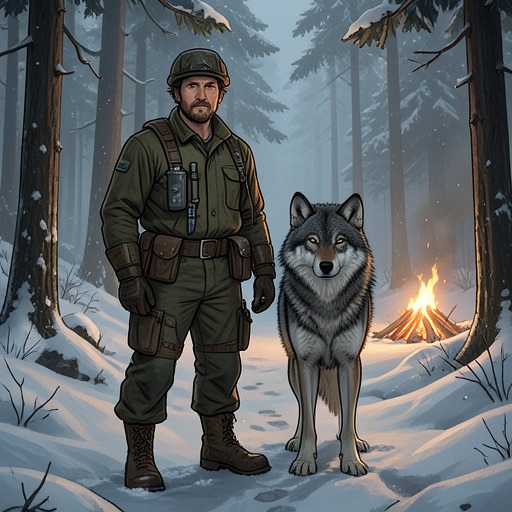
The day after their first meeting, Ootek came to the observation tent carrying his sleeping robe and evidently prepared to stay. The narrator had feared that a visitor might obstruct his work, but those fears quickly receded. Ootek knew a few English words, and his perceptiveness helped the two establish rudimentary communication. He was keenly interested in wolves, in part because Amarok, the Wolf Being, was his personal totem or helping spirit.
Their partnership depended on patience and on other people’s help. As Ootek improved his English and the narrator learned some of Ootek’s language, they could communicate more directly; Mike also served as interpreter between them. Ootek’s arrival softened Mike’s attitude toward the narrator. Mike remained suspicious that the researcher was not quite right in the head and might be dangerous if left unwatched, but he became more cooperative. Ootek therefore changed not only what the narrator could learn about wolves, but also the practical terms under which he could conduct his work.
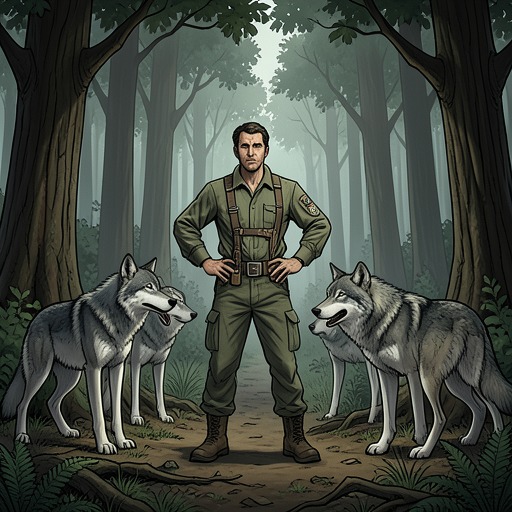
Ootek related that, when he was about five, his father, a respected shaman, took him to a wolf den and left him there for twenty-four hours. According to Ootek, he played with the pups as an equal; the adult wolves sniffed him but did not harm him. The narrator does not simply accept every account on Ootek’s word. He says that he sought supporting evidence where possible, and found Ootek invariably right when such evidence could be obtained. This qualification is important: their collaboration draws on Ootek’s experience without erasing the narrator’s stated concern to distinguish testimony from corroboration.
Knowledge of wolves and the land
Ootek expanded the narrator’s understanding of what wolves ate. He confirmed the importance of mice in their diet and added that wolves consumed many ground squirrels, at times seeming to prefer them to Caribou. The narrator’s account notes that ground squirrels were abundant across much of the Arctic, though their range lay just south of Wolf House Bay. In summer they could become heavy after feeding well, making them a substantial meal for a wolf at less effort than a Caribou hunt. Ootek’s contribution thus broadened a finding the narrator had made through his own experiment and observation: the wolf’s diet could not be reduced to its most conspicuous prey.
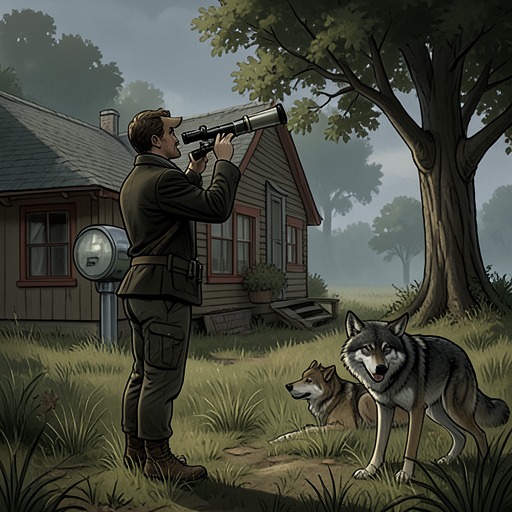
He also helped the narrator interpret a distant exchange of howls. During a still, mosquito-filled day at the den, Ootek cupped his hands to his ears and announced that wolves were talking, pointing toward hills about five miles to the north. The narrator could hear nothing. George, however, sat up, oriented himself toward the hills, and answered with a long howl. Ootek later explained that a wolf in the next territory had relayed news that Caribou had begun moving south, including their location; that report, he said, had itself come from a more distant wolf. George had heard and understood it, then passed the news on.
The narrator remained incredulous, but Mike acted on the information and packed for a hunting trip. His response gave the report practical consequences even before the narrator was persuaded: people at Wolf House Bay depended on Caribou when they were available. Ootek’s account presented wolf calls not as a simple succession of noises but as communication carrying information across territories. The scene also exposes the limits of the narrator’s position: he could record George’s response, but could not hear the signal that Ootek claimed to understand.
Ootek’s explanation of wolf hunting similarly challenged conventional expectations. He told the narrator that a healthy adult Caribou could easily outrun a wolf, and that even a three-week-old fawn could outrun all but the swiftest. Rather than persistently chasing healthy animals, wolves tested herds for individuals that were sick, wounded, or otherwise in poor condition. They might rush a group briefly to make the animals run; if none appeared vulnerable, they stopped and moved on to test another herd. After making a kill, Ootek said, they did not resume hunting until the food was gone and hunger forced them back to it.
The narrator subsequently watched hunts that largely followed this pattern. From one to eight wolves trotted among dispersed deer; an occasional short charge prompted the Caribou to flee, and the wolves then watched before either pursuing a vulnerable animal or turning away. They seldom tested herds of prime bucks in peak condition, while groups of does and fawns offered more opportunity for weakness to be revealed. These observations gave the narrator a basis for revising the picture of wolves as indiscriminate killers. Ootek’s knowledge did not replace observation; it gave the narrator a way to interpret recurring behavior that he had first seen without understanding.
Community knowledge and the limits of explanation
Ootek also placed wolf behavior within a wider social world. When the narrator was surprised to see unfamiliar wolves visit Angeline, Ootek treated the visit as ordinary, comparing it to people calling on other people. Mike identified the visitors as wolves from Hidden Valley, several miles to the south, and suggested that two of them were related to Angeline. He said the groups joined together in autumn and traveled south. The episode shows Ootek resisting the assumption that animal social behavior should seem inexplicable simply because it is not human behavior in the familiar sense.
He also introduced the narrator to a story about the close relation between wolves and Caribou, which he described as almost a single entity. The narrator presents the tale as part of inland community folklore, with Mike confirming its place in that tradition. In the portion of the tale recounted, a woman brings animals out of the earth and Caribou is the last; Kaila, the Sky God, identifies Caribou as the greatest gift because it sustains people. The account gives cultural and narrative form to a relationship that Ootek also explained through hunting behavior and ecological dependence. It should not be mistaken for a complete account of his beliefs: the narrator’s retelling is expressly paraphrased and limited to the story he was told.
A visit to an encampment along a river reveals another practical dimension of Ootek’s knowledge and relationships. He recognized a family camped near a crossing where Caribou passed through a narrows. The men had chosen the site to intercept the animals, using one-man kayaks and short stabbing spears in the hope of securing enough meat for winter. Ootek wanted to join the hunt and asked the narrator to remain at the camp for a few days. The narrator agreed, and the three men left the next morning. Ootek’s request connected the research journey to the seasonal work and social ties on which local life depended.
Later, the narrator found the camp abandoned and never saw its occupants again. When Ootek returned, he asked specific questions about pails and scats, details the narrator did not understand as relevant. He ultimately said he could not explain why the family had left, and never supplied an explanation afterward. The episode ends not with a solution but with a boundary in the narrator’s understanding. Ootek is repeatedly the person who makes unfamiliar behavior legible; here, for the first time in their association, he does not—or will not—resolve the puzzle. That silence preserves the difference between being a valuable guide and possessing an answer to every question, and leaves Ootek’s knowledge integral to the story without making it limitless.