Raunkiaer’s Circle
Never Cry WolfRaunkiaer’s Circle is the metal hoop used in a vegetation survey assigned to the narrator during his fieldwork in the Barrens. The device was meant to make plant sampling random and measurable, but in practice it became a source of lost time and physical strain, then disappeared into a pond in a throw by Ootek. Its brief career in the field exposes a tension between bureaucratic research procedures and the narrator’s stated priority of observing living wolves, while giving an improvised, accidental ending to one of the studies he had postponed.
Purpose and Procedure
As September gave way to October, the narrator faced a backlog of scientific work assigned by officials in Ottawa. The vegetation study had three parts: collecting the area’s plant species, measuring their relative cover, and analyzing the vegetation’s nutritional value from the caribou’s perspective. With little time left, he chose the cover-degree task, which required Raunkiaer’s Circle.
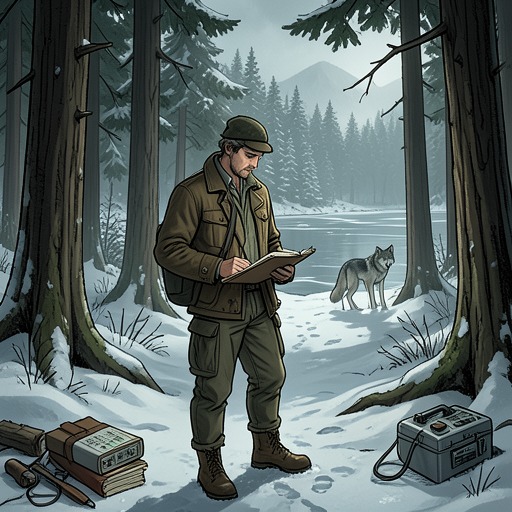
The hoop was intended to produce a random sample. The user stood on the muskeg, shut his eyes, spun several times, and threw it as far away as possible. That elaborate attempt at randomness had an immediate practical drawback: the hoop often vanished from sight, leaving the surveyor to search for it before any measurement could begin. Once found, it marked the area from which the plants had to be collected and counted.
The work inside the circle was exacting. Every plant, however minute, had to be plucked; the species had to be identified and counted, and the individuals belonging to each species counted in turn. The smallness of Barrens plants made this method especially taxing. The narrator’s first attempt took most of a day, strained his eyes, and left him with back pain from crouching over the hoop and using tweezers to collect plantlets. The circle therefore joined a simple object to an unexpectedly laborious routine: its apparent simplicity concealed the time and bodily effort demanded by the measurements.
The Field Encounter
The narrator had discouraged Ootek from joining these expeditions because he did not feel able to explain the purpose of the procedure. On the third day of the work, however, Ootek appeared over a nearby ridge and came over to watch. The narrator, weary and discouraged, made another throw. It did not travel far. Ootek judged the effort poor, and the narrator challenged him to do better.
Ootek picked up the hoop and threw it with far more force. It sailed over a tundra pond and disappeared into the water. The tool designed to secure a sample through controlled, supposedly random placement was thus removed from the study by a single, uncontrolled act. The narrator did not respond with anger: Ootek looked apprehensive, but the narrator embraced him, led him through several steps of a dance, and took him back to the cabin to share his last bottle of wolf-juice. The account presents the loss not as a planned solution but as a reversal in which the failed survey procedure ends through an unanticipated encounter between the two men.
Loss and Narrative Significance
The circle’s disappearance ended the vegetation study. It also relieved the narrator of work he had found painful and distasteful, although the account does not suggest that the required research had been completed. The narrator had already chosen the cover-degree portion as a compromise because the full three-part study could not be done in the time remaining; the lost hoop brought that compromise to an abrupt close.
As a field instrument, Raunkiaer’s Circle was intended to make vegetation legible through sampling, identification, and counts. In the episode, its practical presence instead becomes conspicuous: it must be thrown, found, carried, and used amid tiny plants, a strained back, and dwindling time. The method’s claim to randomness is itself comic, since the prescribed spinning and blind throw regularly make the device hard to locate. The final throw makes that difficulty irreversible. The circle passes from measuring the landscape to being swallowed by it, and an official task gives way to a shared moment with Ootek. The episode’s humor rests on that concrete contrast, not on a rejection of measurement in itself: the book shows both the survey’s intended purpose and the gap between its prescribed procedure and the narrator’s experience of doing it.