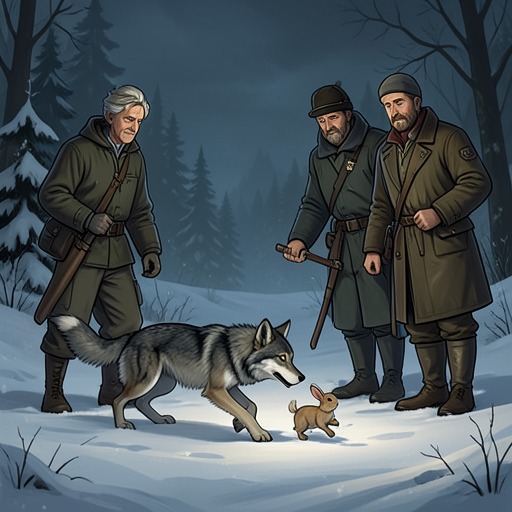
Strange Wolves Visit Angeline’s Territory
Never Cry WolfTwo unfamiliar wolves came to Angeline’s territory during the July doldrums, and their quiet midnight meeting with her unsettled Farley Mowat’s assumption that each wolf family’s range was sacrosanct to outsiders. The encounter did not become a fight or a chase. Instead, a muted call, a bark, slow tail-wagging, and a nose-to-nose greeting marked a change from watchful distance to apparent welcome, before the three wolves went toward the summer den.
Background and Observation
Although Angeline now often hunted with the males, there were still nights when she stayed behind. On one such night, well after midnight, Mowat was dozing in his tent when a wolf howled somewhere to the south, not far away. The call was unusual: muted and without the quavers he associated with a howl. He reached for his binoculars and searched until he found two wolves sitting on a point of land on his side of the bay, directly opposite the wolf esker.
Their presence caught his attention because he had come to regard the territory of each wolf family as off-limits to other wolves. Angeline was at home: Mowat had seen her enter the gully a little earlier. He therefore watched to see how she would respond to the apparent intrusion. The timing and position of the visitors made the question immediate, but their identity and reason for coming remained unknown.
From Vigilance to Contact
Mowat trained his glasses on the gully. The telescope was less useful than ordinary binoculars for night viewing in the prevailing twilight, so the encounter was followed through the binoculars. Angeline had already come out and stood facing the point where the strangers waited. Her head was thrust forward, her ears cocked, and her tail stretched out behind her like a setter’s. The posture registered alertness, but she did not rush toward the visitors.
For several minutes none of the three wolves moved or called again. Then one stranger gave the same tentative howl Mowat had heard from the point. Angeline’s response altered the scene: she began to wag her tail slowly, and her tense stance visibly relaxed. She trotted to the edge of the ravine and barked sharply. The change from rigid attention to a relaxed tail and an answering call was visible even though Mowat could not hear what passed between the wolves beyond that bark.
The bark also challenged what Mowat understood from books, which said wolves and Husky dogs were not supposed to bark. He recorded Angeline’s call as an unmistakable bark, rather than forcing it into a more familiar category of howl or other vocalization. Its effect was clear in the immediate sequence: after hearing it, the two strangers stood and began to trot around the shore of the bay.
The Greeting
Angeline met them about a quarter of a mile from the den. She stood still while they approached; when they were only five or ten yards away, they stopped as well. Mowat could hear nothing from this pause. He could, however, see the tails of all three wolves beginning to wave slowly back and forth. After about a minute of this mutual display, Angeline stepped gingerly forward and sniffed noses with the visitors.
The order of the meeting matters: the strangers did not simply rush into the den area, and Angeline did not drive them away. Their initial stillness gave way to visible signs of ease, then to close contact. Mowat judged from the greeting that the visitors were welcome. That conclusion rests on the observed sequence—relaxed tails, approach, nose contact—not on any identification of who the strangers were or how they were connected to Angeline.
The Summer Den and Its Significance
After the greeting ceremonies, all three wolves trotted toward the summer den. At the edge of the ravine, one stranger began to romp with Angeline, and the two played for several minutes. Their play appeared gentler than Angeline’s play with George or George’s with Uncle Albert, a comparison that situated this encounter among Mowat’s other observations of the family without establishing the visitors’ relationship to it.
The meeting complicated Mowat’s assumption that neighboring wolf-family territories were entirely closed to one another. In this instance, two unfamiliar wolves approached, waited at a distance, and were received by Angeline; the encounter ended in play and a shared movement toward the summer den, not expulsion. Its significance lies in the contrast between the apparent territorial boundary and the welcome witnessed at it. The observation also shows the limits and value of Mowat’s field method: he could not hear most of the exchange, yet by tracking posture, calls, pauses, and movement he could follow its progression from apparent intrusion to acceptance.