The Barren-Ground Wolves’ Winter Migration Period
Never Cry WolfThe Barren-Ground Wolves’ Winter Migration Period is the annual journey that carries Keewatin Barren Lands Wolves away from the frozen tundra and into the taiga in pursuit of Caribou. It is both a movement through a changing food landscape and a season of acute danger: the animals must remain close to their principal large prey, yet in the forest they encounter concentrated human hunting and government-backed control. The wolves’ winter survival is therefore shaped by ecological dependence and human pressure at once.
From tundra to taiga
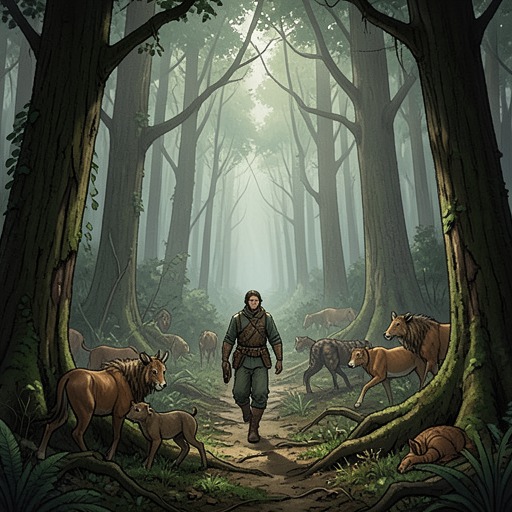
The departure begins in late October, as winter overtakes the open plains and Caribou turn from the tundra toward the shelter of the forests. Keewatin Barren Lands Wolves follow because the frozen plains no longer provide enough food. The migration is not a brief crossing: from early November until April, wolves and Caribou travel together through the taiga, the sparse belt of stunted spruce and jack pine below the timberline.
The forest offers other prey when conditions permit. In years when snowshoe rabbits are abundant, wolves feed heavily on them, but they remain near Caribou because the herds are the resource that can sustain them through famine. This dependence makes the seasonal journey more than a simple change of habitat: the wolves move within the range of their most reliable large prey while using smaller animals as an alternative when available.
Bands, hunting, and winter limits
Wolf families travel together, though two or three small groups may join to form a larger band. There are no fixed rules for such gatherings, and a band can later divide into its component groups. Winter hunting requires cooperation among several wolves, but a large gathering can leave too many animals dependent on a single kill; groups of five to ten are described as an effective size. These shifting alliances allow the wolves to hunt together without making every family part of a permanent, oversized pack.
Unlike their territorial arrangements in other seasons, winter bands appear to have no fixed territories. When unfamiliar bands meet, they may greet one another and continue in separate directions. Concentrations are rare, although how the animals maintain this dispersal is not known. Chippewayan accounts attribute it to urine messages left on prominent points, rocks, trees, and well-used trails; the observed pattern is that nomadic bands generally avoid crowding one another unless starvation disrupts the balance.
The hunting pattern described elsewhere in the account helps explain why Caribou herds are not simply overwhelmed. Wolves may test nearby animals with short approaches, then stop if the Caribou run well and appear in good condition. The wolves turn away rather than persist with prey they are unlikely to catch. This observed selectivity contrasts with the popular image of wolves as indiscriminate hunters, and it places winter predation within the limits of opportunity, effort, and available food.
A season of death and human pressure
The account calls winter the time of death for Barren-Ground wolves. Once they enter the timber, they face a concentrated and skilled assault from trappers. Some trappers resent wolves for competing for Caribou and for springing the light fox traps along their traplines; fear of wolves can add to the impulse to kill them. Provincial and federal governments reinforce that pressure with bounties of ten to thirty dollars per wolf. When fur prices fall, the bounty can function as a subsidy to trappers and traders.
One trapper working along the Manitoba–Keewatin boundary collected bounty on 118 wolves in a winter; 107 were young born the previous spring. The account says he used strychnine across a large area, where the poisoning also wiped out foxes, wolverines, and many smaller carnivores. This example places the migration within a wider campaign that did not selectively affect wolves: methods directed at them could damage other wildlife as well.
The pressure on wildlife also came from hunters pursuing large game. The book notes that aircraft and snowmobiles made previously difficult-to-reach Canadian regions accessible to many more hunters, contributing to reductions in moose, deer, elk, and other game. The resulting complaints often blamed wolves for declining game, even as hunters and other financially interested groups called for their destruction. In another winter practice, a provincial tourist scheme arranged caribou safaris for visiting trophy hunters, sometimes using government-owned aircraft. For a fee of a thousand dollars per hunter, participants were promised a set of antlers; aircraft could gather Caribou into a tight group on a lake and remain in motion while hunters fired from inside. These hunts show that human pressure on the winter range was not confined to trapping or wolf control.
Scarcity, disease, and ecological balance
The migration’s dependence on prey becomes especially clear in the account of 1946. That year, lemmings were at the low point of their four-year cycle, while depleted Caribou herds changed their old migration habits and mostly bypassed southern central Keewatin. Hunger affected foxes and wolves as well as people. Rabies flared among starving foxes and spread to wolves; when food scarcity weakens wolf populations, the account describes epidemics of rabies, distemper, or mange as forces that can reduce their numbers to a bare survival level.
This seasonal history complicates claims that wolves alone cause declines in Caribou or other game. A trapper admitted killing two or three hundred Caribou a year, or possibly more, to feed his dogs and himself and to use as bait for foxes. The narrator also knew of a survey in which trappers and traders had denied killing more than one or two Caribou annually while blaming wolves for immense losses. His cautious calculation, based on half the reported number of trappers and half the individual kill, still produced an estimated 112,000 Caribou killed by trappers in the area each year. The contrast redirects attention from the migrating predator to the human use of the same wintering grounds.
The wolves’ departure from Wolf House Bay also gives the season a personal consequence in the narrative: the observer must leave not because he wishes to, but because the animals are moving toward their winter range. Their annual route thus marks both an ecological transition and the end of the close summer observation. In winter, the same dependence on Caribou that sustains the wolves brings them into a landscape increasingly penetrated by hunters, trapping operations, and policies that treat them as enemies rather than as part of the northern food system.