The Myth of the Wolf as a Threat
Never Cry WolfThe Myth of the Wolf as a Threat describes how wolves came to be treated as a menace to wildlife and human communities, even when the evidence offered for that danger was weak or contradicted by other causes. The image persists through official claims, interested testimony, and stories that grow more alarming in retelling. Farley Mowat challenges it with observed wolf restraint, evidence that people also drove Caribou declines, and the 1946 panic in Churchill, where the response to one sick wolf produced casualties of its own.
How the Threat Was Made Official
The book presents the wolf’s reputation not simply as a popular prejudice but as a story reinforced by political institutions. During Farley Mowat’s briefing, his chief explains that the Department of Mines and Resources has received thirty-seven memoranda from Members of the House of Commons in a single year. Many complaints come from Fish and Game clubs and business interests, including ammunition manufacturers. These groups frame fewer deer in hunters’ returns as evidence that wolves are destroying the game. Their argument presents the animals as a public problem requiring government action, while leaving the interests and activities of the complainants largely outside the frame.
The department’s earlier attempt to explain the decline differently had consequences. Mowat’s predecessor argued that hunters had become so numerous that they outnumbered deer by about five to one. The Minister repeated that account in the House of Commons and was shouted down; three days later, the predecessor retired to civilian life. The Minister then announced a full-scale investigation into the supposed destruction of deer by wolves. In the briefing scene, the chief gives Mowat the assignment with the confidence of an official defending a settled conclusion, although the supposed cause has not yet been established. The investigation is thus shaped from the outset by pressure to confirm a politically useful account.
The same pattern appears beyond the department. In 1972, Minnesota authorities proposed killing 200 wolves a year with guns, snares, traps, and poison until the perceived menace was eliminated. In Quebec, the Minister of Fish and Game decreed a contest open to hunters in Canada and the United States, with a target of 5,000 dead wolves. Prizes included a wolf’s lower jaw set in clear plastic as a trophy. The policy turned the threat story into organized killing, presenting destruction not as a decision requiring proof but as a public achievement.
Claims, Counterevidence, and the Field
The official case rested heavily on reports from people who attributed declining game to wolves. Yet the book identifies a competing pressure: hunters’ access to remote country was expanding with light aircraft and snowmobiles, and the resulting increase in hunting was reducing numbers of large game animals. The decline could then be cited as proof against wolves, even when human activity was part of its context. This reversal matters to the book’s argument: the animal blamed for scarcity may not be the agent chiefly producing it.
Mowat’s field investigation also unsettles the assumptions with which he begins. After weeks of study, he has not found the evidence his employers expect about wolves’ role in the Caribou decline. The official account seemed to offer an easy explanation for a dramatic fall in Caribou numbers, but his observations do not provide the anticipated confirmation. Ootek’s account of the relationship between Caribou and wolves presents predation as part of a natural balance, in which wolves take vulnerable animals. Mowat initially doubts this, reasoning that wolves could choose healthier prey instead. His skepticism is then challenged by the evidence around Mike’s cabin.
Mike explains that he kills Caribou to feed fourteen dogs and himself, and to support trapping: foxes come to feed on the remains of Caribou, making the kills useful to his work. He estimates that he kills two or three hundred animals in a year, perhaps more. He says other trappers, both Indigenous and white, also need Caribou to keep their dogs working; when they cannot obtain enough, they turn to fish, which he regards as less suitable for the dogs. Mowat knows that 1,800 trappers worked in portions of Saskatchewan, Manitoba, and southern Keewatin within the herd’s winter range. Yet an Ottawa poll of trappers and traders had recorded their denials that they killed more than one or two Caribou annually, while they blamed wolves for killing vast numbers.
Using deliberately conservative assumptions, Mowat halves both the number of trappers and Mike’s estimated annual kill before calculating the possible total. Even that reduced estimate comes to 112,000 animals killed by trappers in the area each year. He recognizes that this is not a figure he can use in his reports, and sets aside the revelations as hearsay rather than the evidence he was officially assigned to gather. The episode does not turn Mike’s account into a verified census; it shows how testimony can be discounted when it complicates the accepted accusation, while less credible claims against wolves are treated as authoritative.
A Reputation Tested Against Behavior
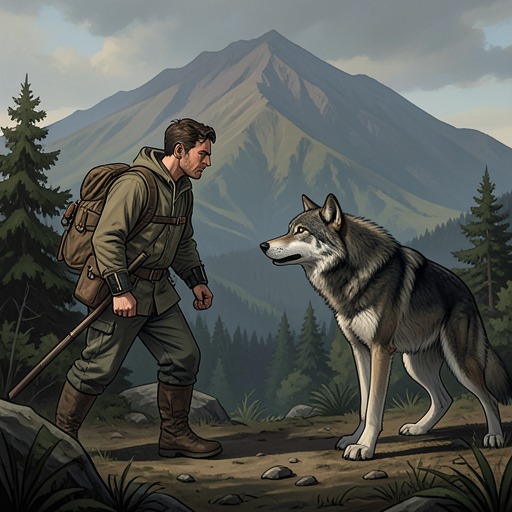
The threat myth is also challenged by Mowat’s direct encounters with wolves. He recalls that on three occasions in less than a week he had been at their mercy, including when he entered their den and seemed to pose a threat to the pups. They did not attack him. Instead, he saw restraint that conflicted with the inherited picture of wolves as indiscriminate killers. Mowat recognizes that the incidents make the old account difficult to sustain, but he is reluctant to abandon it: doing so would mean resisting established scientific belief, losing the aura of danger attached to his mission, and admitting that animals had exposed his own mistaken expectations.
The book sets this change in Mowat’s understanding against the official description he had read. A reference work depicts Arctic wolves as exceptionally large and powerful, gives measurements reaching eight feet seven inches from nose to tail and forty-two inches at the shoulder, and describes teeth capable of breaking strong bones. It concludes with a portrait of a savage and feared killer. The mismatch between that authoritative language and the wolves’ restraint in Mowat’s encounters gives the myth its force: it is not merely an exaggerated description, but a framework that can govern what observers expect to see. Mowat resolves to study wolves as they behave rather than as convention says they must behave.
The 1946 Panic in Churchill
The 1946 episode in Churchill shows how a real danger can be transformed into a much larger imagined one. That year, lemmings were at the low point of their four-year cycle, while depleted Caribou herds altered their migration and mostly bypassed southern central Keewatin. The poor food supply affected people and animals, and rabies spread among starving foxes before wolves began contracting the disease. Mowat explains that rabies makes animals erratic and less fearful; a sick wolf may enter a settlement without behaving according to the distance people ordinarily expect a wild animal to keep.
In Churchill, a sick and dying wolf was encountered by a Canadian Army corporal returning to barracks after visiting the beer hall. The corporal reported a frightening encounter and reached the guardhouse. His warning helped set off a camp-wide panic. Canadian and American contingents mobilized, and armed search parties scoured the surrounding country. Eleven Husky dogs, an American private, and a Chippewayan man returning home became casualties during the ensuing excitement—not from a wolf, but from the vigilantes. For two days, women and children stayed indoors, while soldiers travelled by jeep with weapons or avoided going between buildings.
The search itself exposed the distance between the imagined invasion and what could be verified. On the second day, an Army aircraft spotted what was taken to be a wolf; the animal proved to be the Hudson’s Bay Company manager’s cocker spaniel. The panic eased only on the third day, when an Army truck struck the sick wolf on the road. Too ill to move, it was killed by the collision. The outcome confirms that an infected wolf had been present, but it does not substantiate the armed force’s vision of multiple packs attacking the town.
Retelling, Responsibility, and Significance
For Mowat, the episode’s aftermath is part of the evidence. Residents of Churchill and some soldiers continued to describe a wolf invasion, remembering desperate encounters, attacked families, destroyed dog teams, and a community under siege. In the process, the lone sick animal and the false identification of the cocker spaniel recede, while the scale of the imagined threat expands. Repeated stories preserve the emotional truth of the panic while distorting its factual account. The legend is therefore not undone merely because the search produced contrary evidence; memory can carry the original fear forward as if it were confirmation.
The book places this local case within a broader contest over who is trusted to interpret declines in wildlife. Mowat says that experts derided Never Cry Wolf as fiction despite his having lived in the Arctic for two summers and a winter among wolves; he also notes that later official science confirmed almost every aspect of wolf behavior he had described. Even so, his central argument—that wolves do not pose a consequential threat to other wildlife or constitute a serious danger or competitor to people—remains largely unaccepted in the account. The durability of the myth is thus both scientific and political: correction of particular observations does not necessarily dislodge the public and governmental story built around them.
The book does not present wolves as detached from ecological pressures or deny that particular animals can be dangerous under particular conditions. Instead, it contrasts the limited, specific facts available in its examples with sweeping accusations and disproportionate responses. A sick wolf in Churchill, a misidentified dog, Caribou killed to sustain trapping, and a proposed campaign against thousands of wolves belong to different circumstances, but the threat myth collapses them into one simple explanation: wolves are the enemy. Mowat’s account restores those distinctions and asks readers to consider the human practices and institutional pressures hidden by the accusation. Its central concern is not only the survival of wolves but the consequences of making fear stand in for evidence.