The Wolf Pack as a Family Community and Cooperative Pup-Rearing
Never Cry WolfThe Wolf Pack as a Family Community and Cooperative Pup-Rearing presents the wolf pack not as a loose band organized solely around killing prey, but as a household whose members share territory, companionship, and the work of raising young. At Wolf House Bay, the narrator’s observations of Angeline, George, Uncle Albert, and the pups give this social structure practical form: adults take turns attending the young, while the pups gradually move from the den into the wider life of the family. Ootek’s knowledge helps explain why extra adults belong in this arrangement and how ecological limits shape which wolves can become parents.
Family Structure and Membership
The narrator initially struggled to make sense of a group that included three adult wolves. He could readily understand a pair of parents and their litter, but the apparent presence of a third adult seemed to suggest an unexplained triangle. The smaller, somewhat gray-coated wolf became known to him as Uncle Albert after he saw the animal with the pups. The name marks a caregiving role, not a confirmed biological relationship: the narrator did not know the adults’ precise status within the family, and he explicitly recognized that his observations could not establish it.
The families encountered elsewhere showed that the Wolf House Bay group was one form of a broader pattern. Their size ranged from a pair of adults with three pups to a group of seven adults and ten pups. In nearly every case, adults beyond the apparent breeding pair were present. Since killing a wolf would have revealed only its age and sex, not its place in the family, the narrator turned to Ootek for an explanation rather than treating the extra adults as evidence of disorder.
Ootek described a household that could include offspring who remained with their parents after reaching maturity, as well as adults who did not breed. Young females, he said, did not breed until two years of age, and males until three. Even then, becoming old enough to reproduce did not guarantee that a wolf could establish a family of its own: suitable hunting territory was limited. The family group therefore included animals whose lives were bound to the household even when they were not raising their own litter.
Shared Care and the Pups’ Development
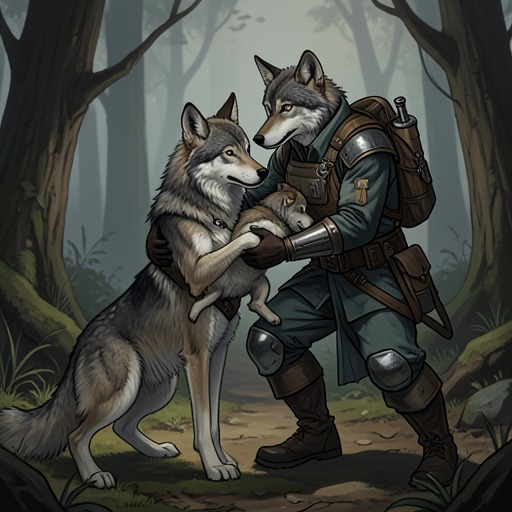
At Wolf House Bay, the adults’ participation in care could be seen in ordinary movements around the den. Angeline sometimes left the pups with Uncle Albert, and on rarer occasions with George, while she went to the bay. One afternoon she nuzzled Albert awake, then trotted away, leaving him to entertain the young. The narrator had previously mistaken her trips for walks or drinks; continued observation showed that the other adults’ presence made those absences possible. Care was distributed across the group rather than confined to the mother.
The pups’ lives changed as they grew. By mid-September they had left the summer den. They still could not keep up with Angeline and the two males on prolonged hunts, but they could accompany the adults on shorter expeditions. Their first wider explorations were thus graduated: the young joined family activity within limits set by their developing abilities, rather than simply remaining at the den or immediately taking part in every hunt.
One observed hunt made this transition especially clear. George roused Angeline, Uncle Albert, and another adult, identified by the narrator as the Stranger, and the adults gathered with the pups before setting out. The howling that preceded the departure recalled the family’s earlier practice before hunts. Angeline, Albert, and the Stranger went on while George remained with the pups. When one youngster tried to follow the adults, George turned it back; the pup rejoined its siblings. The separation was temporary and specific to that expedition: the young were allowed to accompany the adults on some outings, but not on this one.
On another occasion the pups were permitted to run after caribou during a hunt, though they could not catch the animals. They returned after half an hour, exhausted, and flopped down beside the adults, who were resting. None of the adults paid them special attention when they returned, and the narrator concluded that their lesson for the day was over. The episode shows training as participation and exertion under adult supervision, not as a single formal instruction: the pups could try, fail to keep pace with the prey, and return to the resting family.
Territory, Food, and Limits on Reproduction
The household’s structure was connected to the space and food available to it. Wolf families generally occupied territories of one to three hundred square miles, though the pattern was not uniform: some dens were close together, while the narrator and Ootek travelled through apparently suitable country without finding wolf sign. These observations led the narrator to revise an earlier population estimate downward. The family was therefore not simply a group that could expand without limit; its prospects depended on access to a workable territory and enough prey to sustain its members.
Ootek explained that a shortage of territory could keep mature wolves from starting families for years. If wolf numbers exceeded what the country could support, prey would decline and the wolves themselves would face starvation. In this account, remaining without a mate was a population-limiting outcome of restricted territory and food, not evidence that every adult belonged to a breeding pair. The breeding season’s brief period of urgent sexual appetite, described as about three weeks, also informed Ootek’s view that these animals were unlikely to suffer greatly from waiting for a territory to become available.
The communal household offered another kind of belonging. Ootek believed that some wolves might prefer the status of aunt or uncle, which allowed them to share in raising young without bearing the full responsibilities of parenthood. His explanation gives Uncle Albert’s observed presence a possible social meaning while preserving the narrator’s uncertainty about the individual wolf’s exact position. It also makes care and companionship part of the family’s organization in their own right, rather than treating nonbreeding adults as surplus members.
Ootek also described changes in litter size as a further limit on population growth. When food was abundant, or wolf numbers were low, females could have large litters, sometimes as many as eight pups. When wolves were numerous or food scarce, litters could be reduced to one or two. In his account, family life was thus shaped at more than one scale: territories affected whether young adults could establish households, while food conditions influenced how many pups a breeding female produced.
Observation, Knowledge, and Significance
The account distinguishes what the narrator watched directly from what he learned through Ootek. Adult wolves leaving pups with another adult, the young joining shorter expeditions, and George holding them back from a particular hunt were visible actions. The interpretation of extra adults as relatives or preferred helpers, and the explanation of breeding constraints, came through Ootek’s knowledge. The narrator acknowledged the limits of his own observation and found that Ootek’s statements were reliable when he could test them. The resulting picture is built from both field observation and local explanation, rather than from the narrator’s first assumptions alone.
That shift matters because the narrator’s early idea of a family as a mated pair and their litter could not account for the group he actually saw. The presence of Uncle Albert, the variable numbers of adults in other families, and the coordinated care of the pups all required a wider definition of membership. The young were not merely dependent on their mother; they lived within a social group whose adults shared time and activity with them, while the pups’ growing participation in travel and hunting connected rearing to the family’s way of life.
The family community also complicates the familiar image of wolves as animals driven by unrestrained predation. The evidence here is not an abstract claim about affection but a sequence of practical arrangements: an adult remains with the pups while another leaves; the young join some excursions and are kept back from others; the group’s size responds to territory and food. Taken together, these details make cooperative pup-rearing both a domestic pattern and an ecological one. The wolf family persists through shared care, but its composition and reproductive future remain bounded by the country that must feed it.