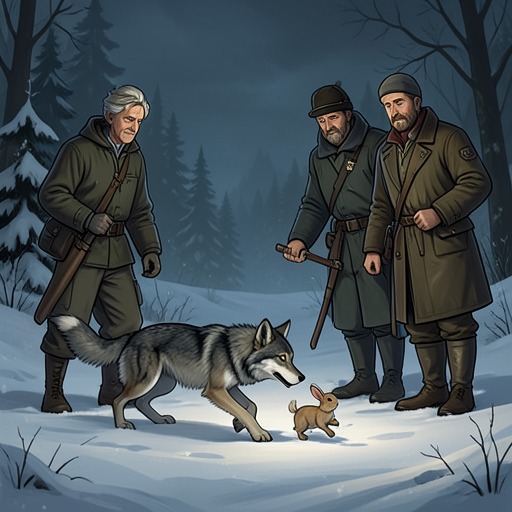
The Wolves Adopt Motherless Pups
Never Cry WolfThe Wolves Adopt Motherless Pups is an episode remembered by Ootek in which a bereaved wolf and other adults transfer orphaned pups to a second den. There, a nursing female takes them in, and the expanded group is reported to care for ten pups alike. The account gives a concrete instance of the cooperative care Ootek considered normal among wolves, while the narrator’s delayed acceptance makes the story also a test of whose knowledge he is prepared to trust.
Ootek’s Understanding of Wolf Families
Ootek introduces the episode against a broader understanding of wolf family life: he says wolves regard pups much as his community regards children, so that biological paternity matters little and there are no orphans in the human sense. His account presents that view not as an abstract claim alone, but as something he had watched unfold. He was particularly concerned by the loss because he considered himself magically related to wolves; elsewhere, the narrator explains that Ootek’s personal totem was Amarok, the Wolf Being.
That relationship shaped Ootek’s response, but the story is also grounded in his own observation. As a child, he had been taken to a wolf den by his father, a respected shaman, and left there for a day. He later described playing among the pups while adult wolves sniffed him without harming him. The narrator says Ootek’s accounts were consistently borne out when supporting evidence could be obtained. This background helps explain why Ootek treated wolf behavior as knowledge accessible through close attention and kinship, rather than as a collection of frightening human legends.
The Mother’s Death and Ootek’s Vigil
Some years before telling the story, Ootek was living at a camp near a wolf family when a passing white man traveling by canoe shot and killed the mother. Ootek was distressed and considered digging out the pups to place them with a female Husky dog that had a litter at the camp. His father stopped him, saying that such intervention would not be needed because the wolves would resolve the situation themselves.
Ootek did not entirely trust this assurance, despite his father’s reputation. Instead, he kept watch near the den. After only a few hours, he saw a strange wolf arrive with the widowed male. The two entered the den and emerged carrying one pup apiece. The sight turned the father’s prediction into an observable sequence: rather than leave the young behind or require Ootek to take them into human care, the wolves began moving them elsewhere.
The Move to a Second Den
Ootek followed the two adults for several miles. He recognized that they were heading toward another wolf den whose location he already knew, and he used a combination of running and shortcuts to reach it first. His account thus follows the transfer beyond the first den, showing that the pups were not simply carried away but brought into another established family group.
The female who occupied that den already had a litter of her own. When the two wolves arrived, she came to the den entrance, took the transferred pups one after the other by the scruff, and carried them inside. The two males then left to retrieve another pair. The account describes this as a repeated, organized transfer: adults carry the pups in pairs, and the receiving female brings each arrival into the den.
Once the move was complete, there were ten pups at the second den. Ootek judged them to be much the same size and age, and said that the several adults—including the bereaved male—treated them with equal care and kindness. The outcome is not a claim that every detail of wolf family life was known to him; it is his report of what he observed at this den. Within the story, however, the decisive fact is that the motherless pups joined a larger group and were cared for alongside its existing litter.
The Narrator’s Doubt and Later Confirmation
The narrator initially found the account touching but did not give it full credence. He says that he accepted a nearly identical report years later from a white naturalist of considerable reputation, and then questioned why that person’s status should count for more than Ootek’s testimony. The comparison exposes a bias in the narrator’s standards of proof: Ootek’s firsthand account had been discounted, while a socially recognized expert’s similar report seemed easier to believe.
The episode therefore matters both for what it describes and for how it reaches the reader. Ootek’s account supports his view that wolves share responsibility for pups, even when a mother dies and the surviving adults must move the young into another den. The narrator’s retrospective uncertainty does not supply independent verification of every part of the story, but it does acknowledge that his earlier skepticism rested partly on whose word he considered authoritative. The adoption remains a reported event, and a vivid example of the cooperative care that Ootek had urged him to recognize.