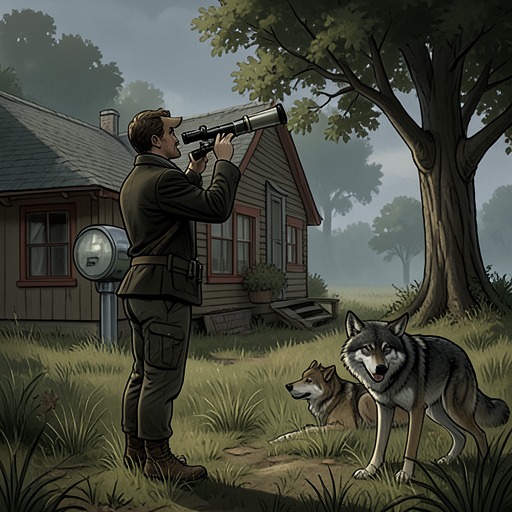
The wolf pack observes Mowat in turn
Never Cry WolfFarley Mowat’s effort to observe the wolf pack at Wolf House Bay turns into an encounter with the limits of observation: while he searches for the animals through a telescope, they sit behind him and watch. The reversal challenges his confidence in human equipment and expertise, and later leads him to test whether a deliberate territorial signal can make the animals acknowledge his presence.
The watcher’s blind spot
The morning after the large male had shown little interest in him, Mowat returned to the presumed den with different equipment. He left aside the shotgun and hatchet, though he retained a rifle, pistol, and hunting knife, and brought a high-powered periscopic telescope mounted on a tripod. On a fine morning, he selected a rocky knoll about four hundred yards from the esker. The ridge concealed him while allowing the telescope to peer over its crest; the wind blew from the animals toward him, which he took as assurance that they would not smell his arrival.
The arrangement seemed to give Mowat a controlled view of the ground. The telescope magnified the sand grains, and he searched the esker for a mile on either side of the presumed den. Yet he saw no animal and found no sign that the site was occupied. By noon, eyestrain and cramps had made the vigil uncomfortable, and he began to doubt his interpretation of the hole in the sand. The difficulty was not merely that the day’s search had failed: without the pack’s cooperation, his elaborate plans offered little chance of seeing animals in such open country.
He resumed the survey after growing discouraged, but the esker remained apparently deserted. Heat rising from the sand worsened his eyestrain. At about two in the afternoon, he abandoned concealment and stood up. The moment he began to unbutton his clothing, he became conscious of the possibility that he was not alone. Looking around, he found the missing animals sitting less than twenty yards behind him.
They appeared relaxed, as though they might have been there for hours. The large male seemed bored; the female kept her attention on Mowat. The scene reverses the arrangement he had carefully constructed: he had hidden himself to study them, but they had occupied a position from which they could study him without his noticing. The telescope had enlarged the landscape in front of him while leaving the ground behind his back outside his awareness.
A startled response and a changed question
Mowat reacted not with the panic he thought another person might feel, but with indignation. He turned away to finish dressing, then faced the animals and shouted at them to leave. Startled, they rose, glanced at one another, trotted down a draw, and disappeared toward the esker without looking back. Their departure ended the encounter, but did not restore Mowat’s composure. The realization that they had been close behind his unprotected back made him abandon the observation and pack his equipment for the return to his cabin.
That evening, he understood the encounter as more than a successful sighting. He had wanted the animals to cooperate with his study, and their sudden appearance seemed to satisfy that wish; at the same time, it made him question who had been watching whom. His training and his confidence in human superiority had seemed to entitle him to the leading position in the encounter. The possibility that the pack had already been observing him unsettled that assumption. The episode therefore changes the terms of his project: he is not simply a hidden observer collecting information about animals, but a visible presence whose actions may themselves be noticed.
The next morning, he resolved to examine the esker directly and went by canoe toward Wolf House Bay. The spring caribou migration was underway, and he saw animals crossing the muskegs and hills in many directions. As he neared the esker, he saw no wolves and supposed that they had gone hunting. The journey gives the earlier reversal a practical continuation: even when Mowat deliberately approaches the place he means to study, the animals’ whereabouts and movements remain beyond his control.
Making a claim in wolf country
Mowat later tried to use what he had learned about the pack’s strong sense of property to ensure that the animals recognized him. One evening, after they had left on their regular night hunt, he staked out a claim of roughly three acres. His tent stood at its center, and the claimed ground included a hundred-yard section of the pack’s path. The exercise turned a general observation about territorial behavior into a test of communication: could Mowat make his presence legible to the animals on terms they would notice?
To mark the boundary, he placed signs on stones, clumps of moss, and patches of vegetation at intervals no greater than fifteen feet. The work occupied most of the night. He repeatedly returned to the tent for tea, and finished before dawn, when the hunters would return. The scale and care of the marking contrast with the earlier telescope vigil. There, his instruments had improved his ability to inspect the terrain but had not revealed the watchers behind him; here, he tried to make a message visible through repeated marks distributed across the ground.
At 8:14, according to his wolf log, the leading male appeared over the ridge on his way home. He did not look toward the tent as he approached. At the point where Mowat’s boundary crossed the trail, however, he stopped abruptly, about fifty yards from the observer. Through binoculars, Mowat could see the male’s manner change: fatigue gave way to bewilderment as he cautiously sniffed one of the marked bushes. After a pause, the animal backed away and sat down. Only then did he look directly toward the tent and Mowat, holding his attention there in a long, considering gaze.
Recognition without mastery
The male’s response gave Mowat the immediate result he wanted: at least one member of the pack had taken notice of him and his claim. But recognition did not mean that Mowat understood the rules governing the encounter. As the gaze continued, he wondered whether he had violated an important law of wolf territory, and regretted that he had no weapon with him. The incident thus ends not with proof that he had established command, but with a new uncertainty about what his act meant to the animal.
Across the two encounters, the direction of attention repeatedly shifts. Mowat first arranges himself as a concealed observer, only to discover that the pack has been watching from behind him. Later, he marks a boundary to announce himself, and a returning male pauses to inspect it before looking at him. The animals’ actions are directly observable; their intentions remain less certain. Mowat can record the distance, time, path, sniff, pause, and gaze, but he cannot be sure that the animal interprets his boundary as he intends. That gap between visible conduct and human explanation is central to the episode: the pack is not simply an object in the field of view, but a presence capable of redirecting the observer’s attention toward his own position and assumptions.