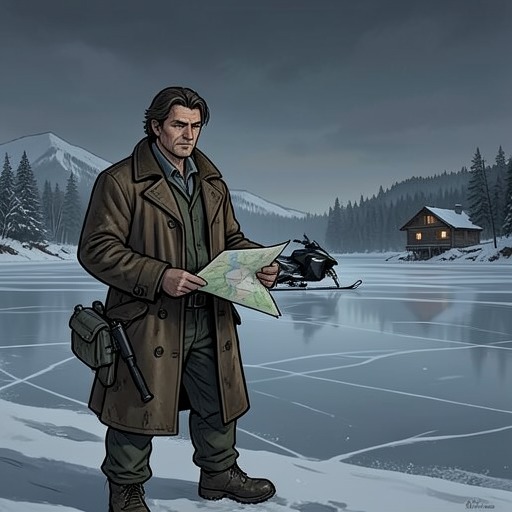
Wolf House Bay observation grounds
Never Cry WolfWolf House Bay observation grounds is the landscape around an ice-covered lake bay and a high, winding sand esker where Farley Mowat discovered a pair of wolves and their den. The site became more than a setting for wildlife observation: after finding the den, Mowat camped across the bay and watched the wolves from a tent, arranging his presence around their habits. Its vast emptiness first magnifies his isolation, then makes the esker’s paths and the wolves’ movements newly legible.
Setting and Formation
The bay lies within the austere terrain of the Keewatin Barrens, among rolling muskeg and frost-shattered stone. From the shore, the land extends toward a horizon so distant that it recalls the sea. In this largely treeless landscape, an unseen plover’s whistle is one of the few signs of life; the yellow sand of the esker provides an unusual break in the subdued colors of muskeg and stone.
The esker rises about fifty or sixty feet and winds away along the far side of the bay. It is not merely a striking ridge: such formations are the deposited sandy beds of rivers that once ran through and over glaciers. When the glaciers covering the Keewatin Barrens melted, roughly ten thousand years ago after reaching thousands of feet in depth, those beds were left on the land. On the tundra plains, they now supply almost the only visual relief from an otherwise unbroken expanse.
The surroundings also change with the season. When Mowat later returned to the esker by canoe, the rivers were clear and a stiff northerly breeze was driving the lake’s rafting ice offshore. The spring Caribou migration was under way, with animals moving north from Manitoba’s forested areas toward the tundra plains near Dubawnt Lake. From the canoe, Mowat saw their lines crossing the muskegs and hills in every direction. The bay thus sits between two seasonal worlds: the forested country to the south and the distant tundra toward which the herds were moving.
First Sight of the Wolves
Mowat’s first view of life near the bay began at a distance. Scanning the esker through binoculars, he saw movement and thought someone might be waving just beyond its crest. He hurried along the ridge to reach a point nearer the far shore. The initial uncertainty matters to the scene: the place offers no immediate explanation of what is moving across its open ground, so the observer must close the distance and look again.
The ridge then disclosed a wolf pair. After tumbling down the sand, the animals separated and stood panting close together. The female embraced the male with her forepaws and showered him with kisses; he tried to turn his head away until she tired and climbed partway up the esker. Mowat saw her disappear, and only after looking back toward a dark fold in the ridge did he recognize the shadow as the mouth of a den. The esker that had first appeared as a distant landmark had become a concealed home.
His excitement at finding both wolves and their den led him to run toward a nearby rise for a better view. The male noticed him and bounded onto the ridge, standing in tense vigilance. Mowat’s impression of the animal shifted sharply: the playful-looking figure became, in his eyes, a formidable presence. The close encounter makes the bay a place of reversed scrutiny. Mowat had arrived to observe the wolves, but their alertness makes him conscious that he, too, is being watched.
The Den and Its Trails
The following morning, Mowat set out by canoe to examine the esker. As he approached, no wolves were visible, and he supposed they had gone hunting Caribou. He landed and climbed the loose sand carrying cameras, guns, binoculars, and other equipment. His ascent revealed signs of repeated wolf use: the ridge was scattered with scats and crossed by tracks, some worn into clearly defined paths. The esker was not just the location of one den but a familiar route through the animals’ territory.
The den lay in a small wadi, concealed well enough that Mowat nearly walked past it. Small squeaks stopped him. Less than fifteen feet below, four young wolves were wrestling together. Their round bodies, short legs, tiny tails, and small ears differed so greatly from his prior idea of what a wolf pup should look like that he did not recognize them at first. This encounter changes the meaning of the dark opening he had glimpsed from across the bay: it is not only shelter for the adults but a nursery occupied by a litter.
A Camp Across the Bay
In the weeks that followed, Mowat made the bay the base for sustained observation. He decided to go to the wolves rather than continue observing from a greater remove, but took care not to disturb their ordinary lives. Abandoning Mike’s cabin, he pitched a small tent on the shore directly opposite the den esker. His pared-down camp contained a primus stove, a stew pot, a kettle, and a sleeping bag. He brought no weapons, though he sometimes regretted that choice; instead, he positioned a large telescope at the tent entrance so he could watch the den day or night without leaving his sleeping bag.
At first he remained inside except for brief necessary trips outdoors, which he timed for when the wolves were absent. Concealment was a practical part of the arrangement: he wanted the animals to become accustomed to the tent as no more than another bump in the terrain. When the mosquitoes became abundant, he stayed inside nearly all the time unless a strong wind offered relief. The contrast is characteristic of the site: the wolves are not the only animals shaping the observer’s conduct, and close attention requires accepting the conditions of the tundra as well as maintaining a view of the den.
The bay’s significance therefore rests on the meeting of visibility and concealment. Its open water and bare landscape allow Mowat to watch the esker from across the shore, while folds in the sand hide the den until he is close enough to hear the pups. From his first uncertain glimpse to his tent-bound observations, the site repeatedly unsettles the distinction between looking and being looked at. It becomes the ground on which an attempted study of wolves gives way to a more patient, carefully bounded presence among them.