Wolf Prey Selection and Hunting Constraints
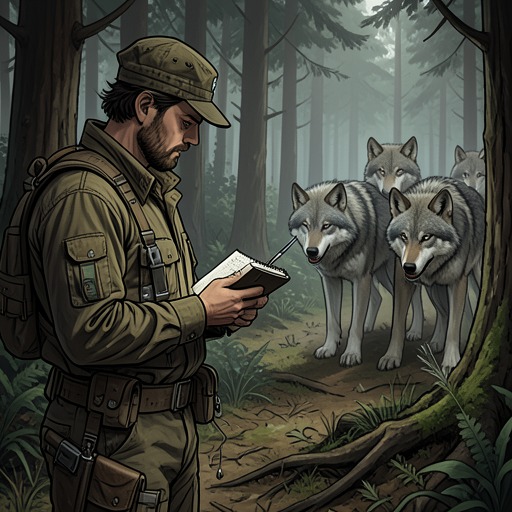
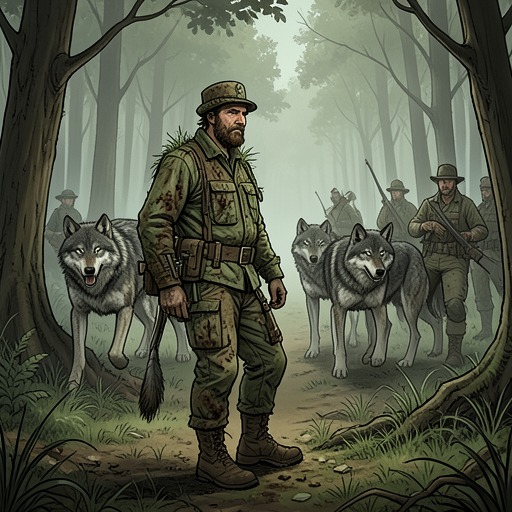
Never Cry WolfWolf Prey Selection and Hunting Constraints is the pattern of assessment, restraint, and selective pursuit that governs how Wolves hunt Caribou in the account. Healthy prey can escape; the hunters recognize this, test animals for weakness, and usually stop when a chase shows that a Caribou is in good condition. Farley Mowat’s observations gradually lend weight to Ootek’s explanation: hunting is not an indiscriminate slaughter, but a demanding process shaped by the limits of the prey and predator alike.
Physical Limits and the Logic of Testing
Ootek begins with a practical constraint. A healthy adult Caribou can outrun a wolf with ease, and even a three-week-old fawn can outrun all but the fastest. Caribou are aware of their advantage, and Wolves are aware of it too. Rather than waste energy trying to catch a healthy animal, they test the condition of a herd and look for one that is sick, wounded, or otherwise less capable.
When Caribou are abundant, the test is often brief. Wolves rush a band and make it flee long enough for any vulnerable individual to become apparent. If one does, the hunters turn their attention to it; if not, they give up the chase and move on to another group. The rush is therefore not, by itself, evidence that the pack intends to pursue every animal to a kill. Its purpose is to reveal whether a possible target can keep pace with the herd.
When prey is harder to find, Wolves may change tactics. Several may drive a small herd toward companions waiting in ambush, or hunters may take turns pursuing Caribou along a relay route. These methods reduce the prey’s advantage, but do not erase it: according to Ootek, the Caribou that fall are still generally the weakest or least able to escape. Scarcity changes how the hunt is organized, not the basic preference for vulnerable prey.
Farley Mowat’s Observations in the Field
Farley Mowat later watches many hunts and finds that they usually follow the same measured pattern. Between dispersed groups of Caribou, the hunters trot without apparent haste. A wolf, or sometimes two or three, will break from the line and make a short rush at nearby animals. The Caribou often wait until their pursuers are about a hundred yards away before running. If they move strongly, the Wolves stop and watch them go rather than continuing a futile chase.
The animals tested are not chosen at random. Mowat seldom sees Wolves trouble herds of prime bucks at the height of their condition. Their antlers are not the central deterrent; the relevant fact is that the hunters have little chance of catching them. Mixed herds of does and fawns attract more attention because young animals are more likely to include individuals that are injured, malformed, or otherwise in poor condition. Groups of aged, sterile does are also tested. Mowat notes that a weakened animal may be hidden among apparently vigorous Caribou, yet Wolves can identify and test it even when the herd looks uniformly healthy to him.
Fawns may be pursued more insistently than adults, sometimes for two or three hundred yards. That distance is still a test, not an automatic commitment to a kill: if the fawn shows no weakness or exhaustion, the chase is usually abandoned. The repeated pattern makes restraint visible in the action itself. A pursuit can begin and then end without a kill because the animal has demonstrated that it can escape.
Effort, Capture, and Use of the Kill
The search for a suitable target may continue for hours. Mowat understands economy of effort as a guiding principle: Wolves conserve energy through much of the testing process, then expend it when an infirm Caribou finally offers a realistic prospect of capture. The shift from unhurried movement to a concentrated chase reflects the difference between assessing prey and committing to a hunt.
Mowat reports that he never saw a wolf try to hamstring a Caribou. In his observations, an attacking wolf instead draws alongside and leaps toward the animal’s shoulder, then secures it around the back of the neck. The kill is made quickly. This account disputes a familiar claim about how Wolves bring down their prey, while keeping the emphasis on a close, practical contest in which the Caribou’s ability to escape remains important.
A successful hunt does not lead immediately to more hunting. Ootek says Wolves rest until the available food is gone and hunger drives them back to work. Mowat describes the effort behind a large-game kill as substantial: a wolf may hunt through the night and cover fifty or sixty miles before succeeding, and even that effort does not guarantee success. Once the animals have enough meat for themselves and their families, they spend their time resting, socializing, or playing rather than killing for its own sake.
The pack also uses a carcass thoroughly. During the denning season, a kill may be revisited until little meat remains. If scavengers are numerous, Wolves may divide the carcass and bury portions some distance from the kill site for later use; when the family roams its territory together, it may remain near a kill until the food is consumed. Mowat examined sixty-seven Caribou killed by Wolves after the hunters had finished. Few had much left beyond bones, ligaments, hair, and offal; in many cases, even long bones had been opened for marrow. These observations support his account of the carcass as food to be used, not surplus discarded after a moment of predation.
Selective Predation and Ecological Meaning
The condition of the remains reinforces the selection pattern. Mowat found signs of disease or serious debility on many of the Caribou carcasses, including bone deformities and worn teeth associated with older animals. On some occasions he reached a freshly killed Caribou soon after the hunt and drove the Wolves away to examine it. Several such animals carried heavy parasite burdens and appeared likely to die soon regardless. His findings do not make every kill identical or prove that every prey animal is infirm, but they accord with the pattern he had watched: Wolves often take animals already weakened by age, disease, or other disadvantage.
Ootek’s account reverses the assumption that Wolves are capable of catching almost anything and driven by an insatiable desire to kill. Their hunts are limited by speed, stamina, the availability of prey, and the likelihood that a particular Caribou can be caught. They test, abandon, and wait; their success depends on discrimination as much as force. As the weeks toward summer’s end passed, Mowat found the observed pattern increasingly persuasive. He came to see the Wolves’ role as preserving the strength of the Caribou herd by removing vulnerable animals, while recognizing that this ecological argument would require convincing evidence to persuade his employers.