Wolf Territorial Boundary Convention
Never Cry WolfThe Wolf Territorial Boundary Convention is the observed practice by which wolf families mark and periodically renew the limits of their territories. At Wolf House Bay, the Wolf House Bay wolf family occupies a range of more than a hundred square miles, and the narrator learns that its boundaries are not merely an abstract feature of the landscape: they are repeatedly marked, recognized, and maintained. His attempt to establish a small human enclave within that range becomes an unusual test of how the convention works and what recognition looks like when it is expressed through action rather than words.
Territory and Its Markers
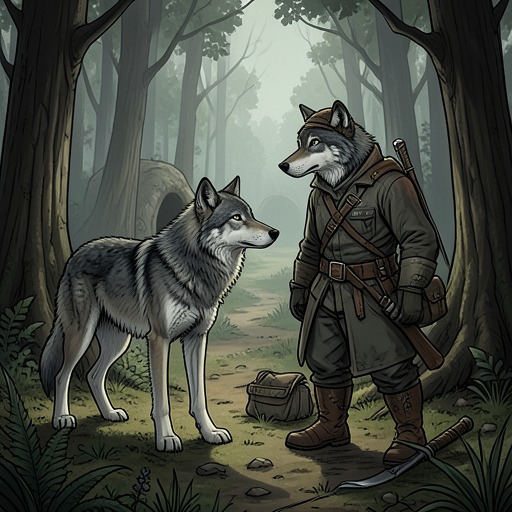
The narrator’s observations overturn his earlier expectation that wolves are nomadic roamers. The family he watches is settled, occupying a large, enduring estate with definite limits. A river marks one side of its territory; elsewhere, the boundaries do not follow obvious geographical features. Their presence must instead be read through the animals’ own signs and repeated activity.
About once a week, the family makes a circuit of its land and renews the boundary markers. The narrator compares this routine to a ceremonial tour of the bounds: it is regular enough to maintain a visible, or rather olfactory, distinction between neighboring territories, but he does not find evidence that it is driven by continual conflict. Two other wolf families have lands adjoining the observed range, yet he sees no signs of bickering or disagreement between them. He therefore suspects that the rounds have a ritual aspect, while leaving that interpretation appropriately uncertain.
The convention is thus presented through observable particulars rather than a formally stated rule. A family occupies a bounded range, makes recurring circuits, and refreshes markers along its limits. The narrator’s account establishes both the regularity of the practice and the limits of what he can infer from it: he observes maintenance and neighboring territories, but no boundary dispute that would show how the animals settle one.
The Human Claim Within the Range
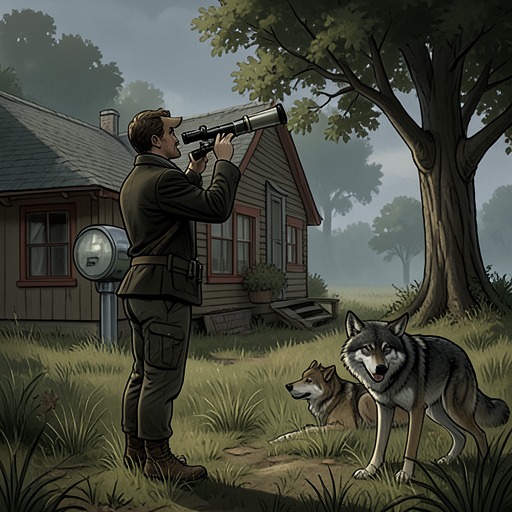
After recognizing how strongly the animals attend to territorial boundaries, the narrator decides to make his own small claim. He waits until the wolves have left on their nightly hunt, then stakes out roughly three acres around his tent, including about a hundred yards of the path they use. The scale is sharply unequal: his claim occupies only a tiny portion of the family’s range, but it crosses a route the animals regularly travel.
Marking it proves laborious. To make the boundary difficult to overlook, he places marks on stones, clumps of moss, and patches of vegetation at intervals of no more than fifteen feet. The work takes most of the night, with repeated returns to his tent for tea. The detail matters because his intervention is not simply an announcement that he is present. He tries to communicate in the terms he has inferred the animals use: by marking a perimeter across the ground.
At 0814, according to his log, the leading male comes over the ridge on its way home. It initially behaves as it usually does, showing no interest in the tent. At the point where the narrator’s boundary crosses the trail, however, the male stops abruptly. From fifty yards away, the narrator watches it sniff one of the marked bushes, withdraw, and sit. After a period of hesitation, it looks directly toward the tent and the observer. The sequence records a change from routine passage to focused attention; it does not establish what the animal thought the marks meant.
Recognition and Reciprocal Maintenance
The male then makes a circuit of the small claim. At each marker it sniffs and places its own mark on the outside of the marked grass clump or stone. The narrator recognizes that he has made an error in his own marking method: the wolf’s marks are economical, and the male completes the circuit in about fifteen minutes. It then rejoins the path and leaves. The encounter does not show the animal accepting a human property claim in any fully human sense; what it does show is that the male detects the new boundary and responds to it by marking along its perimeter.
The narrator’s purpose had been to make the wolves recognize that he existed. Once the leading male has investigated and marked the area, he interprets the encounter as a formal establishment of his enclave, ratified by the animals’ response. From then on, the small area around the tent remains inviolate: no wolf trespasses within it. Wolves occasionally stop while passing to renew marks on their own side of the line, and the narrator follows suit as best he can. The earlier attempt to gain attention therefore develops into a continuing practice of reciprocal maintenance, carried out on opposite sides of a boundary.
Scope and Significance
The episode supports a precise but limited conclusion. The narrator observes a settled family territory, periodic boundary rounds, a neighboring arrangement without visible disputes, and a leading male responding to his newly marked perimeter. He also reports that the enclave remains undisturbed afterward. These observations make the convention consequential to his life in the field: after the boundary encounter, his doubts about personal safety dissolve, and he can give his attention to studying the animals.
At the same time, the account does not establish a universal code or prove that wolves understand human ownership as people do. The narrator is adapting his behavior to a pattern he has observed, and his reading of the male’s response remains an interpretation of conduct. The force of the episode lies in that combination of evidence and restraint. A line made from marks on stones, moss, and vegetation becomes a point of contact between human observation and wolf behavior; the boundary is not negotiated in speech, but answered through inspection and renewed marking. In the wider account, territoriality also corrects the image of wolves as unbounded wanderers: these animals move widely while hunting, yet the narrator understands their movements as taking place within a family range whose limits are repeatedly attended to.