Wolf-Mediated Ecological Regulation of Caribou
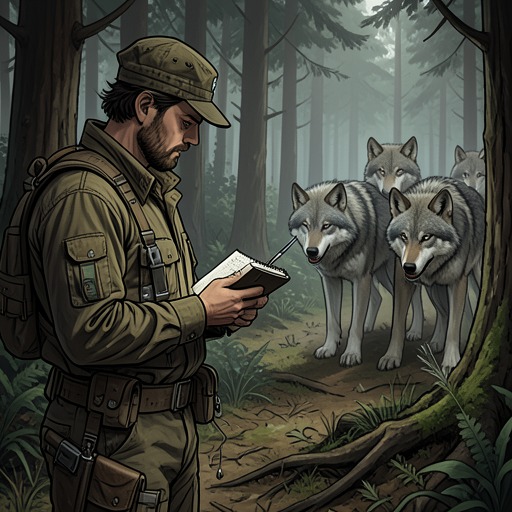
Never Cry WolfWolf-mediated ecological regulation describes how Keewatin Barren Lands wolves may help preserve caribou herds by selecting vulnerable animals instead of attempting to kill healthy, swift deer. Through Ootek’s account and the narrator’s later observations, hunting emerges as a process of assessment and restraint, shaped by the condition of the herd and the effort a pursuit would require.
How the Wolves Test a Herd
Ootek explained that a healthy adult Caribou can outrun a wolf with ease, and that even a three-week-old fawn can outrun all but the swiftest. Both predator and prey, in his account, understand this advantage: Keewatin Barren Lands wolves seldom attempt to run down a healthy animal because the effort is unlikely to succeed. Their usual approach is to test a herd for an individual whose health or condition makes it more vulnerable.
When Caribou are abundant, the wolves rush a group briefly, prompting it to flee and exposing whether any animal is sick, wounded, or otherwise less able to keep pace. If one is revealed, they pursue it; if the herd appears sound, they soon abandon the chase and move on to test another group. When Caribou are scarce, the tactics can change: several wolves may drive a small herd toward an ambush, or take turns pursuing it in a relay. These methods reduce the deer’s advantage, but the animal most likely to be caught is still the weakest or least able to escape.
The narrator’s observations gave this account a visible pattern. Keewatin Barren Lands wolves moved at an unhurried trot among dispersed groups of Caribou, which often seemed little troubled by their presence. A wolf, or sometimes two or three, would make a short dash at nearby deer. The deer might wait until the wolves had come within roughly a hundred yards before running; if they ran strongly and appeared in good condition, the wolves stopped and watched them go rather than continuing the pursuit. Hunting, in this account, begins with repeated tests, and a chase is not itself proof that the wolves intend to catch every animal they approach.
Selection and Economy of Effort
The narrator’s observations suggested that the wolves’ testing was selective, not random. Prime bucks at peak condition were rarely challenged: they were not especially dangerous, but the wolves had little chance of catching them. Mixed groups of does and fawns drew more attention, as did groups of aged or sterile does, where an animal’s weakness might be concealed among vigorous herd members. Fawns could be chased for two or three hundred yards, but the wolves usually gave up unless the young animal showed signs of weakness or exhaustion. The search might continue for hours; conserving energy while testing one group after another was part of the hunting strategy.
Once a vulnerable Caribou was identified, the wolves shifted from measured assessment to a concentrated pursuit. The narrator describes an attack as a sudden expenditure of the energy conserved during the search, ending when a wolf brought the animal down. This contrast—long periods of unhurried testing followed by a committed chase—challenged the familiar image of wolves as indiscriminate hunters. Their pursuit was conditional: when an animal ran strongly, the wolves let it go; when one could not keep pace, it became the focus of the hunt.
The same restraint continued after a kill. Ootek told the narrator that the wolves did not resume hunting until the available food was gone. The narrator’s examination of sixty-seven wolf-killed Caribou found that little remained beyond bones, ligaments, hair, and offal; even bones had often been opened for marrow. When scavengers were numerous, wolves sometimes divided and buried parts of a carcass at a distance, preserving food for later. The evidence thus linked selective pursuit with thorough use of prey: the wolves did not simply kill and move on, but returned to a carcass until its food value was exhausted.
Evidence and the Ecological Thesis
The case for ecological regulation rested not only on how the wolves chose their prey but also on what they left behind. The narrator found signs of disease or serious debility among the remains of many wolf-killed Caribou: skull necrosis and other bone deformations were common, while worn teeth pointed to old, weakened animals. On several occasions he arrived soon after a kill and drove the wolves away to examine the carcass. Some of those Caribou carried heavy internal and external parasite burdens, suggesting that they were already in poor condition and unlikely to survive for long.
As summer advanced, these findings made Ootek’s account increasingly persuasive to the narrator. He came to regard the wolf’s role in preserving the Caribou herd, rather than simply reducing it, as difficult to dispute. But accepting the explanation himself was not enough: he doubted that his employers would see the evidence in the same light and wanted material proof that could support his conclusions. He therefore began collecting parasites from wolf-killed Caribou, turning the remains into specimens for a case that could be examined beyond the field.
Ootek initially took an interest in the collection, then lost it when he saw the numbers and variety of worms and cysts the narrator extracted from the animals. His response reflected a different relation to the evidence: his people had long lived largely on Caribou meat, and the animal had been his staple food since childhood, but close familiarity with it had not led him to inspect its parasites analytically. The contrast underscores how the ecological argument was assembled from distinct kinds of knowledge: Ootek’s understanding of wolf and herd behavior, the narrator’s repeated observations, and the physical evidence gathered from the carcasses.
A Flexible Place in the Food Web
The wolves’ relationship with Caribou was consequential but not exclusive. The narrator’s observations at Wolf House Bay led him to conclude that the family there, and likely other Barren Land wolves raising pups beyond the summer Caribou range, lived largely or almost entirely on mice. Ootek widened that picture: wolves also ate ground squirrels, which could provide a substantial meal for less effort than a Caribou hunt, and sometimes appeared to prefer them to Caribou. Their food sources could shift with local availability rather than remaining fixed on one large prey animal.
Ootek also described wolves catching fish. During spring spawning runs, Northern pike entered narrow channels along boggy lake shores; a wolf could drive one upstream into progressively shallower water, then block its escape toward open water. Ootek had once watched a wolf catch seven large pike in less than an hour. Wolves also took suckers from shallow tundra streams, snatching them as they passed. These accounts place Caribou selection within a broader pattern of opportunistic feeding and varied hunting methods.
The narrator’s scat analysis supplied another, distinct kind of evidence: about 48 percent of the samples contained rodent remains, while other identifiable material included Caribou bones and hair and a few bird feathers. This dietary breadth does not by itself prove how much alternate prey changed pressure on Caribou. It does, however, complicate the picture of wolves as predators driven to pursue deer indiscriminately. Their ecological role emerges alongside their capacity to live on smaller prey and fish, while their observed tests of Caribou herds show that a pursuit of deer could be selective and abandoned when the animals appeared fit.