Wolves’ Dietary Adaptability
Never Cry WolfWolves’ Dietary Adaptability is the capacity to make a living from prey that varies with season, location, and opportunity, rather than depending on a single large animal. At Wolf House Bay, the discovery that mice could sustain adult wolves and their pups overturned Mowat’s assumptions about the animals and challenged the official expectation that wolves survived by killing caribou. The evidence also shows that this was not a simple replacement of one prey species with another: wolves used a varied food supply and changed their hunting methods to match it.
The Summer Food Problem
Mowat began from a practical question. After weeks of study, he still could not explain how the wolves fed themselves, and solving that problem was central to the expedition. Caribou were the only large herbivores found in significant numbers in the Keewatin Barrens, but their population had sharply declined in the decades before his journey. Government accounts attributed the decline chiefly to wolf predation, reinforcing the expectation that a close study of wolf–caribou relations would substantiate a case against the predator. Mowat had looked for evidence to satisfy that expectation and had not found it.
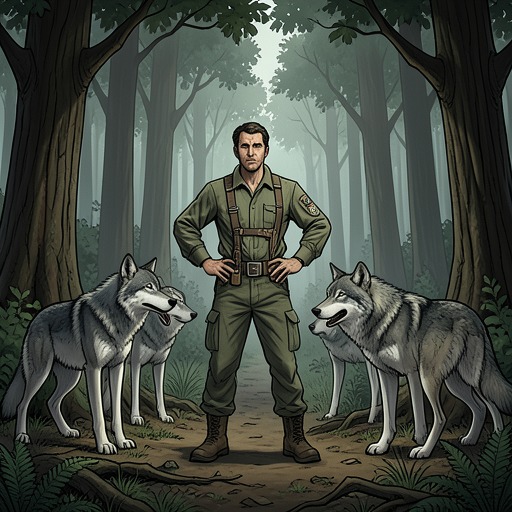
The seasonal movement of the herds made the gap in his understanding unavoidable. Toward the end of June, the last migrating caribou passed Wolf House Bay on their way north to spend the summer. The wolves still had hungry pups to feed, but their most conspicuous large prey had left. Mowat considered hares, birds, and fish, but at first judged each an unlikely answer: hares were scarce and difficult to catch, birds could fly, and the wolves did not seem equipped to fish. With three adults and four young animals at the den, he could see no adequate food source nearby.
Their apparent condition deepened the puzzle. The two male wolves went out hunting at night and returned in the morning, yet Mowat never saw them bring prey back. The wolves seemed well fed all the same. Concerned, he baked five loaves of bread and left them beside a hunting path; the gift was ignored. His mistake was not merely an inability to see a kill. He was looking for the kind of prey he considered worthy of a wolf, while small rodents were becoming abundant in the bogs around him.
Mice as Sustenance
As June turned into July, lemmings, red-backed mice, and meadow mice multiplied across the spongy sphagnum bogs. The rodents invaded Mike’s cabin and threatened Mowat’s food supplies. One morning he found that a meadow mouse had given birth to eleven young inside the pillow of his sleeping bag. Their abundance was immediately visible in his own domestic life, but he did not at once connect it to the wolves’ good condition. A diet of mice seemed too incongruous with the powerful, large-prey hunter he believed a wolf to be.
Angeline’s hunting provided the decisive observation. One afternoon she left Uncle Albert with the pups, crossed the muskeg, and waded into the bay for a drink. After she returned to shore, she rolled and moved about on the rocks before setting off slowly across the grass. Mowat watched her stretch upward, move cautiously, and repeatedly pounce with her forelegs held straight out. Six times she swallowed without his seeing what she had caught. On the seventh, he saw a mouse in her jaws. He initially treated the hunt as amusement or incidental snacking, but Angeline had eaten about twenty-three mice. That number made it difficult to dismiss the meal as inconsequential.
Only after assembling the observations did Mowat accept the larger conclusion: the wolves at Wolf House Bay, and probably other wolves raising families beyond the summer caribou range, lived largely or almost entirely on mice. This finding changed the meaning of the adults’ nightly absences. They were returning without visible prey because their small catch was not carried home in their mouths. Mowat had seen George and Uncle Albert go directly into the den after hunting; he later understood that they were regurgitating partly digested food for the pups. In summer, the adults could therefore transport a meal internally and deliver it at the den, a solution suited to prey too small to carry in an ordinary way.
Establishing the Case
Mowat regarded the mouse diet as a claim that would meet scientific doubt or ridicule unless supported by more than a striking observation. He distinguished three parts of the case: wolves caught and ate mice; rodents were numerous enough to support the wolf population; and mice had sufficient nutritional value to maintain a large carnivore in good condition. His field observations addressed the first two points, but he recognized that the third required a different kind of evidence.
Because he could not control the wolves’ diets, he considered a comparative trial with two of Mike’s husky dogs, one fed only mice and the other caribou meat. Mike was away, however, and Mowat could not carry out that proposed experiment. He then devised a self-experiment: equal periods on a mouse diet and on canned meat and fresh fish, followed by physiological tests for comparison. He understood that evidence about his own metabolism could not conclusively establish how wolves would fare, though unimpaired results under a mouse regimen could support the possibility that wolves functioned normally on such food. The account records this as a proposed method, not a completed test or a reported result.
A later analysis of wolf scat supplied another kind of evidence. About 48 percent of the samples contained rodent remains, chiefly fur and incisor teeth. Other identifiable materials included caribou bones and hair and a few bird feathers. One sample also contained a corroded brass button bearing an anchor-and-cable motif; Mowat could not explain its presence and explicitly rejected it as evidence that a wolf had eaten a sailor. The scat analysis therefore supported the importance of rodents while also showing that the diet was not limited to them.
A Broader Menu and Varied Methods
Ootek, whom Mowat came to know as a close friend and a capable naturalist, expanded the account of wolf food beyond what Mowat had seen himself. Ootek confirmed the role of mice and described wolves eating large numbers of ground squirrels, sometimes seeming to prefer them to caribou. Though Wolf House Bay lay just south of the squirrels’ range, they were abundant across much of the Arctic. In summer they could grow fat and weigh as much as two pounds; because they were comparatively easy to catch, a wolf could obtain a substantial meal with less exertion than a caribou hunt required.
Ootek also described wolves fishing for Northern pike. In spring, spawning fish entered narrow channels in marshes along lake shores. A wolf could wade upstream, driving a pike into shallower and narrower water until it tried to escape toward open water. The wolf then blocked its route and could break even a large fish’s back with a bite. Ootek said that he had once watched a wolf catch seven large pike in less than an hour. Wolves also took spawning suckers by crouching on a rock and snatching fish as they passed, and caught Arctic sculpins by turning over rocks in shallow water. Mowat later confirmed the sculpin behavior when he watched Uncle Albert fishing along the shore; he did not witness the reported pike hunt himself, although he tried the technique using a short spear.
The account’s treatment of caribou places these smaller prey within a wider, selective hunting strategy rather than presenting mice as the wolves’ only food. In the hunts Mowat subsequently watched, wolves commonly trotted among dispersed deer. They sometimes made short approaches toward individual animals, but stopped when fit deer ran strongly away. Prime bucks in good condition were rarely tested, while mixed groups of does and fawns drew more interest because the young included a greater proportion of injured, malformed, or otherwise inferior animals. This pattern contrasts with the image of indiscriminate killing: the prey available and the likelihood of success shaped what the wolves pursued.
Ecological and Narrative Significance
Dietary adaptability emerges from several forms of evidence with different limits. Mowat directly saw Angeline catch mice and Uncle Albert take sculpins; he inferred the adults’ delivery of food to the pups from their behavior at the den; Ootek supplied observations of other prey and hunting techniques; and scat analysis documented food remains. Keeping these forms of evidence distinct makes the account’s central conclusion stronger, not weaker. The claim is not that every food source was observed firsthand, but that repeated observations, local knowledge, and physical remains together revealed a more varied diet than Mowat initially imagined.
The discovery also reverses the logic behind the expedition’s original question. If wolves could sustain a family through the summer on rodents, and use fish and other small prey as well as caribou, then the presence of wolves did not by itself prove that they were responsible for the decline in caribou. The book does not use the dietary finding to deny that wolves preyed on caribou; instead, it complicates a single-cause explanation by showing how their food supply shifted with the herds and the season.
Most of all, the episode exposes the limits of a human-centered picture of what counts as meaningful prey. Mowat’s early failure was partly a failure of attention: mice were plentiful enough to disrupt his cabin, yet he regarded them as too small to explain the health of a large predator. Watching Angeline hunt, and learning from Ootek, shifted the wolves from symbols in a policy argument to animals whose skill and feeding habits had to be understood on their own terms. Adaptability here is not an abstract virtue but a practical relation between predator, prey, season, and place.