
Collision, Injury, and Accidental Responsibility
Never Kiss a Man in a Christmas JumperThis conflict thread follows how a snowy bicycle collision turns mutual blame into an unexpected obligation to care for an injured stranger.
increasing Bearing strength in each event
 decreasing
Bearing strength in each eventdecreasingThe Snowy Collision
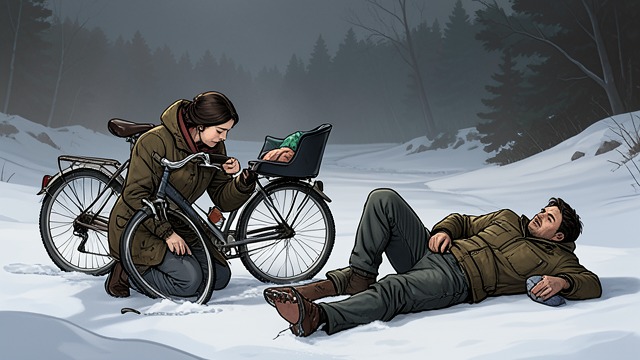
The collision that changes the terms
A preventable impact
Maggie and Marco collide while cycling on an icy Oxford street. Marco is on the wrong side of the road, moving too fast and listening to music; Maggie has also been distracted, and neither can swerve in time.
The impact sends Maggie skidding across the snow and leaves Marco sprawled nearby with a badly injured leg and fractured ribs. Both cyclists have made mistakes, but the immediate imbalance is stark: Maggie can move, while Marco cannot safely get up.
Blame meets alarm
Maggie’s first response is anger at Marco’s reckless riding, followed almost at once by concern when she sees how badly he is hurt. His bicycle’s child seat makes her fear that Luca has been in the collision too, and she demands to know where the child is.
The accident interrupts an ordinary day and forces Maggie into the role of first responder. What begins as a confrontation over responsibility becomes a practical crisis: she must control her shock, find her phone, and get help for a man she had only recently met.
The Missing Child Panic
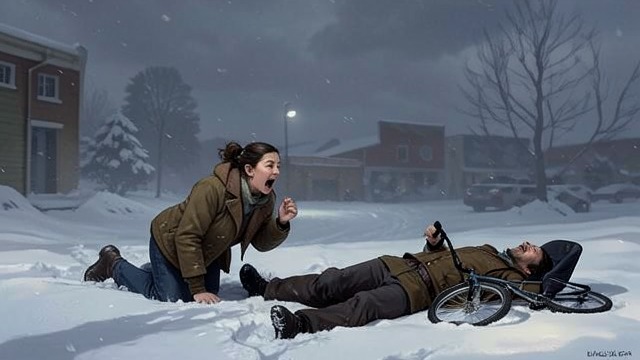
The fear behind the accusation
A child seat without a child
Seeing the child seat attached to Marco’s damaged bicycle, Maggie assumes that the small boy she previously saw with him may have been riding in it. Her alarm shifts the collision from an argument between two adults into a frightening search for a potentially missing child.
She crawls toward Marco through the snow, shouting both her anger and her question. Her own bruised body and the damaged book in her backpack matter less than learning whether Luca is safe.
Relief without absolution
Marco manages to tell her that Luca is not there and is safe. The revelation releases Maggie’s immediate panic, but it does not erase the danger of the collision or the seriousness of Marco’s injuries.
The misunderstanding gives their first conversation after the impact an unexpected intimacy. Maggie’s fear has been genuine, even as her harsh words reflect the pain and shock of the moment; Marco, in turn, has to recognize that her alarm came from concern rather than simple hostility.
The Hospital Reckoning
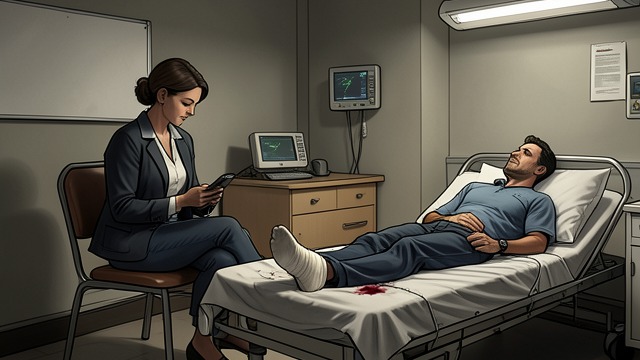
Injury and reluctant dependence
Damage made visible
At the hospital, the collision’s consequences become harder to dismiss. Marco’s leg requires treatment and immobilization, while Maggie learns that her own injury is a painful but less serious bruised coccyx.
Maggie stays in the family waiting area and uses Marco’s phone to contact his relatives. She has reason to leave, but remains until Leah and Rob arrive and she learns that Marco has been taken into recovery.
A new kind of responsibility
Marco later thanks Maggie for staying and calling his family, while she continues to feel guilty despite knowing that the accident was not solely her fault. Their exchange does not settle who bears responsibility for the crash; it establishes that both are willing to acknowledge its human cost.
The hospital encounter also makes their future contact unavoidable. Marco has sustained a serious injury, and Maggie is now one of the people who helped him through the first hours after it. A brief collision has become the beginning of an obligation neither had planned.
The Care Arrangement
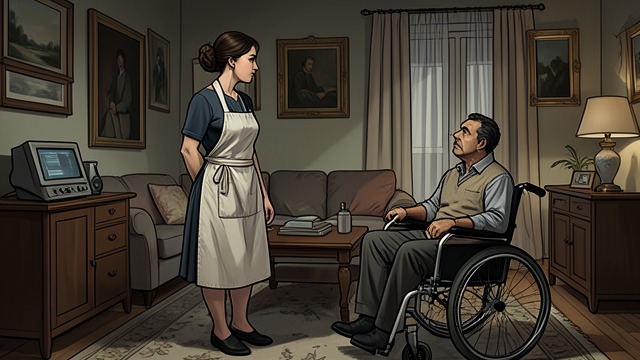
The consequences move home
Family pressure
Leah and Rob ask Maggie to let Marco recover in her home while they return to Scotland. They argue that he needs company and support, and that he already knows Maggie; they also offer to cover practical costs and any care she cannot provide.
Maggie resists. She is a dressmaker, not a nurse, and has work, a daughter, and an elderly father to consider. She recognizes that Leah is appealing to her compassion, while Rob’s practical arguments make the request harder to refuse.
Consent under pressure
Maggie eventually agrees, although she worries that she has been maneuvered into taking responsibility for a difficult patient. Her family’s encouragement also exposes how little they think she has to occupy her life beyond work and caring for others.
The arrangement transfers the conflict from the hospital to Maggie’s home. Marco’s injury now affects her daily routines, her privacy, and her sense of control, while his dependence gives the two of them time together they would otherwise never have had.
Recovery Without Patience
Healing becomes a contest
Independence against medical limits
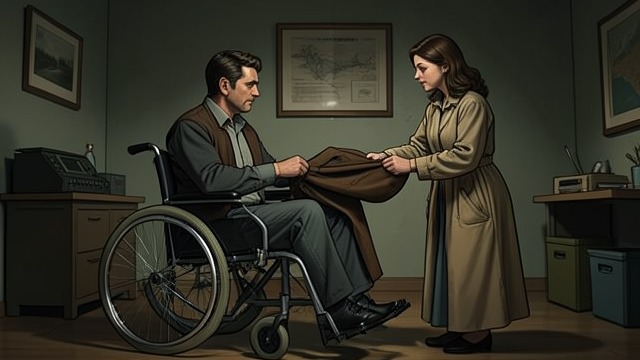
Marco struggles to accept bed rest, medication, a wheelchair, and help with ordinary tasks. He resents being spoken about as though he were absent, and bristles when Maggie tries to manage his coat or movements without asking.
Maggie, meanwhile, must distinguish practical assistance from taking over. She wants to keep him safe, but learns that constant intervention can make him feel more helpless and provoke anger that neither of them wants to direct at the other.
Negotiated care
Their arrangement improves through small compromises: Marco accepts help when a task is genuinely unsafe, while Maggie gives him room to dress himself and make choices. His outings to the shop and to weddings also reveal both his determination to recover and the limits imposed by his cast.
The original collision does not disappear when the bones begin to mend. It leaves Marco temporarily dependent and Maggie responsible for balancing care with respect. That tension gradually becomes a foundation for trust, even as his recovery remains incomplete.
The third time Maggie encounters Marco, on a snowy morning shortly before Christmas
Immediately after the bicycle collision
A few hours after the collision, at Oxford General
Five days after the collision, as Marco prepares to leave hospital
During Marco’s first weeks of convalescence, before his departure for Scotland
