Maggie O’Donnell–Marco Cavelli relationship
Never Kiss a Man in a Christmas JumperThe Maggie O’Donnell–Marco Cavelli relationship grows out of an accidental meeting, a spell of practical dependence, and an attraction neither initially knows how to handle. Its central conflict is not whether they care for one another, but whether Maggie can accept that Marco may choose a future with her even though she cannot have more children. The story makes care both the beginning of their intimacy and the test of whether either can let the other speak for himself.
Origins and Circumstances
Their first encounter takes place in Oxford shortly before Christmas, when Maggie is cycling through the city in falling snow. She has collected an expensive, wrapped present and is carrying it in her backpack: Maggie’s Mabel Lucie Attwell-illustrated Alice in Wonderland, intended for Ellen. The encounter turns abruptly into a collision near Brasenose College. Maggie is hurt, her book is soaked and damaged, and the other cyclist is Marco, a man she has already noticed during earlier chance meetings. His bicycle has a child seat, a small detail that later resonates with her anxiety about the family she believes she cannot offer him.
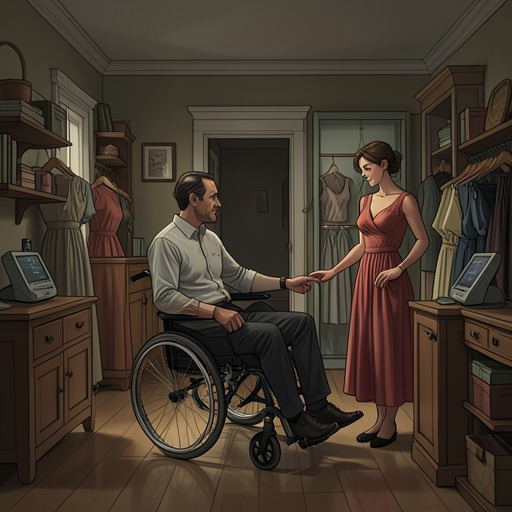
The accident brings them back together under circumstances that make distance difficult. Marco is recovering in hospital, and Maggie feels responsible enough to visit despite her discomfort. Their early exchanges mix awkward humour with the realities of his dependence: he is in a hospital gown, connected to medical equipment, and still adjusting to his injuries. Maggie tries to respond lightly when he asks after her, but her concern is apparent. Marco, in turn, is attentive to her even while he is weak and medicated. He has met her only briefly, yet already cares more than he expects to, and is unusually conscious of how she sees him.
Care, Attraction, and Growing Trust
When Marco needs somewhere to recuperate, he would prefer to return to his own flat and arrange hired help. Staying with Maggie instead means relying on her, and the prospect makes him feel exposed. He recognizes that he would behave differently with paid help: Maggie’s opinion matters to him too much for the casual rudeness he might otherwise indulge. His concern is not simply a response to her practical assistance. Since meeting her, he has felt protective of her and drawn to the combination of nervousness, warmth, humour, and occasional defiance she reveals.
Maggie, for her part, agrees that they should try to make the arrangement workable until Marco recovers. She acknowledges that the plan is strange and that they are both frustrated, but asks him to treat it as a temporary situation rather than make it harder for either of them. Marco accepts responsibility for having acted badly. Her directness changes the balance between them: he sees that her reserve does not mean she lacks strength, and he finds himself enjoying her willingness to challenge him.
Their closeness also develops through small acts of reassurance. When Maggie appears withdrawn, Marco asks her to stay and draws her into an embrace. She has gone without that kind of comfort for a long time; Ellen is no longer a child, her father is often occupied, and her work brings her into contact with brides who need reassurance themselves. She lets herself rest beside Marco, discovering that physical closeness feels welcome even as it unsettles her. The scene registers a change neither has yet put into words: caregiving has opened a space for tenderness, and tenderness is becoming harder to mistake for mere obligation.
Their conversation about the ruined book gives that growing attention a material focus. Marco remembers Maggie gathering it from the snow and asks about the present she had bought for Ellen. Maggie explains that the first edition was also meaningful to her: her mother read the book to her, and she later read it to Ellen. The damaged pages might still be framed, but the loss touches a family memory as well as the gift she had chosen. Marco listens closely, an attentiveness that will matter when he later finds a replacement.
A Kiss and a Retreat
As Marco recovers, Maggie continues to include him in parts of her life beyond the immediate demands of care. When he shows interest in attending a wedding with her, his invitation helps bring him into her working world. At another wedding, he persuades her to dance with him. Maggie guides them toward the edge of the dance floor, where a nearby wall can offer support, and then allows herself to be close to him. The dance leaves her exhilarated and frightened: her response reveals an intensity that her careful, orderly life has not made room for.
Marco kisses her after pausing long enough to give her an opportunity to refuse. Maggie responds, and the kiss changes the emotional terms between them. The following day, both are unsure how to understand what happened. Maggie tries to reduce it to a drunken incident and tells herself that her responsibility is to help Marco recover, not to encourage a complication that may end when he leaves. Marco, who has usually treated romantic encounters as casual and straightforward, finds that his ordinary approach does not fit. Maggie matters to him in a way other women have not, and he is uncertain how to proceed without taking advantage of her vulnerability.
Their conversation the next morning brings caution into the open. Marco apologizes and assumes he crossed a line; Maggie tells him that she did not experience the kiss as something forced on her. Even so, she says it should not happen again. She is drawn to him, but believes a deeper relationship would lead to hurt: he will soon be gone, and she cannot give him the children she imagines he will want. Her effort to contain the relationship is therefore also an effort to protect both of them, though it means deciding on Marco’s behalf what future he ought to seek.
The Fear Behind the Boundary
Marco gradually learns why intimacy is especially complicated for Maggie. When she tells him that the last time she had sex was in May 1996, he understands that this was the year Ellen was conceived. Maggie says that life changed after Ellen’s birth and that work and family responsibilities took precedence; she had never planned to go so long without another relationship. The disclosure helps him understand her nervousness, but it also gives their connection a new seriousness. For Maggie, the kiss is not simply an unfamiliar experience. It touches a long absence of intimacy and the life she built around raising Ellen and caring for her family.
Later, Leah confronts Maggie’s claim that her relationship with Marco has been only a pleasant interlude. She has seen the connection between them from the beginning, including during their first meeting at the hospital, and argues that Marco’s history of putting his own life aside for Rob may help explain why he has remained unattached. Leah believes Maggie has interrupted that pattern. Faced with someone who sees the feelings she has been trying to deny, Maggie admits that she loves Marco.
Her confession also exposes the obstacle she has kept to herself: she cannot have more children, and Ellen is her only child. Seeing Marco with Luca, Maggie imagines that he deserves a family like Leah’s and concludes that continuing the relationship would deprive him of the future he should have. Leah is compassionate about Maggie’s loss but challenges the reasoning. Whether Marco wants that future, and what he considers worth choosing, are decisions that belong to him. Maggie’s protective intention has become a form of withdrawal: she is trying to spare him pain by withholding the information and the choice that would allow him to answer for himself.
Separation, Return, and a Future Chosen Together
Maggie leaves Marco in Scotland without first explaining her decision to him. When they meet again, she recognizes the harm in the way she left. She apologizes for not staying to talk and for not giving him a chance to understand what was happening. Marco acknowledges that she should have spoken to him, but also recognizes that fear lay behind her actions. The separation makes visible the cost of Maggie’s attempt to manage the relationship alone: rather than prevent pain, silence has hurt both of them and left Marco without the choice she believed she was protecting.
Marco answers her fear directly. He does not deny that her inability to have children matters, or promise that a life together will be effortless. Instead, he rejects the idea that he is seeking a partner only to produce a conventional family. He proposes possibilities that include adoption, sharing family life with Rob and the children, or simply being together. What he wants is Maggie herself, not an idealized future with someone else. His response turns the question from whether she can meet an assumed requirement into whether the two of them can choose a future that suits them.
The damaged book becomes part of that answer. Marco gives Maggie a new first edition of Maggie’s Mabel Lucie Attwell-illustrated Alice in Wonderland, matching the one ruined in their first collision. The gift shows that he has remembered both her attachment to the book and its history in her family. Maggie has no present for him, but he does not ask for repayment. He asks instead that she take a chance on the relationship, at whatever pace and in whatever place she wants, including Oxford or Chicago. He offers commitment without demanding that she promise a perfect outcome.
Maggie accepts the gift as perfect and answers him with a kiss, then acknowledges that she brought him nothing. The exchange closes the circle opened by the collision: the book first marked an injury and a lost gift, and its replacement now carries Marco’s attention and a renewed possibility between them. Her acceptance does not erase the practical uncertainty she fears, but it marks a change in how she faces it. Rather than ending the relationship in order to decide what is best for Marco, she agrees to let them try together. Their bond thus moves from accidental meeting, through care and retreat, toward a future grounded in mutual choice rather than Maggie’s solitary sacrifice.