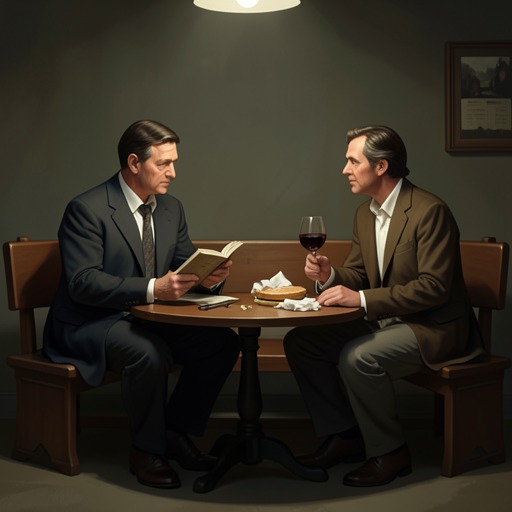
Maggie faces spending Christmas alone
Never Kiss a Man in a Christmas JumperMaggie O’Donnell’s prospect of spending Christmas alone begins as a practical change in her family’s plans and becomes a measure of how much her familiar household has shifted. Ellen’s invitation to Paris and Paddy O’Donnell’s possible cruise threaten the small family gathering that has defined the holiday; at the same time, Maggie’s growing intimacy with Marco Cavelli makes the thought of solitude part of a more difficult question about what kind of future she believes she can offer him.
The family tradition under pressure
Maggie’s usual Christmas is a modest gathering with Ellen and her father, Paddy O’Donnell. The food may be poor: the family has endured dried-out turkey, burned sprouts and potatoes cooked almost to ruin. Yet the imperfect meal matters less than the fact that they have always been together. Maggie thinks of them as a small but complete family unit, and that continuity has made Christmas a dependable point of belonging.
The first change arrives when Ellen comes to tell Maggie and Marco Cavelli that Jacob and his family have invited her and some friends to spend the holidays in Paris. Ellen asks whether the plan is all right, reasoning that Maggie will have her grandfather around. Her announcement unsettles Maggie in two different ways. She is relieved that Ellen is not pregnant, a possibility that briefly crosses her mind, but her daughter’s first Christmas away from home feels harder to process. Maggie’s first impulse is to refuse: Ellen is young, and Maggie believes she has not known Jacob or his family for long. She also recognizes that Ellen will soon be nineteen, is independent and strong-minded, and deserves the chance to have the experience. Maggie cannot fairly deny her that opportunity simply because it will leave a gap in their own celebration.
Rather than settle the matter in front of Marco, whom she is meant to be caring for, Maggie gives Ellen a quick smile and suggests that they discuss it properly the next day. The response postpones a decision without concealing what the announcement has exposed: Maggie’s role as a mother is changing, and she must consider whether protecting a family tradition would mean limiting her daughter’s independence.
A second departure
Paddy O’Donnell’s news makes the possibility of an empty Christmas more immediate. He explains that Jim has been offered a last-minute place on a cruise to the Canaries after a cancellation, at half price. Jim has nobody else to go with him, and Paddy admits that he is tempted by the prospect of sunshine, company and plentiful drink. He asks Maggie whether she minds, adding that he assumes Ellen will be there.
Maggie is standing in the doorway, looking toward Marco while listening to her father. As she takes in Paddy’s plan, she understands that another member of the family may be leaving her Christmas gathering. She tells him that the cruise sounds lovely and says she does not mind, although the disappointment is already difficult to hide. When Paddy repeats his assumption about Ellen, Maggie nods instead of explaining the uncertainty. She occupies herself gathering strands of lametta from around the tree and holds back tears until she can turn to him with a composed smile.
Her answer allows Paddy to leave without being made to feel guilty. He kisses her goodbye and heads through the snow toward the local pub, where he expects to meet a pint of Guinness and a darts board. Maggie watches him go, then returns inside and looks out at the houses opposite: their lights, decorated trees, wreaths and festive garden display make the neighborhood appear full of celebration. Against that brightness, the family’s possible absence is especially stark.
The meaning of being alone
Maggie imagines what the holiday would look like if both plans go ahead: the large Christmas tree, a bottle of Baileys and, if she is sensible, a Marks and Sparks microwave meal for one. The prospect leaves her feeling drained and sad, the opposite of the festivities around her. This would be the first Christmas she had ever spent alone, not merely a quieter version of the family meal she usually prepares, however badly.
Marco Cavelli notices her distress and asks why she did not tell Paddy what was really bothering her. Maggie initially responds defensively, but Marco understands that the holiday plans have touched more than disappointment. When she stays to talk with him, his expression and his hand holding hers register the change: the warmth and humor he has seen in her have given way to withdrawal and fear. Her assumed Christmas solitude is therefore linked to the emotional complication she has been trying to keep at a distance.
Maggie has already told herself that her connection with Marco should not continue. She likes him, perhaps more than she considers wise, but believes he will soon leave her life and wishes him the marriage and children she thinks she cannot give him. In conversation with Leah, she finally admits that she loves Marco Cavelli. She explains that she cannot have more children and assumes that continuing the relationship would deprive him of the family he deserves. Her effort to protect him rests on deciding for him what his future must contain, even as she struggles with the prospect of being left behind by her own family.
A different Christmas in view
The story places this anticipated loneliness beside other holiday scenes in which separation and togetherness take unexpected forms. On Christmas Eve, Maggie and Marco attend Isabel and Michael’s hospital wedding after Michael becomes seriously ill. A ceremony once expected to take place in a village church is brought forward to a hospital room. Patients and staff applaud the wedding party in the corridor, and the celebration proceeds with the couple’s commitment and hope intact despite the circumstances. Maggie watches with Marco beside her; when the emotion overwhelms her, she leans on him. The scene establishes that their closeness is already expressed through shared presence at a moment of uncertainty.
That intimacy does not immediately persuade Maggie to trust the relationship. She leaves Marco in Scotland rather than stay to explain her fear, and later recognizes that leaving without a proper conversation was wrong. When Marco tells her that he loves her as she is, he challenges the assumption beneath her decision: that her inability to have more children makes her an inadequate choice for him. He considers other possibilities, including adoption and sharing time with Luca and Rob Junior, but insists that the future he wants is a real one with Maggie rather than an idealized life with someone else.
His proposal is specific to the holiday that Maggie feared losing. Marco tells her that he wants a future with her, beginning with their first Christmas together. The line redirects the meaning of the earlier family departures: Christmas need not reproduce the old arrangement with Ellen and Paddy O’Donnell in order to be shared. Maggie’s anticipated solitude is thus not simply answered by replacing one family gathering with another; it becomes the pressure that brings her fear, her love for Marco, and the possibility of a changed family life into the open.