Maggie’s Mabel Lucie Attwell-illustrated Alice in Wonderland
Never Kiss a Man in a Christmas JumperMaggie’s Mabel Lucie Attwell-illustrated Alice in Wonderland is both a long-planned Christmas present for Ellen and a link across three generations of reading. Maggie buys the first edition after saving for months, but the snowy bicycle collision with Marco tears and soils it before it can reach its intended recipient. Its damaged pages change its practical future while making its personal history newly visible: Maggie admits that the book had mattered to her as much as it did as a gift.
Acquisition and Intended Gift
Maggie’s purchase begins on her first full day off in more than a month, when the snow has transformed Oxford and she cycles into town with the bookshop visit foremost in mind. She has been paying for the volume for months; at the antiquarian bookshop off the Broad, she finally collects it, wrapped in brown paper, and puts it in her backpack. The purchase is a planned act of Christmas generosity, not an impulse: she has anticipated taking the book home and giving it to Ellen.
The gift also marks a small reversal in Maggie and Ellen’s household. Maggie notices that Ellen has become too cool for Christmas, while Maggie herself is the one caught up in the excitement of a treasured present. That inversion suits the choice of book. The first edition is not simply something expensive or collectible that Maggie has found for Ellen: it belongs to a shared family history of being read aloud. Maggie’s mother read it to her, and Maggie later read it to Ellen. The volume therefore carries a reading relationship forward across generations, even as the present is meant to pass from mother to daughter.
The Collision and the Book’s Damage
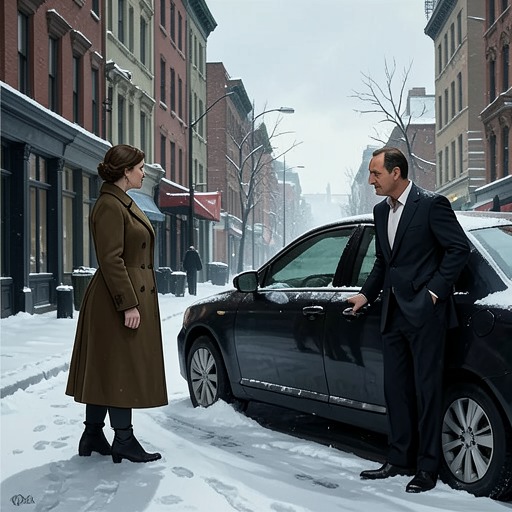
On the ride from the bookshop, Maggie keeps the wrapped purchase in her backpack as she makes her way through the snowy streets. The planned outing is interrupted when she collides with Marco. After the fall, she sees that her backpack has come open and the book lies in the slush, torn, dirty, and taking in the wet. The damage is immediate and concrete: a book she had carefully saved for and collected as a special gift is no longer in the condition in which she bought it.
The scene makes the book’s material condition part of the event rather than a background detail. Before the collision, it is secured in its wrapping and carried toward its destination; afterward, its pages are exposed to the snow and its illustrations are at risk. The object Maggie had anticipated presenting is suddenly something she must assess and handle. In the same moment, her attention is divided between the ruined present and Marco’s apparent pain, so the book’s loss of condition enters an already chaotic encounter rather than unfolding as an isolated disappointment.
Aftermath and Personal Meaning
Later, Marco asks Maggie about the present she had been picking up from the floor on the day they crashed into each other’s lives. Maggie identifies it as a first edition of Alice in Wonderland illustrated by Mabel Lucie Attwell, then describes its new state as a crumpled pile of old paper in her bedroom. By then the pages have dried. She thinks Ellen may prefer cash, but she also considers cutting out or framing some of the pictures and putting them in the hallway. These are possibilities, not a completed restoration or a decision to give the book away in another form.
Maggie’s explanation shifts the emphasis from the object’s intended recipient to the memories it holds for her. She says she was buying it as much for herself as for Ellen: it is the book her mother read to her and that she read to her daughter. The collision has not erased that history, but it has interrupted the planned handoff of an intact edition. The possible framed illustrations suggest a different use for what remains, preserving parts of the book within the home rather than presenting it as the pristine volume Maggie had originally secured.
The book’s significance rests in that change of status. It begins as a carefully anticipated purchase and a Christmas gift, becomes a casualty of the collision, and survives in Maggie’s account as both damaged paper and a container of shared reading memories. Its journey from the bookshop into the slush and then to her bedroom gives physical form to the gap between what Maggie meant to give Ellen and what the accident leaves her able to do. The volume matters not only because it is a first edition, but because its damaged illustrations and remembered readings connect Maggie’s own childhood to her relationship with her daughter.