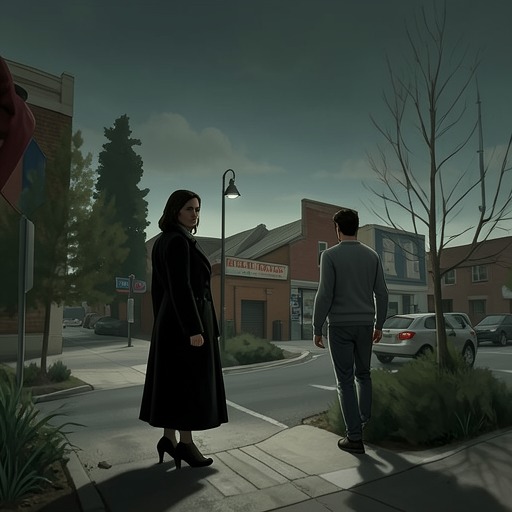
Maggie's long-term state of lack of intimate relationships
Never Kiss a Man in a Christmas JumperMaggie O’Donnell’s prolonged lack of intimate relationships is not simply an absence of sex: it is a life organized around motherhood, work, and self-reliance, in which adult closeness has never had room to develop. A single encounter in May 1996 resulted in Ellen, and Maggie’s later connection with Marco Cavelli unsettles the solitary pattern she had built. Her desire for him is real, but so is her fear that intimacy will bring complications—and that she cannot offer him the family she believes he deserves.
Origins and Circumstances
Maggie’s sexual history begins with one encounter, which she later identifies as having taken place in May 1996. She became pregnant with Ellen at seventeen. The relationship with Ellen’s father did not continue beyond that initial occasion, and Maggie says she was so drunk that she cannot remember it. Her account therefore joins a consequential change in her life to an experience she did not retain as a memory of intimacy: she became a mother, but did not enter an ongoing adult relationship.
The years that followed were shaped by responsibilities rather than a deliberate vow to avoid men. Maggie explains that life went into upheaval after Ellen was born; her daughter, her father, and work occupied her attention. She did not plan to remain without sexual relationships, but she was not in the mood to meet men, and the absence continued. When Marco asks when she last had sex, she answers with the date of her first and only encounter. The gap is not presented as a chosen identity so much as a condition that gradually became difficult to discuss.
A Life Built Around Care
Maggie’s routines show how thoroughly her life has been arranged around Ellen. At weddings, she would ordinarily leave quietly for cocoa and a book, then check that Ellen was in bed and breathing. If she thought Ellen had drunk too much, she might put her into the recovery position. These acts of watchfulness sit alongside Maggie’s own description of her life as, more accurately, Ellen’s. Her responsibility is practical and enduring; it has left little space for a private life that does not circle back to family.
Her work makes the contrast especially sharp. Maggie creates beautiful dresses for women preparing to marry the people they love, yet she has never married and, before her feelings for Marco emerge, has never been in love. Seeing Leah and Rob together, and watching Leah experience pregnancy with a committed partner beside her, makes Maggie feel that she is looking into another world. The contrast is not merely between a wedding and her unmarried status. It is between the intimate, shared life she helps other women prepare for and the emotional experience she believes she has never had herself.
Nor has she experienced the ordinary private closeness that can accompany a relationship. Before the wedding party where she and Marco share an evening, she has never spent a whole night with a man, slept cuddled beneath a duvet, or relaxed in another person’s arms. Those absences make her past pattern tangible without making it a simple story of loneliness: she has had independence, and she recognizes its comforts, but she has not known this form of companionship.
Marco and the First Breach in Solitude
Marco’s presence changes Maggie’s sense of what her daily life can contain. During the week he stays with her, she has company in the evenings, laughter at work, and someone with whom to eat pizza, drink beer, watch television, and talk. He is not a relative who has known her all her life. At a wedding, she realizes that she has not felt alone for days and that she is enjoying the event partly because he is there to share it. This companionship matters in its own right, before either of them can settle what their attraction means.
Their kiss intensifies the change. Maggie privately understands it as the most exciting and sensual physical contact she has experienced, and as the first time she has wanted a man more than her solitude. Yet she tells Marco that it should not happen again. She likes him, perhaps more than she feels safe admitting, but believes he will soon be out of her life and that renewed intimacy would lead to an unhappy outcome. Her restraint is not evidence that the kiss meant little; it is a response to how much it has unsettled the life she knows how to manage.
When Marco asks about her sexual history, the scale of that inexperience becomes explicit. He recognizes that her answer explains why the kiss was so affecting and why she seems nervous around him. Maggie says she has never told anyone, because it is not a conversation she can have with her father or teenage daughter, while her friends have assumed she was sexually active but independent. The admission turns a private circumstance into something she can finally share. Marco responds without treating it as a defect: he acknowledges her loneliness and the distance she has lived from intimacy, but rejects her description of herself as pathetic. He also tells her that he has never been in love, placing their different histories beside a point of emotional similarity rather than making experience a measure of worth.
Fear, Fertility, and the Changing Pattern
Maggie’s fear of intimacy later becomes bound to her inability to have more children. She confesses to Leah that she loves Marco but cannot give him a family like Leah’s. Seeing Marco with Luca, she believes he is naturally suited to fatherhood and that continuing the relationship would take that possibility away from him. She wants to end things for both their sakes, although she admits she does not know how. The reasoning grows from care for Marco, but it also lets Maggie decide what he should want without first asking him.
Leah challenges both parts of that withdrawal: she sees Maggie and Marco’s mutual attachment, and asks whether Maggie has actually talked to him about what he wants. After Maggie leaves, she recognizes that her attempt to protect him was also selfish and cowardly in its execution; she should have stayed and explained herself. Marco does not deny that she should have spoken to him, but he says he understands why she left. Their exchange exposes the cost of Maggie’s established self-protective pattern: a decision meant to prevent future pain creates immediate hurt and leaves the other person without a voice in the choice.
Marco later tells Maggie that infertility is a real difficulty, but not the whole definition of their relationship. He rejects the idea that he is choosing her only for the possibility of having children and says that he loves her as she is. His response begins to loosen the assumptions on which her withdrawal rests. Maggie has not yet reached certainty, but she starts to imagine a future in which they stay together. Her long absence of intimacy is therefore neither erased nor instantly repaired; it becomes a history she can speak about and a pattern she can begin to question, as companionship and desire make a different life imaginable.