Marco Cavelli
Never Kiss a Man in a Christmas JumperMarco Cavelli is an American visitor to Oxford whose broken leg turns a chance collision with Maggie O’Donnell into an extended stay in her home. First seen through Maggie’s startled recognition of the handsome man she has noticed around the park, he becomes more than a romantic figure: his care for his nephew Luca and his response to Maggie’s fear of infertility challenge the assumptions that threaten their relationship.
Identity and Introduction
Maggie first recognizes Marco in the snow by the several playful identities she has given him: the Hot Papa from the Park, the Man with the Tux, and the man who made Christmas jumpers seem sexy. The comic catalogue captures the distance between her initial, mostly visual fascination and the more consequential encounter now unfolding. He is not simply an attractive stranger: beside him lies a crumpled bicycle fitted with a child seat, and Maggie’s immediate panic is for the baby she assumes may have been involved. She discovers that the child is not at the crash site, but the bicycle has already suggested Marco’s connection to a young passenger.
Marco is in Oxford to deliver a guest lecture at the Law Institute. The vacation lecture series brings an international audience and is written up for journals; he had also hoped to spend time exploring the United Kingdom. Instead, he says, much of the Oxford he has seen has been in the company of a two-year-old, or of Maggie’s mother and his broken leg. His account presents a visitor whose professional plans and wish to travel have been overtaken by family responsibilities and injury, without suggesting that he resents either.
The Collision and Recovery
The bicycle collision leaves Marco badly hurt. His ribs, face, and especially his leg ache; although he has played many sports and sustained other injuries, he feels more comprehensively broken than before. The abruptness of the accident is part of its force: he is cycling, listening to a playlist Leah sent him and letting his attention drift between the music and thoughts of the lectures he has been preparing, when he is thrown onto the freezing snow. Aerosmith’s Love In An Elevator is still running through his mind afterward, an incongruously lively accompaniment to pain, confusion, and cold.
Maggie’s frantic shouting initially registers to him as another assault on his already overwhelmed senses. From her side, the same moment is a tangle of anger, concern, pain, and practical alarm: her backpack has spilled open, her precious illustrated copy of Maggie’s Mabel Lucie Attwell-illustrated Alice in Wonderland is damaged by slush, and she is searching for her phone while trying to assess Marco’s badly positioned leg. Their meeting begins, then, not as polished courtship but as a shared emergency in which both are hurt and neither has the luxury of composure.
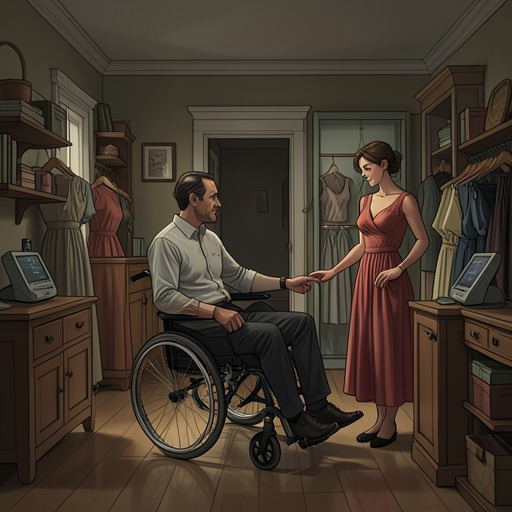
After a stay in hospital, Marco becomes Maggie’s unexpected houseguest for several weeks. The arrangement is urged on by someone who trusts that Marco will recover more quickly among people he knows, and Maggie’s daughter Ellen supports it with teasing enthusiasm. For Marco, recuperation means depending on Maggie in intimate, ordinary ways; for Maggie, it means making space in her home and daily routine for the man whose presence she had previously encountered in passing. The domestic arrangement gives their attraction time to become familiarity.
His recovery also brings small measures of independence back into view. When he feels steadier and stronger, he asks Maggie to drive him to his ground-floor flat before his lecture so that he can take a proper shower and wash his own hair. He jokes about watering prize orchids and feeding pet chinchillas, though neither exists; beneath the invented errands is the straightforward wish to manage his own care again. The exchange shows their growing ease with one another, as Maggie recognizes his humor rather than taking the absurd claims literally.
Family, Care, and Relationships
The apparent father-and-child pairing suggested by the bicycle seat proves misleading. Luca is Marco’s nephew, not his son. Marco has been looking after him while delivering the guest lecture, during a short break that Leah and her husband Rob are spending together in their cottage in Scotland. The revelation recasts the child seat and Marco’s attentiveness: he is not Luca’s father, but he has taken on a caring uncle’s role while Luca’s parents are away.
That distinction matters to Maggie because she sees how naturally Marco relates to Luca. Later, when she confesses her feelings to Leah, she identifies his apparent ease with the child as evidence of the family life she thinks he deserves. Her conclusion is painful but incomplete: she treats Marco’s capacity to care for a child as proof that he must need a partner who can have children. His relationship with Luca therefore becomes both a sign of his generosity and the focus of Maggie’s fear that loving him would deprive him of a future.
Leah offers another account of Marco’s selflessness. She suspects that after Rob’s first wife, Meredith, died, Marco put his own life on hold while Rob went through a prolonged breakdown; after Rob met Leah, supporting his brother had become a habit. This is Leah’s reading of Marco rather than an explanation Marco himself gives in the available scenes. Still, it places his care for Luca within a broader pattern of family loyalty and helps explain why Leah sees Maggie as the first woman to disrupt a life organized around being there for Rob.
Love and the Question of Family
When an emergency call reaches Maggie from Oxford General, she learns that Marco has given her name and number as his emergency contact. The call unsettles her before she knows which person is in danger: the familiar hospital setting and the possibility of bad news momentarily turn care into fear. For Marco, naming Maggie as his contact is a concrete sign that she has become someone he trusts to be reached when he needs help.
At Christmas, Leah confronts Maggie with what she sees in the way the two look at each other. Maggie finally admits that she loves Marco, but insists that the relationship cannot work because she cannot have more children. Ellen was her first and only child, and Maggie fears that continuing the relationship would take from Marco the family she believes he deserves. Her confession makes clear that the obstacle is not a lack of feeling: she is trying to end a love she already recognizes because she interprets her infertility as a harm she might inflict on him.
Marco rejects that interpretation. He tells Maggie that she has built a world of objections around this single problem because she is afraid to take a chance on their relationship. He does not pretend that their circumstances will be easy, but insists that he loves her as she is and that their life together cannot be reduced to his supposed desire for a fertile partner. The contrast is central to their conflict: Maggie sees his bond with Luca and imagines a future she cannot provide, while Marco insists that her value and their relationship do not depend on biological parenthood. His declaration does not instantly erase her fear, but it opens a crack in the certainty with which she has been preparing to leave.
The Gift and Narrative Role
Marco’s gift makes his attentiveness tangible. He gives Maggie the First edition of Alice’s Adventures in Wonderland, illustrated by Lucy Mabel Attwell, matching the kind of treasured book damaged in the bicycle collision that brought them together. The original had been lying in the slush after their crash; this replacement shows that Marco listened, remembered what mattered to her, and acted on that knowledge. Its significance lies not simply in its rarity but in the way it returns the story to their first meeting with a different outcome: the book once caught in the wreckage becomes an offering from the person who shared it.
Maggie’s response gathers together the romance’s central tension. She recognizes the care behind the present and thinks that leaving Marco to find someone new would be as impossible for him as it would be for her. The gift does not settle every practical question about their future, but it counters her belief that their connection can be discarded for his sake. Across the accident, the months of recovery, his place in his family, and his insistence that Maggie is loved as she is, Marco’s decisive role is to make care visible as something more expansive than parenthood or sacrifice: it can include an injured stranger, a nephew, a brother, and a partner whose fears he refuses to mistake for her whole identity.