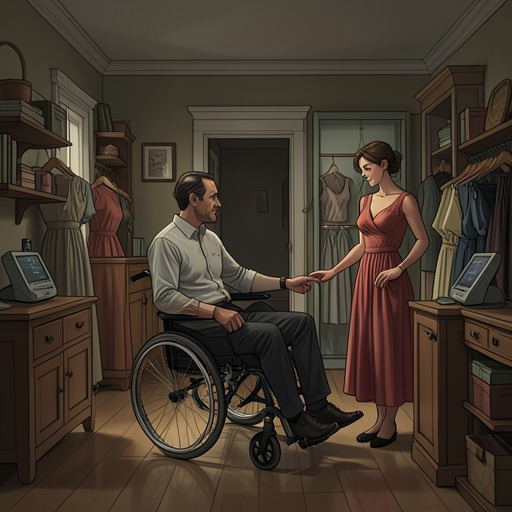
Marco’s post-accident recovery restrictions
Never Kiss a Man in a Christmas JumperMarco’s post-accident recovery restrictions turn his discharge from hospital into a period of supervised recuperation rather than an immediate return to ordinary life. The plan calls for him to stay put for the first three weeks, follow detailed aftercare instructions, and recover before travelling to Scotland; in practice, it also places Maggie in the role of his principal caregiver and makes their forced proximity part of the story’s developing relationship.
Discharge timetable
After Marco is discharged, Leah explains that he needs a few weeks of care before he can travel. The doctors’ advice is that for the first three weeks he should try to remain where he is and recuperate, so that he will be ready for the journey to Scotland. The family hopes he can follow Leah and Rob there in time for Christmas Eve, where arrangements for Luca’s Christening are continuing. The timetable therefore connects a clinical restriction to a family deadline: Marco’s recovery must progress sufficiently for him to rejoin them, but travel is not treated as something he can undertake immediately.
Instructions and practical support
The discharge plan covers medication, the chair Marco will use, warning signs to watch for, when to increase his dosage, and when to call the doctor or take him to the emergency room. The nurse repeats the aftercare checklist three times, addressing Maggie as the person expected to absorb and act on its details. She becomes increasingly flustered as the instructions accumulate, while Marco, sitting in a recliner and equipped with crutches, resents being discussed as though he were not present.
The care arrangement is meant to make the restrictions workable at home. Rob offers to pay for needed equipment or additional care, including a vehicle large enough to accommodate Marco’s wheelchair, and says the family can compensate Maggie if caring for him affects her work. He also anticipates that Marco will try to do too much too soon and argues that Maggie will be better able to enforce the advice than hired help. Marco already knows her and feels responsible for what happened, Rob reasons, so he is less likely to disregard her instructions.
Resistance and supervision
Marco initially does not want to stay with Maggie. He would rather return to his own flat and use hired help, which he imagines would leave him free to behave badly without social consequences. His resistance reflects his confidence that broken bones are painful but temporary, as well as his frustration at being treated as a passive patient. He does not consider the restrictions a reason he could not manage elsewhere; the discharge plan, however, places practical demands on whoever cares for him, and his family has chosen Maggie as the person best positioned to keep him from overexerting himself.
Maggie’s role is consequently more than providing a place to recuperate. The plan depends on her monitoring his conduct and helping him follow instructions he is inclined to minimize. That reliance gives her authority in their day-to-day dealings, while Marco’s own admission that he cares what she thinks makes him unusually receptive to her in a way he expects he would not be with hired help.
Consequences for the story
The restrictions are temporary, but they reorganize both characters’ routines around Marco’s injury. His need for assistance brings him into Maggie’s home for several weeks, and the expected end of that arrangement—his eventual departure for Scotland—gives their closeness a built-in limit. As Maggie becomes increasingly attached to him, she regards the prospect of his leaving within days as a reason not to repeat their first kiss; the recovery timetable thus shapes not only where Marco can go, but also the urgency and uncertainty of their relationship.
The plan also exposes a difference between medical necessity and Marco’s own assessment of his condition. He believes he has endured broken bones before and will heal, while the nurse’s checklist and Rob’s warnings insist on care, observation, and restraint. The narrative gives the restrictions concrete force through medication decisions, mobility equipment, crutches, and the possibility of needing medical attention, even as Marco’s impatience repeatedly presses against them.