Closure of Hailsham
Never Let Me GoThe closure of Hailsham is more than the end of a school: for Kathy H. and the former students dispersed across the country, it threatens the living connection to the place and shared childhood that still bind them. News of the impending closure makes the past feel newly vulnerable, and shifts Kathy’s sense of how much time remains to act on relationships she has left unresolved.
Rumors and the approaching end
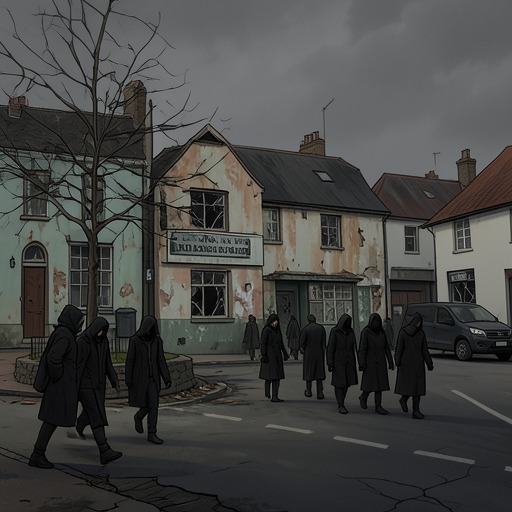
Kathy H. first heard rumors that Hailsham might close about a year before she met Laura in a car park. Other carers and donors raised the possibility as though Kathy would already know whether it was true. The rumors became more definite when she encountered Roger C., who had been in the year below her, outside a clinic in Suffolk. He said that Hailsham was about to close and that its house and grounds were to be sold to a hotel chain. The account gives no precise closing date; its force lies instead in the sense that the news could become final at any moment.
Kathy’s first response to Roger’s announcement was to ask what would happen to all the students. He took her to mean the younger pupils still living at Hailsham, and began to imagine them being transferred to other houses around the country, some far removed from the school they had known. Kathy meant something else: the former students who had grown up with her and were now spread across the country as carers and donors. Though separated, they remained linked by where they had come from. The misunderstanding reveals the difference between the school as an institution responsible for its current pupils and Hailsham as a common origin carried by people who had already left it.
A community held in memory
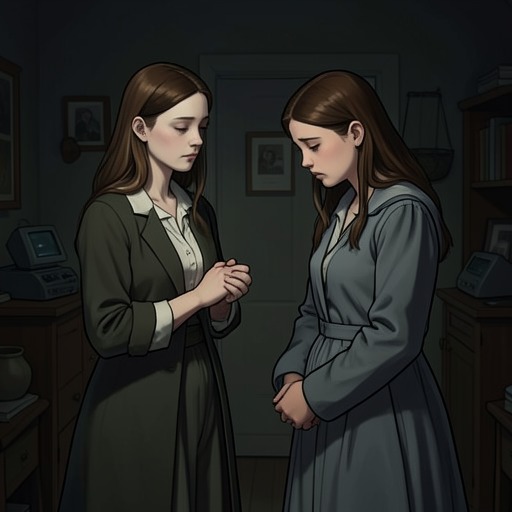
The closure becomes personal when Kathy later meets Laura. The two have been talking about Laura’s difficulties, including a nursing sister who seems to be against her, but both sense that an important subject remains unspoken. When Laura says that it is strange to think Hailsham is gone, Kathy turns back toward her and agrees that its absence is hard to believe. Their spontaneous embrace does not simply console either woman. It affirms the school’s continuing presence in their memories, even though it no longer exists as the place they once shared.
That moment gives the news a communal meaning. Kathy has imagined the former students as scattered yet still connected, and the closing makes the connection seem vulnerable without erasing it. What survives is not the house and grounds but the memories held by those who grew up there: knowledge of a past that people outside that experience do not share. Laura’s response confirms that this past matters even after it can no longer shape the present as a functioning school.
The severed strings
After hearing Roger’s news, Kathy lies awake remembering a clown she had seen on a wet seafront in North Wales. The man had a dozen or so helium balloons, each with a face and shaped ears, and walked ahead of her holding their strings tightly together in one fist. The image returns to Kathy as she thinks about Hailsham’s closure. She imagines someone cutting the strings just above the clown’s hand: afterward, the balloons would no longer have the same sense of belonging together.
The comparison gives form to the fear beneath Kathy’s reaction. Roger may be right that the closure makes little practical difference to people who have already left, but Kathy is unsettled by the thought that life at Hailsham is no longer continuing as she had imagined it. She pictures Miss Geraldine leading Juniors around the North Playing Field, an ordinary scene whose presumed repetition had helped keep Hailsham present in her mind. The school’s disappearance breaks that imagined continuity. The former students remain connected by memory, but the institution that gathered them is no longer there to renew their shared world.
Urgency and the choices left
In the months after Roger tells her the news, Kathy begins to feel that things she had expected to do eventually may have to be done soon or abandoned. She does not describe herself as panicking; rather, Hailsham’s disappearance rearranges her sense of time. This change helps explain why Laura’s suggestion that Kathy become Ruth’s carer has such an impact, even though Kathy initially refuses to engage with it. The idea has already begun to take shape in her, and Laura’s words seem to uncover a decision Kathy had not yet acknowledged.
Kathy arrives at Ruth’s recovery centre in Dover only a few weeks after that conversation, about two months after Ruth’s first donation, which had gone badly. Their reunion begins warmly: they talk about Hailsham, the Cottages, and the years since they last shared their lives. Yet they do not discuss the painful way they had parted. The news of the closure has helped bring Kathy back to Ruth, but their first meeting shows that renewed closeness does not instantly resolve old conflict.
The closure also sits against Kathy’s long career as a carer. At thirty-one, she has been working for more than eleven years and expects to continue for another eight months, bringing her service to almost exactly twelve years. She has been allowed to choose donors only during the last six of those years, and the ability to care for people from her past has helped her become close again to Ruth and Tommy. As the number of donors she remembers diminishes, that work becomes harder; finishing at the end of the year feels right to her. Hailsham’s loss thus sharpens not only her attachment to the past but her awareness that the opportunities to act on it are finite.
The same pressure of limited time shapes Kathy’s final visit to Ruth after Ruth’s second donation. Three days afterward, Kathy sits beside Ruth’s hospital bed, holding her hand through the pain. During a brief moment when Ruth recognizes her, Kathy promises to become Tommy’s carer as soon as she can. The closure is not the only cause of this promise, but it belongs to the changed horizon in which Kathy’s postponed choices have become urgent. Later, Tommy asks whether she ever tires of caregiving and wishes to receive notice herself. His question brings the long span of her service and the donors’ finite lives into sharp contrast. Against that limit, Hailsham’s closure marks a further loss: not merely a place that has ended, but a shared past whose remaining bonds must now be carried, and acted upon, by those who remember it.