Completion
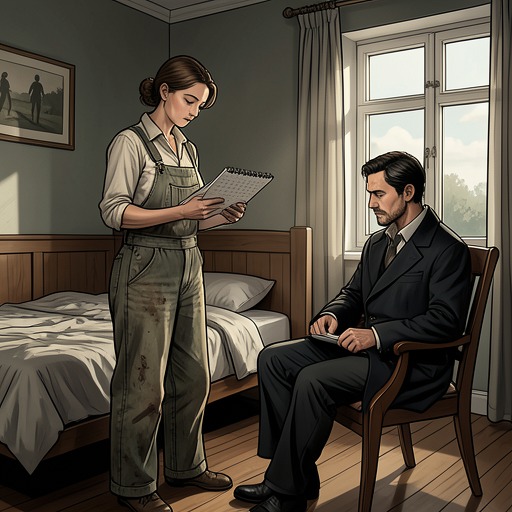
Never Let Me GoCompletion is the terminal state toward which the organ-donation system directs the students, yet the word offers less certainty than it seems to promise. The donors know that their lives have been assigned a course of donations, but they are not told exactly when that course ends or what the final stages involve. For Kathy H., Completion is therefore at once an institutional outcome, a source of fear and rumor, and a reality encountered through care for people whose futures have narrowed to the next procedure and its uncertain aftermath.
Definition and Place in the Donation System
At Hailsham, Miss Lucy tells the students that their futures have already been decided: they will become adults, donate vital organs, and begin doing so before they are old or even middle-aged. That knowledge establishes the broad destination of their lives without giving them a full understanding of its conditions. They have been told what they were created to do, but the limits of what they know remain consequential. Completion is the endpoint implied by that instruction, not a freely chosen conclusion or a stage the students can avoid by changing their plans.
The distinction between a donation and Completion matters throughout the novel. Donors may undergo multiple donations, and the prospect of a fourth becomes a particular focus of attention. Kathy explains that people often treat being on a fourth donation as deserving congratulations and special respect; even doctors and nurses greet such donors warmly before a check. That recognition does not mean the fourth donation is known to be the final one. Instead, the ritual sits beside uncertainty: donors and medical staff mark the milestone without being able to promise what follows.
What Donors Know—and Fear
The donors’ knowledge of Completion is incomplete partly because the people around them do not give them certainty. Tommy tells Kathy that people worry so much about a fourth donation because they cannot be sure whether they will really complete. If they knew the outcome in advance, he suggests, they might find it easier to face. Kathy cannot offer evidence against his concern, and her attempt to dismiss it does not settle the question between them.
One circulating account imagines a frightening possibility beyond the expected sequence: that a donor might technically have completed but remain conscious, then face further donations without recovery centres, carers, or friends, until the remaining donations are taken away and the donor is switched off. Kathy identifies this as horror-story talk rather than established fact. Its importance lies in the gap it exposes. Neither she nor Tommy can confirm the account, but no reliable assurance is available to replace it. The boundary called Completion thus remains opaque precisely where the donors most need an explanation.
The uncertainty is not confined to speculation about what follows a fourth donation. Kathy remembers caring for a donor who had just undergone his third donation, which had gone badly. He could hardly breathe and seemed to know he would not survive. When he learned that Kathy had come from Hailsham, he wanted to hear about the place rather than be reminded of where he had grown up. For five or six days, she described its guardians, games, paths, duck pond, food, and view from the Art Room. He asked about details she had already told him, not because his mind was unclear, but because he wanted those memories to sink in as his own. Kathy understood that he was approaching Completion and using her memories to imagine a childhood he had not shared. His response makes the approaching endpoint visible not as a single medical fact, but as a pressure on memory, attention, and the time left to him.
Uneven Timings and Reported Outcomes
Completion does not arrive at a uniform point in the donation sequence. During a trip to see the stranded boat, Ruth reports hearing that Chrissie completed during her second donation. Tommy has heard the same report and accepts that it may be true, while Ruth suspects that such outcomes happen more often than donors are told. Kathy replies that Chrissie’s death was sad but that the event is not common and that donors are treated carefully. The conversation gives no definitive account of how often early Completion occurs; it instead sets rumor, professional reassurance, and the donors’ limited access to information against one another.
The news changes the mood of the conversation. Ruth questions how Rodney could have known what Chrissie felt or wanted, since he had not been the person on the operating table trying to cling to life. Tommy agrees that completing during a second donation cannot be good. Their disagreement is not merely about the accuracy of a report: it concerns who can claim knowledge of another donor’s experience. Completion makes the limits of outside interpretation stark, while the donors’ own accounts remain incomplete and vulnerable to hearsay.
Ruth’s own condition brings the danger closer without making her outcome identical to Chrissie’s. Three days after her second donation, Kathy is allowed to visit her alone in a hospital room. The doctors, coordinator, and nurses behave in ways that lead Kathy to believe Ruth may not survive. Ruth is conscious but largely inaccessible, and Kathy sits beside her holding her hand, squeezing it when pain makes her twist away. For a few seconds Ruth recognizes her. Kathy promises that she will become Tommy’s carer, believing Ruth understands, though she cannot know for certain. The scene presents a life at risk after a second donation, not a confirmed Completion at that point; its uncertainty is part of the experience the scene records.
Care, Milestones, and the Limits of Reassurance
Kathy’s work as a carer gives her repeated contact with donors at different stages, but it does not give her authority over their eventual outcomes. She has learned to judge when to stay, comfort, listen, or leave a donor alone. Her experience leads her to value care because it changes what a donor’s life is like, even though it cannot change the fact that donors will donate and, in the system’s terms, complete. Tommy presses that painful distinction when he asks whether good care is really so important if every donor ultimately follows the same course. Kathy insists that the quality of a donor’s life matters. Their exchange places humane attention beside institutional inevitability: care can offer companionship and relief without undoing the structure that makes Completion the destination.
The fourth donation concentrates this tension. After Tommy receives notice that his fourth donation is approaching, he and Kathy discuss how donors respond: some talk about it repeatedly, some joke, and others refuse to discuss it. The milestone is publicly honored, yet the most frightening question attached to it remains unanswered. Kathy later recognizes that, when Tommy tried to raise his fears about further donations after Completion, she dismissed them as baseless. She had no certain knowledge with which to reassure him. The episode shows how silence can pass between people who care for one another, even when one of them has begun to name the fear the other would rather set aside.
Narrative Significance
Completion gives the novel’s account of time its governing limit. The students’ lives are not described as open-ended journeys toward ordinary adult futures; Miss Lucy states that their purpose has already been decided. Yet the system does not make the endpoint fully legible to those who must approach it. The result is a sharp contrast between institutional certainty about what the donors are for and uncertainty about the lived experience of reaching the end. Reports of Chrissie’s second-donation Completion, Tommy’s fear after his fourth notice, and the unnamed donor’s wish to inhabit Kathy’s Hailsham memories each reveal a different consequence of that contrast.
Kathy’s narration also resists making Completion a bare administrative term. She recalls the small, specific things the dying donor wanted to hear, the rumors that moved between centres, and the few seconds in which Ruth recognized her. Such details do not explain the whole process or erase its uncertainty. They preserve the relationships and remembered places that remain meaningful within a future the donors cannot control. At the end of her account, Kathy says that she has lost Ruth and Tommy but will not lose her memories of them. Completion remains the system’s name for an ending; memory becomes Kathy’s way of keeping those lives present without pretending that they escaped it.