Creativity as social currency at Hailsham
Never Let Me GoCreativity as social currency at Hailsham describes how artistic production became bound up with possession, reputation, and belonging. Through the Exchanges, students exchanged their work for tokens and used those tokens to acquire objects made by their peers. Artistic ability therefore mattered for more than the work itself: it affected how students were regarded, while Tommy’s history shows how quickly a judgment about creativity could become a lasting social stigma.
The Exchanges and the value of making
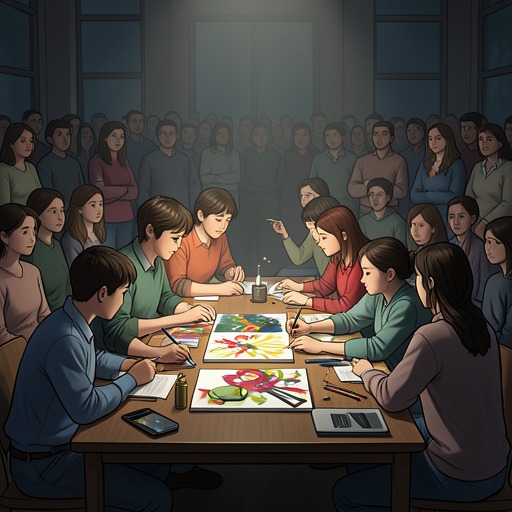
The Exchanges took place four times a year, in spring, summer, autumn, and winter. Students submitted work made during the preceding three months, including paintings, drawings, pottery, and sculptures assembled from whatever materials were fashionable. The guardians decided how many Exchange Tokens each submission merited. On the day of the event, students spent their tokens on work by others in their own year. The process linked making, evaluation, and choosing: students produced objects, received an institutional judgment of their value, and then used that judgment as purchasing power among their peers.
The Exchanges also provided one of the few ways students could build collections of personal possessions. A student might acquire something to decorate the wall around a bed or carry in a bag and set on a desk from room to room. These ordinary uses gave the works a private, continuing life after the public event. The system made students dependent on one another not only for the production of things they might want, but for the possibility of possessing them at all. As Kathy later recognized, that dependence could affect relationships: how well a student was liked and respected at Hailsham often had something to do with how good that student was at creating.
Kathy and Ruth recalled the Exchanges years later, when Kathy was caring for Ruth at the Dover recovery centre. Ruth remembered the practice as part of what made Hailsham special, emphasizing that students had been encouraged to value each other’s work. Her recollection conveys the institution’s positive ideal: creative activity was supposed to cultivate attention and mutual regard. Yet the same arrangement also made artistic judgment socially consequential. Tokens quantified the worth of submitted work, and students carried those evaluations into their wider impressions of one another.
Tommy’s work and the making of a stigma
Tommy’s difficulties reveal the harsher side of this system. By the time Kathy reflected on the matter, the idea that he deliberately failed to try had circulated since the Juniors. What might have looked like a short-lived problem was, in fact, a years-long experience. His account traced the trouble to an art class with Miss Geraldine, where he painted a watercolour of an elephant standing in tall grass. He said he had meant it as a joke. The picture took about twenty minutes, resembled the work of a much younger child, and got a laugh, though not the response he expected.
Miss Geraldine’s kindness helped turn the incident into a point of social friction. She was a favourite guardian, known for being gentle and for comforting students when they had been told off. Rather than dismissing Tommy’s picture, she tried to find things to praise and pointed them out to the class, apparently anticipating that the other students might mock him. Her sympathy did not protect him from that reaction. Tommy later remembered hearing students talk about him after they had left the room, without caring that he could hear. In a community where creative work helped determine how students were regarded, public praise for work others considered childish could itself expose its maker to resentment.
Kathy suspected that Tommy had already felt that his painting lagged behind that of other students and had been using deliberately childish pictures as a defence. After the elephant painting, his ability became a focus of attention. He tried to make a greater effort, but sneers and giggles followed when he began something; the harder he tried, the more laughable his attempts seemed to become. He eventually returned to work that appeared intentionally childish, as if to show that he did not care. The response to his work thus helped make the very performance of not caring seem necessary, while further entrenching the reputation that had made trying so difficult.
From art-room judgment to everyday exclusion
Tommy’s treatment did not remain confined to art lessons, even though Hailsham students had many art classes in the Juniors. He was left out of games, boys refused to sit beside him at dinner, and students sometimes pretended not to hear him in the dorm after lights-out. The exclusion could ebb for months, making him think it had passed, before something he did or a tormentor such as Arthur H. started it again. Artistic standing was therefore not simply a ranking attached to individual pictures. It could travel into games, meals, and dormitory life, shaping whether Tommy was included in routine social exchanges.
The temper tantrums further intensified the cycle. Kathy remembered Tommy as having a temper even in the Infants, whereas he told her that the tantrums began only after the teasing became severe. The disagreement leaves their precise beginning uncertain, but both accounts connect his temper to the story others told about him. His outbursts became another reason for students to react against him, and by the summer of Senior 2, when the students were thirteen, the persecution had reached its peak. The conflict between his work and his standing had become a broader pattern of ostracism, reinforced by conduct that the ostracism itself may have helped provoke.
Reputation beyond artistic ability
Tommy’s later change in how other students treated him complicates any simple equation between creativity and status. Kathy noticed that his work had not improved in reputation; it remained as poorly regarded as before. Yet the tantrums had stopped, and something in his manner had changed. He carried himself differently, looked people in the face, and spoke in an open, good-natured way. The change became visible in small social encounters: Alexander J. and Peter N. walked with him toward the fields and talked naturally, while other students spoke of him differently.
During a football game, Arthur H., once one of Tommy’s most persistent tormentors, mimicked his stance from behind as Tommy prepared to take a free kick. The other boys did not follow Arthur’s cue. Tommy took the kick, play continued, and Arthur did not try again. The scene offers a concrete contrast with the earlier pattern of ridicule: Tommy’s artistic reputation remained low, but the group no longer responded to the old invitation to laugh at him. It suggests that creativity mattered as a measure of standing without wholly determining it; the students’ response to Tommy could shift even when their assessment of his work did not.
Miss Lucy’s later account of her own mistake adds another dimension to the role of adult judgment. When she spoke with Tommy in her study, she told him that she had been wrong to reassure him that he need not worry about being creative. She said that she had done him a disservice and that the other guardians had been right about his art. Her reversal did not undo the years in which his work had been mocked, and her reported words gave no assurance that his artistic ability had changed. Instead, the episode shows how encouragement and evaluation could pull in opposite directions: Miss Geraldine’s protective praise had helped expose Tommy to peer resentment, while Miss Lucy later withdrew the reassurance she had given him. Together, these moments reveal a social world in which creative work was treated as a measure of the student, not merely as something the student made.